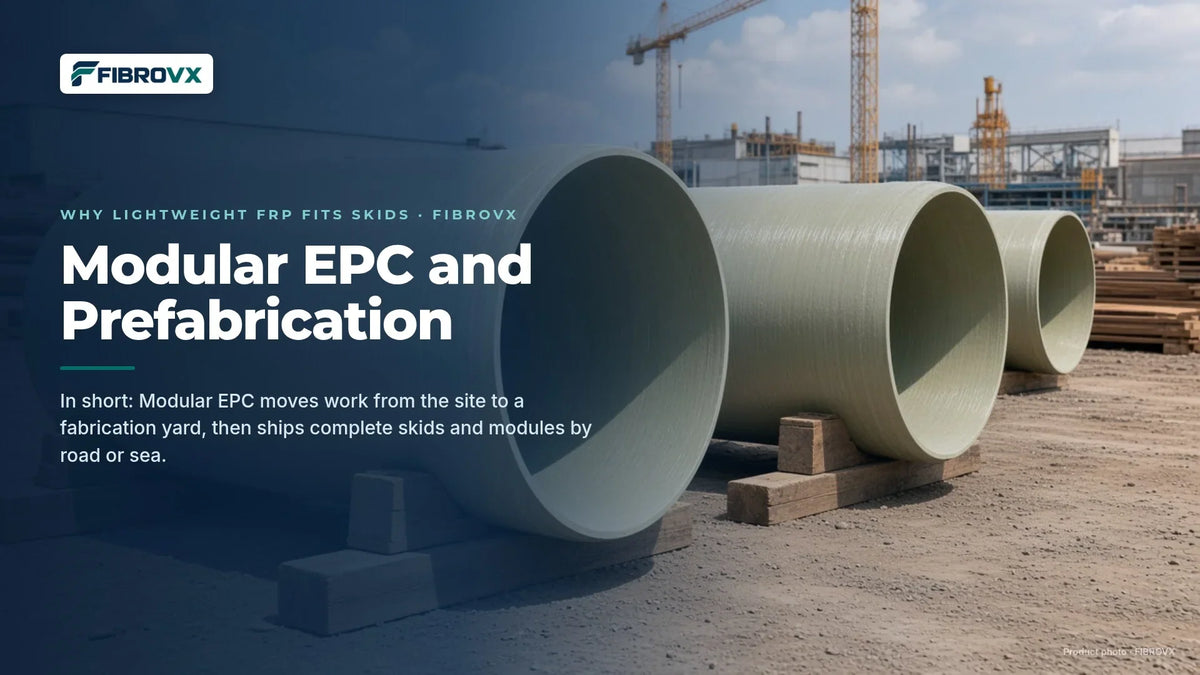
In short: Modular EPC moves work from the site to a fabrication yard, then ships complete skids and modules by road or sea. Weight and size limits decide how big each module can be, and corrosion decides how long it lasts at a coastal, chemical or wet site. FRP helps on both counts. Pultruded FRP has a density of about 1.7–2.0 g/cm³ against about 7.85 g/cm³ for steel, so grating, handrail, cable trays, ladders, tanks and scrubber shells add far less weight to a module, and they do not rust in transit or service. FRP is much less stiff than steel, so it is not a substitute for the main module frame, and it has temperature and fire limits. This guide shows where FRP fits on a module, where it does not, and how to plan it with your fabricator.


How this guide fits with our others
This is the modular and prefabrication guide: how FRP helps you build, ship and lift skids. For the odor and VOC rules that create many of these skids, read odor and VOC rules in the EU, US and China. For platform layout details, see designing FRP platforms with grating, profiles and handrail, and for a material comparison, FRP profiles vs steel and aluminum. Sectors that use modular plants are listed on our industries page and emerging industries page.
What modular EPC means
In a stick-built project, most work happens on site. In a modular project, the contractor builds skids, pipe racks, process modules and equipment packages in a yard, tests what it can, and ships them to site for setting and hook-up.
The Construction Industry Institute (CII) has studied this for decades under the name prefabrication, preassembly, modularization and offsite fabrication (PPMOF). Its 2002 preliminary research (RT-171) concluded that advances in design and information technology had made these methods more viable than ever for tackling cost, schedule and labor issues. A later paper in the Journal of Industrialized Construction summarizes the benefits widely credited to modularization: lower capital cost, better schedule performance, higher productivity and quality, better safety, less waste and better environmental performance. It also notes that up-front planning and engineering cost more than in a stick-built project.
CII's industrial modularization research (RT-283) identified 21 critical success factors. In its ranking, the top five were module envelope limitations, alignment on drivers, owner's planning resources and processes, a timely design freeze and early completion recognition. The same paper stresses that the transport route between the yard and the site sets module size, and that changes after design freeze are expensive. When the same authors checked 25 real projects against the expert survey, transport delay avoidance and management of execution risks were among the factors experts had underestimated.
Two points matter most for materials:
- Every module has a weight and size budget. Road, sea and crane limits set the envelope.
- The module must survive the journey and the site. Salt spray in shipping, wet yards and corrosive process areas all attack carbon steel.
Weight: the numbers behind the benefit
A European pultruder's product comparison gives these typical values:
| Property | Fiberglass profile | Steel S235 | Aluminum |
|---|---|---|---|
| Density, g/cm³ | 1.7–2.0 | 7.85 | 2.7 |
| Young's modulus, N/mm² | 24,000 | 210,000 | 70,000 |
| Tensile strength, N/mm² | 240 | 225 | 95 |
| Thermal expansion, per K | 10 × 10⁻⁶ | 12 × 10⁻⁶ | 23 × 10⁻⁶ |
A US pultruder's specifications for its shapes list a density of 0.068–0.070 lb/in³, which is in the same range. By volume, an FRP part weighs roughly a quarter of the same steel part. In practice, FRP sections are often deeper or thicker than steel ones to control deflection, so the weight saving per part is smaller than the density ratio suggests, but it is still large for grating, handrail, cable trays, covers and tank shells.
The same European pultruder itself notes that its figures are indicative and that each case must be checked by a consulting engineer. We say the same.
Why weight matters on a module
Road transport. In the US, the Federal Highway Administration (FHWA) sets a vehicle width of 102 inches on the National Network; cargo wider than that needs an overwidth permit. On the Interstate System the federal limits are 20,000 pounds on a single axle, 34,000 pounds on a tandem axle and 80,000 pounds gross, and the Bridge Formula may require a lower gross weight. There is no federal height limit; FHWA notes that state limits range from 13.6 to 14.6 feet. Anything wider or heavier needs permits, escorts or route studies. Lighter secondary steelwork can keep a module under a permit threshold or let you add more equipment within the same envelope.
Lifting. Lighter modules can mean smaller cranes or longer reach with the same crane. FRP items are also easier to handle by hand during fit-up.
Center of gravity. Grating, handrail, ladders and cable trays sit high on a module. Taking weight off the top lowers the center of gravity, which helps lifting and sea transport. Your lift engineer must still check every lift.
Offshore and elevated structures. Where every kilogram on deck counts, light walkways and supports reduce the load on the structure below.
How to compare weight on your own module
Density ratios are a starting point, not a design. To see the real saving on a module:
- List the secondary items on the module: grating area, handrail length, ladders, cable tray length, covers and any small tanks.
- Size each item in FRP for the same load, span and deflection limit. Use the supplier's load tables, such as those in our FRP grating span and load tables guide.
- Compare unit weights from the supplier's data for both materials, then total them.
- Check the effect on the module's gross weight, center of gravity and lift plan.
If the saving does not change the transport class, the crane or the number of modules, corrosion and maintenance may still justify FRP, but weight alone may not.
Corrosion: shipping and service
Modules often travel by sea and sit in yards before hook-up. Carbon steel rusts and galvanizing can be damaged in handling. FRP does not rust. With the right resin, it suits wet, salty and chemical service, which is why it is common on water treatment skids, chemical dosing packages and scrubber modules.
Typical modular packages that use FRP
Some kinds of skid use FRP more than others because they combine weight limits with wet or corrosive service:
- Odor and fume control skids: a scrubber, recirculation tank, fan and stack on one frame. The FRP shell, fan and ducts keep the module light and resist the scrubbing liquor. See FRP acid fume scrubbers and bio deodorization units.
- Chemical dosing and storage packages: tanks, pipework and bunded platforms for acids, caustic or hypochlorite, with FRP grating for access.
- Water and wastewater treatment modules: basins, covers, walkways and cable routing in wet, chlorinated areas.
- Cooling packages: compact FRP cooling towers with fill media are built and shipped as units where size allows; see FRP cooling towers.
- Electrical and instrument racks: non-conductive cable trays and supports on pipe racks and E-house surrounds.
Interfaces with the steel frame
Most modules mix a steel primary frame with FRP secondary items, so the joints between them need care:
- Thermal movement. In the European pultruder's data, FRP profiles expand about 10 × 10⁻⁶ per K and steel about 12 × 10⁻⁶ per K, so movement between them is small along the profile. Long runs still need slotted holes or gaps as the designer specifies.
- Fasteners. Use stainless or coated fasteners suited to the site, with washers to spread the load on the FRP.
- Clips and saddles. Grating is fixed with clips; see our guide to FRP grating clips.
- Tolerances. Agree hole patterns and cut sizes before fabrication, so FRP kits arrive ready to bolt.
Where FRP fits on a module
The table below shows typical module items and whether FRP is a good fit.

- Walkways and platforms: FRP molded grating and stair treads
- Edge protection and access: FRP handrail systems and FRP ladders
- Cable routing: FRP cable trays and cable supports, which are non-conductive
- Secondary structure: FRP pultruded profiles for supports, frames for light equipment and covers
- Process equipment: FRP tanks, acid fume scrubbers, FRP fans and FRP pipes
- Odor capture: FRP wastewater tank covers
How to plan FRP into a modular project

- Freeze the envelope early. CII research ranks module envelope limitations first among success factors and stresses a timely design freeze. Fix module size, weight and lift points first.
- Choose the FRP scope. Decide which items will be FRP, typically access, cable routing, covers and corrosive equipment.
- Design connections. FRP is joined with bolts, clips and bonded joints, not welding. Plan connections to the steel frame with isolation where needed.
- Fabricate and test fit in the yard. FRP cuts with standard tools; seal cut edges with resin as the manufacturer advises.
- Ship and set. Protect FRP surfaces from impact and long UV exposure in storage, and check bolted joints after transport.
Honest limits of FRP on modules
- Stiffness. FRP's modulus is roughly one ninth of steel's in the European pultruder's data. Long spans deflect more. The main module frame, lifting lugs and heavy equipment supports should normally stay steel unless an engineer designs otherwise.
- Temperature. Resins soften well below steel's working range. FRP is not for hot lines, furnaces or hot exhaust. Check the limit for the resin you choose.
- Fire. FRP is combustible. Fire-retardant and phenolic resins improve performance, but enclosed modules, offshore units and buildings have fire codes that may limit FRP. For scrubber and duct modules, FM Global Data Sheet 7-78 covers fire spread in plastic exhaust systems. Check your code, insurer and classification society.
- Connections and creep. Bolted joints need the right design, and sustained loads cause creep. Use the manufacturer's design data.
- Impact in transit. FRP can chip or crack under hard impact. Pack and lift it properly.
What to send for a quote
- Module drawings with walkway, ladder and cable tray routes
- Loads, spans and deflection limits
- Process fluids, temperatures and site environment
- Weight targets and transport limits for each module
- Fire, insurer or classification requirements
- Delivery schedule to the module yard
How we customize for module yards
We cut grating panels, handrail runs, ladders and cable tray kits to your module drawings, so the yard fits them with little rework. Tanks, scrubbers and fans are designed to your process and to the space on the skid. Items outside our standard range, such as special structural members or complete FRP-framed modules, are custom / available on request. See our grating, profiles and access range.
Need a quote or a drawing check?
FIBROVX manufactures FRP products in our own factory in China and builds every item to order: sizes, resin system, color, molds and OEM branding. Send your application, dimensions or drawing, quantity and destination port.
Request a QuotePrefabricated stations and field-wound tanks
Two more ways FRP shortens site schedules: prefabricated FRP pumping stations arrive as one unit with pumps and controls, and field-wound tanks up to DN25000 are built on site when shipping is impossible.
Watch: Prefab & Field-Wound in 27 Seconds
FAQ
How much lighter is FRP than steel?
By density, about 1.7–2.0 g/cm³ against 7.85 g/cm³, roughly a quarter. Real parts are often deeper, so the saving per item is smaller but still large.
Can FRP replace the steel module frame?
Usually not. FRP is much less stiff than steel, so the main frame and lifting points normally stay steel.
Is FRP welded on a module?
No. It is bolted, clipped or bonded.
Does FRP need painting before shipping by sea?
FRP does not rust. UV-resistant surface layers or coatings help for long outdoor storage.
Does FRP meet offshore fire rules?
It depends on the rule and resin. Phenolic and fire-retardant resins help, but check with your classification society and insurer first.
Can you supply cut-to-fit kits for a module yard?
Yes. We cut grating, handrail, ladders and cable trays to your drawings.
Related: How to Import FRP from China: Specs, QC Inspection and Container Loading; Custom FRP Manufacturing: Sizes, Resins, Colors, Molds and OEM Explained.
Sources
- Construction Industry Institute, Preliminary research on prefabrication, pre-assembly, modularization and off-site fabrication (RT-171): https://www.construction-institute.org/preliminary-research-on-ppmof-in-construction
- Construction Industry Institute, Industrial modularization: how to optimize, how to maximize (RT-283): https://www.construction-institute.org/industrial-modularization-how-to-optimize-how-to-maximize-e3e8d8f9b5f19c2790438959b1e075b3
- Calibrating CII RT-283's modularization critical success factors, Journal of Industrialized Construction: https://journalofindustrializedconstruction.com/index.php/mocs/article/download/99/97/97
- A European pultruder, Product comparison (density, modulus, strength, thermal expansion)
- A US pultruder, Specifications for FRP structural shapes and plate (density)
- FHWA, Questions and answers about vehicle size and weight (102-inch width): https://ops.fhwa.dot.gov/freight/sw/faqs/qa.cfm?category=7
- FHWA, Commercial vehicle size and weight program (80,000 lb; Bridge Formula): https://ops.fhwa.dot.gov/freight/sw/overview/index.htm
- FM Global Property Loss Prevention Data Sheet 7-78, Industrial Exhaust Systems: https://www.fm.com/FMAApi/data/ApprovalStandardsDownload?itemId=%7B9832E070-0CDF-4B1F-87F7-357F3902B707%7D