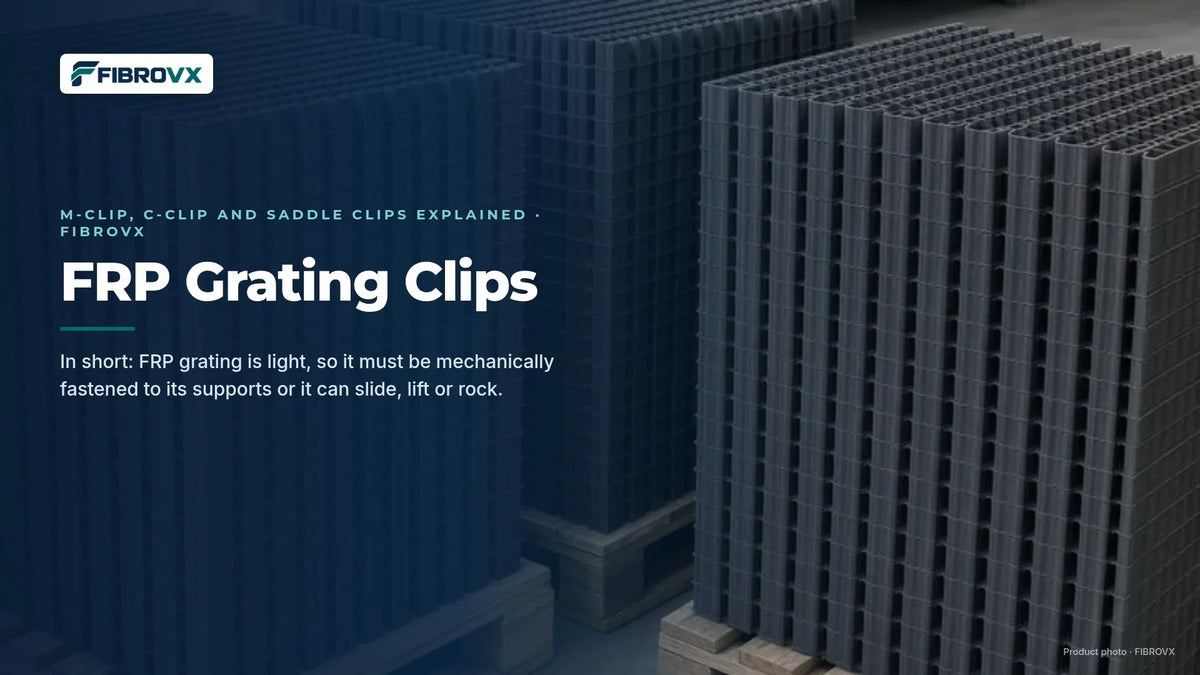
In short: FRP grating is light, so it must be mechanically fastened to its supports or it can slide, lift or rock. Hold-down clips do that job. M-clips sit on top of the grating, spanning bars, and bolt to a clip piece under the support flange. C-clips (hook clips) hook under the beam flange so you do not need to drill the steel. Saddle or plate clips grip the bars of pultruded grating. F-type clips join the edges of adjacent molded panels, and W clips hold covered grating. Published manufacturer guidance calls for at least four hold-down clips per panel, more on large panels. Clip names vary between makers, so always check the drawing. FIBROVX supplies molded grating made to order, and we confirm compatible fixings for your supports in the quotation.


Why FRP grating needs clips
A steel grating panel is heavy enough that gravity alone keeps it roughly in place. FRP grating weighs a fraction as much. Without fixings, panels can:
- Slide under foot traffic, carts or vibration, opening gaps at the edges.
- Lift in wind, from water pressure in a channel, or from pressure washing.
- Rock on uneven supports, creating a trip hazard and wearing the bars.
Clips solve all three. A US FRP grating manufacturer's engineering guidance says gratings must be mechanically fastened to prevent sliding, with a minimum of four M-style clips per panel on each installation, and six to eight on larger panels. Grating captive in an embedment angle, such as a trench cover in a frame, may not need clips unless the bearing surfaces are uneven and the panels rock.
Our FRP grating installation guide covers the full installation sequence. This article focuses on the clips themselves.
The main clip types

M-clip (top-mounted hold-down clip)
The M-clip is the most common hold-down for molded grating. A shaped top piece sits in the mesh and bears on the bars. A bolt passes down between the bars to a lower clip or nut plate that grips the underside of the support flange. Tightening the bolt clamps the grating to the beam.
- Best for: molded grating on steel or FRP beams; also used on some pultruded grating.
- Pros: no drilling into the support; easy to fit from above; easy to remove panels later.
- Watch for: the clip size must suit the grating depth and mesh. The lower piece must suit the flange thickness.
C-clip (hook clip)
A C-clip, also called a hook or J clip by some makers, has a hooked lower part that wraps under the edge of the support flange. A top plate or washer sits across the bars, and a bolt pulls the two together.
- Best for: fixing to I-beams or channels where you cannot reach under the flange easily, or where drilling the structure is not allowed.
- Pros: quick to fit; no holes in the beam.
- Watch for: the hook must match the flange thickness and edge. It needs a flange edge within reach of the clip.
Saddle and plate clips (pultruded grating)
Pultruded grating has I- or T-shaped bearing bars joined by cross rods. Its clips are often saddle clips that straddle a bearing bar, or plate clips that grip the lower flange of the load bars. The same manufacturer, for example, offers an M-style clip and a plate-style "RI" clip for its pultruded gratings.
- Best for: pultruded grating, stair treads and long one-way spans.
- Watch for: the clip must suit the bar shape and spacing of that particular grating.
F-type abutment clip
Where two molded panels meet between supports, a load on one panel can make it deflect more than its neighbor, creating a step. An F-type clip fastens the abutting edges together. The same manufacturer's guidance is to support abutting edges or fasten them with F-style clips at a maximum of 24 in (610 mm) on center.
W clip (covered grating)
Covered grating has a solid plate bonded to the top of the mesh. Because covered panels can be slightly warped, they may rock if not held down. The same manufacturer recommends hold-down clips for all covered grating applications and supplies W-type clips with its covered stock panels.
Other fixings
Some projects use through-bolts with large washers, adhesive bonding to FRP supports, or welded studs on steel structures. These are less common and should follow the engineer's detail.
How many clips, and where?

Typical guidance from published manufacturer documents:
- At least four hold-down clips per panel, placed near the corners over supports.
- Six to eight clips on larger panels.
- Spacing: clips along a support are commonly placed no more than about 48 in (1.2 m) apart.
- Abutting edges: support them, or fit F-type clips at 24 in (610 mm) maximum.
- Cantilevers: where molded grating overhangs a support, hold it down to at least two supports, with at least three clips at each interior support to prevent overturning.
These are general figures from one maker's guidance. Your grating supplier's drawing and your engineer's specification take priority.
Clip materials
The clip should last as long as the grating. Common choices:
| Material | Typical use |
|---|---|
| Type 316 stainless steel | Most corrosive sites: chemical, marine, wastewater |
| Type 304 stainless steel | Milder industrial and indoor sites |
| Galvanized steel | Dry, low-corrosion areas only |
| FRP or nylon clips | Where metal must be avoided, light-duty fixings |
Choose bolts, nuts and washers in the same material to avoid galvanic corrosion. In chloride-rich or acid environments, 316 stainless is the usual minimum.
Fitting tips
- Check the supports first. Supports must be level and give the required bearing on every panel edge. Published guidance for molded grating calls for at least 1-1/2 in (38 mm) of support on all edges.
- Lay out the panels to the drawing, aligning bars between panels.
- Place clips over supports, near the corners first, then at the required spacing.
- Tighten to the specified torque. Over-tightening can crush or crack the FRP bars; under-tightening lets panels move.
- Seal any cut or drilled edges with compatible resin before fitting.
- Walk the area and check that no panel rocks and every clip is present and tight.
- Re-check after a few weeks of service, then at routine inspections. Vibration can loosen bolts.
Choosing the right clip: a quick guide
- Molded grating on steel beams, can reach under the flange: M-clip.
- Molded grating, no drilling, only top access: C-clip / hook clip that suits your flange.
- Pultruded grating: saddle or plate clip that matches the bar shape.
- Joints between molded panels without a support: F-type clip.
- Covered grating: W clip or the clip the maker specifies.
- Trench covers in a frame: often none, unless the panel rocks.
Ordering grating with FIBROVX
FIBROVX makes FRP molded grating to order. Panel size, grating height, mesh (including mini-mesh), resin type, surface and color are all customized. When you send an inquiry, include:
- Panel sizes and quantity, or a layout drawing
- Grating height and mesh size
- Resin type for your environment
- Surface (gritted, concave or plain)
- Support details: beam type, flange width and thickness, and spacing
- Clip type you prefer, if any, and the material (for example 316 stainless)
We will confirm compatible fixings for your supports in the quotation. Browse Grating, Profiles & Access, or read molded vs pultruded FRP grating, FRP grating span and load tables and the FRP grating RFQ checklist.
Need a quote or a drawing check?
FIBROVX manufactures FRP products in our own factory in China and builds every item to order: sizes, resin system, color, molds and OEM branding. Send your application, dimensions or drawing, quantity and destination port.
Request a QuoteCommon mistakes
- No clips at all. Light FRP panels slide and lift.
- Too few clips. Four per panel is a common minimum; large panels need more.
- Wrong clip size. The clip must match grating depth, mesh and flange thickness.
- Galvanized clips in a corrosive plant. The clip fails long before the grating.
- Over-tightening. Crushed bars crack and loosen.
- Unsupported abutting edges. Fit F-clips or add a support to stop steps between panels.
Key terms
- Hold-down clip: A fixing that clamps grating to its support.
- Abutment clip: A clip that joins the edges of two adjacent panels.
- Bearing bar: The main load-carrying bar in pultruded grating.
- Embedment angle: A steel or FRP angle frame that holds grating captive, often in trenches.
FAQ
How many clips does an FRP grating panel need? Published guidance calls for at least four hold-down clips per panel, with six to eight on larger panels. Follow your drawing.
What is the difference between an M-clip and a C-clip? An M-clip clamps from the top to a lower piece under the flange. A C-clip hooks under the flange edge, so you need no drilling and less access underneath.
Which clip material should I use? Type 316 stainless steel is the usual choice for corrosive sites.
Do trench covers need clips? Grating held captive in a frame often does not, unless the panels rock.
Can FIBROVX advise on clips for my supports? Yes. Send your support details with your grating inquiry and we will confirm compatible fixings in the quotation.
Related guides
- FRP Grating Installation Guide
- Molded vs Pultruded FRP Grating
- FRP Grating Span and Load Tables
- FRP Grating RFQ Checklist
- Industries we serve
Sources
- A US FRP grating manufacturer, Guidelines for the Engineer and Designer (hold-down clips, F clips at 24 in, W clips, RI and M clips for pultruded, cantilevers)
- A US FRP grating manufacturer, Guide to Fabrication (1-1/2 in edge support, clip spacing, cutting and sealing)
- A US FRP grating manufacturer, Fabrication & Installation Manual