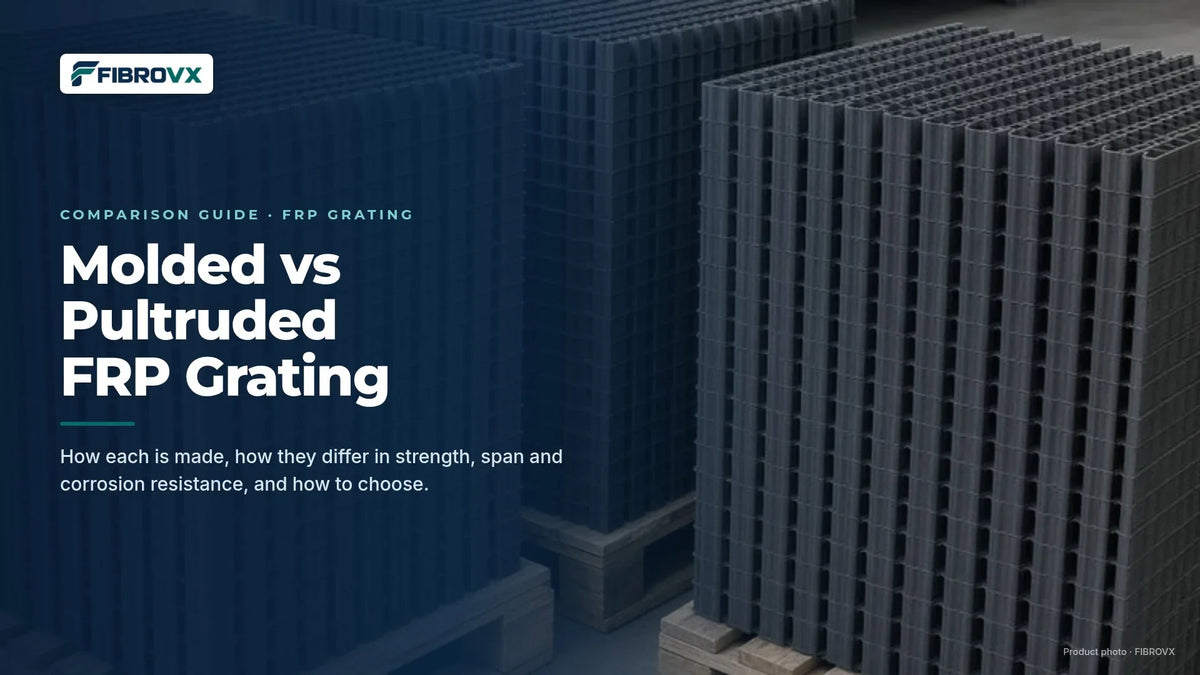
In short: Molded FRP grating is cast as one piece in an open grid mold. It is resin-rich (roughly 35% glass by weight), has a square mesh and is strong in both directions. It offers excellent corrosion and impact resistance and stays stable around cut-outs. Pultruded FRP grating is assembled from pultruded I- or T-shaped bearing bars joined by cross rods. It is fiber-rich, with most glass running along the bearing bars, so it is much stronger and stiffer in that direction and can span further. Choose molded for aggressive chemicals, short spans and many cut-outs. Choose pultruded for longer spans and heavier loads. FIBROVX supplies both.

How each type is made
Molded grating
Continuous glass rovings are laid in alternating layers into a grid mold (often heated), and liquid resin is poured in to fully wet the fibers. The panel cures as a single monolithic piece. Because fibers are laid in alternating layers in both directions, load is shared across both axes.
Pultruded grating
Glass rovings and mats are pulled through a resin bath and a heated die to make long bearing bars, usually I-bars or T-bars. The bars are then assembled at fixed spacing with cross rods passed through holes and locked with adhesive or mechanically. Most fibers run along the bars, giving high strength and stiffness in that direction. Learn more in What Is Pultrusion?.

Key differences
| Factor | Molded grating | Pultruded grating |
|---|---|---|
| Glass content (by weight) | About 35% (resin-rich) | Much higher (fiber-rich) |
| Strength direction | Bidirectional | Mainly along bearing bars |
| Span capability | Shorter spans | Longer spans for the same depth |
| Corrosion resistance | Excellent; high resin content | Very good; resin choice matters |
| Impact resistance | Very good | Good |
| Cut-outs | Stable; no loose bars | May need banding or extra support |
| Typical mesh | Square, e.g. 38 × 38 mm (1.5 × 1.5 in) | Bar spacing sets open area |
| Panel sizes | Mold sizes such as 1220 × 3660 mm | Long panels; bars cut to length |
Glass content figures are from a US FRP grating manufacturer and are typical, not universal. Always check the specific product data.
When to choose molded grating
- Chemical plants, plating and pickling lines, wastewater treatment
- Wash-down areas and food processing
- Platforms with many cut-outs for pipes and equipment
- Short to moderate spans
- Where bidirectional load sharing is useful, such as trench covers with point loads near edges
Molded grating's resin-rich construction gives it a strong corrosion barrier, and its monolithic grid tolerates impact well. See our FRP molded grating.
When to choose pultruded grating
- Longer spans between supports, so fewer support beams are needed
- Heavier pedestrian loads, carts or equipment access within the rated loads
- Long walkways and catwalks where a uniform direction suits the layout
- Where higher stiffness reduces deflection
Pultruded grating is available with different bar shapes, bar spacings and open areas. It can be supplied with grit tops or solid covers.

Cost and installation
Comparing cost per square meter alone can mislead. Pultruded grating may reduce the number of support beams on long spans, which lowers total cost. Molded grating can reduce fabrication time on platforms with many cut-outs. Compare installed cost, including supports, fixings and labor.
For both types:
- Seal cut edges with compatible resin.
- Use hold-down clips suited to the grating type.
- Orient pultruded grating so the bearing bars span between supports.
See How to Install FRP Grating.
Common misconceptions
"Pultruded is always stronger." It is stiffer and stronger along the bars, but not across them. In bidirectional or point-load situations near unsupported edges, molded grating may behave better.
"Molded grating is only for light duty." Thicker molded grating, and heavy-duty mesh options, carry substantial loads at suitable spans.
"All FRP grating has the same chemical resistance." Resin type and glass content both matter. See Polyester vs Vinyl Ester vs Phenolic Resin.

Customization
We manufacture molded and pultruded grating to order: depth, mesh or bar spacing, panel size, resin, surface finish, color and cut-outs prepared to your drawing. Pair the grating with FRP pultruded profiles for support frames, FRP stair treads and handrail systems.
Need a quote or a drawing check?
FIBROVX manufactures FRP products in our own factory in China and builds every item to order: sizes, resin system, color, molds and OEM branding. Send your application, dimensions or drawing, quantity and destination port.
Request a QuoteCommon mistakes
- Assuming one load table fits both types. Molded and pultruded grating behave differently. Use the table for the exact product.
- Placing pultruded grating the wrong way. Bearing bars must span between supports. Turning a panel 90 degrees greatly reduces its capacity.
- Forgetting to seal cut edges. Cut edges of either type should be sealed with resin to protect exposed fibers.
- Choosing on price alone. Life-cycle performance depends on the resin, the environment and the load. A cheaper panel that deflects too much or degrades early costs more over time.
Key terms
- Bearing bar: The main load-carrying bar. In pultruded grating it spans between supports.
- Cross rod: The smaller member that ties pultruded bearing bars together and spaces them.
- Bidirectional: Having strength in both directions. Molded grating is bidirectional because its fibers run both ways.
- Clear span: The distance between supports, measured along the bearing bars.
- Resin content: The proportion of resin in the laminate. Molded grating typically has more resin than pultruded grating, which helps corrosion resistance.
Watch: Molded vs Pultruded FRP Grating in 27 Seconds
FAQ
Which is better: molded or pultruded grating?
Neither is better in every case. Molded excels in corrosion, impact and cut-outs. Pultruded excels in span and stiffness along one direction.
Can pultruded grating be cut like molded grating?
Yes, but cutting through bearing bars at openings can reduce support. Openings often need banding or extra framing.
Do both types come with grit surfaces?
Yes. Both can be supplied with a grit top, and both can be covered with a solid plate. See FRP Grating Surface Options.
Can molded and pultruded grating be used together?
Yes. Many projects use pultruded grating for long-span walkways and molded grating for areas with heavy chemical exposure or many cut-outs. Select each panel for its own span and load, and match the panel depths at joints so that the walking surface stays level.
Which type is lighter?
It depends on depth, bar spacing and glass content. For long spans, pultruded grating can often meet the deflection limit with less material. Compare datasheet weights for panels that meet your load table. See our FRP grating weight guide.
Related guides
- FRP Grating: Complete Guide
- FRP Grating Span and Load Tables
- FRP Grating Mesh Sizes
- Technical Resources: datasheets and drawings on request
- FRP vs Aluminum Grating for Walkways and Platforms
- FRP Grating vs Steel Grating: Weight, Corrosion and Where Each Wins
Sources
- A US FRP grating manufacturer, "Molded vs. Pultruded Fiberglass Grating" (molded ~35% glass / 65% resin; strength direction)
- A US grating supplier, "Pultruded FRP Grating" (I-bar and T-bar types)
- An FRP grating manufacturer, "Molded FRP Grating Technical Data Guide" (1220 × 3660 mm panels, 38 mm mesh)