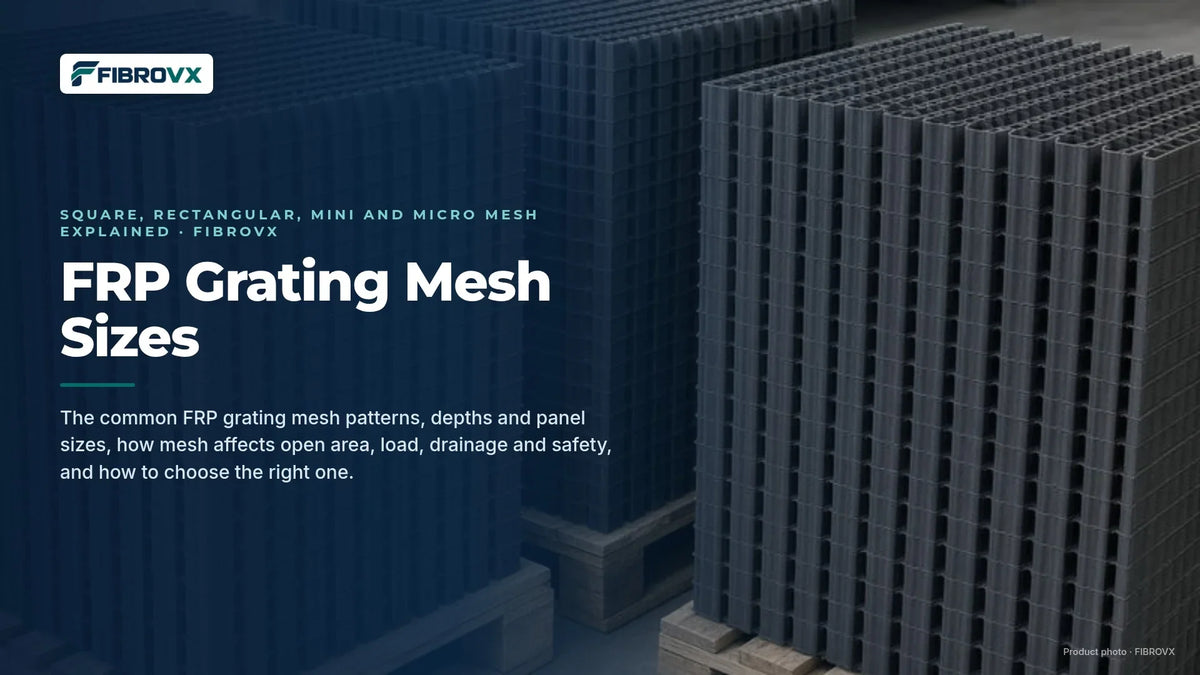
In short: Mesh is the pattern and spacing of the bars in FRP grating. The most common molded mesh is 38 × 38 mm (1.5 × 1.5 in) square, offered in depths such as 25, 30, 38 and 50 mm (1, 1.25, 1.5 and 2 in, depending on the supplier). Rectangular mesh (for example 1 × 4 in) adds stiffness in one direction. Mini mesh and micro mesh reduce the opening size for heel safety, small dropped objects and wheeled traffic. Larger openings drain better and weigh less. Smaller openings give a more continuous walking surface. Choose by use first, then confirm load and span with the load table.


What "mesh" means
In molded grating, mesh is the center-to-center spacing of the bars in each direction. A 38 × 38 mm mesh means bars are spaced 38 mm apart both ways, forming square openings slightly smaller than 38 mm because of bar thickness. Depth (also called thickness or height) is the bar height. Together, mesh and depth set the load capacity, weight and open area.
In pultruded grating, the equivalent is the bearing bar spacing and the cross-rod spacing.

Common mesh types
Standard square mesh: 38 × 38 mm (1.5 × 1.5 in)
The industry workhorse for industrial walkways, platforms and trench covers. It offers a high open area for drainage and airflow, and bidirectional strength. North American suppliers commonly list this mesh in 1, 1.25 and 1.5 in depths with panel sizes such as 3 × 10 ft, 4 × 8 ft and 4 × 12 ft. Metric suppliers commonly offer 1220 × 3660 mm panels.
Rectangular mesh (e.g. 1 × 4 in)
Bars are closer in one direction, so the panel is stiffer along that axis. Rectangular meshes are often used for heavier loads or where a smaller opening in one direction is needed.
Mini mesh (e.g. 13 × 13 mm)
A small square opening. It is used where narrow heels, small tools or debris must not pass through, for example in public spaces, ramps and stage areas. Some suppliers list a mini mesh of 13 × 13 mm alongside their 38 × 38 mm standard.
Micro mesh
Micro mesh grating has very small top openings (for example, one US maker's micro-mesh grating has a 3/4 in square top mesh over a 1-1/2 in bottom mesh) while keeping a larger opening below for drainage. It is used for pedestrian bridges, ADA-sensitive routes in the US, and rooftop walkways.
Covered (solid-top) grating
A solid FRP plate bonded to the top of the grating removes openings altogether. See FRP Grating Surface Options.
Open area: why it matters
Open area is the percentage of the panel surface that is open.
- High open area: better drainage, less buildup of liquids and debris, lighter weight, and more airflow and light. Typical of standard square mesh.
- Lower open area: a more continuous surface for heels, carts and small objects, but more weight and less drainage.
Open area values depend on bar width, mesh and taper, so check each product datasheet.

Choosing the right mesh
| Use case | Typical mesh choice |
|---|---|
| Industrial walkways and platforms | 38 × 38 mm square |
| Heavy loads in one direction | Rectangular mesh, or deeper grating |
| Public walkways, heel safety | Mini mesh or micro mesh |
| Carts and wheeled equipment | Smaller openings, plus a concentrated load check |
| Drainage, wash-down, spills | Standard square mesh with high open area |
| Nothing may fall through | Covered grating |
Mesh selection should also consider local accessibility and walking-surface rules. For example, in the US, accessible routes have opening-size limits in the ADA Standards (openings in floor surfaces on accessible routes must not allow passage of a 1/2 in diameter sphere, with elongated openings placed perpendicular to the main direction of travel). Confirm the requirements that apply to your project.
Depth and panel size
Thicker grating spans further and deflects less. Use the load table to choose the depth for your span. See FRP Grating Span and Load Tables. Panel sizes depend on the molds available. Plan support layouts around standard panels to reduce cutting and waste, and see FRP Grating Weight Guide for handling.
Customization
FIBROVX supplies FRP molded grating in standard and small meshes and a range of depths. Pultruded grating is available with different bar spacings. Non-standard meshes, depths or panel sizes can be produced with new molds. Tell us your application, span, load and any opening-size rule.
Need a quote or a drawing check?
FIBROVX manufactures FRP products in our own factory in China and builds every item to order: sizes, resin system, color, molds and OEM branding. Send your application, dimensions or drawing, quantity and destination port.
Request a QuoteCommon mistakes
- Choosing mesh before load. The mesh and depth must carry the design load at your span. Check the load table first.
- Using standard mesh in public areas. Openings that are fine for industrial workers can catch narrow heels or let small objects fall through. Consider mini mesh, micro mesh or covered grating.
- Forgetting the drainage needs. Small openings drain more slowly. In washdown or wet areas, balance safety against drainage.
Key terms
- Depth: The height of the grating bars, which mainly sets stiffness and load capacity.
- Mini mesh: A small square mesh used to reduce opening size.
- Micro mesh: A grating with a very small top opening over a larger bottom opening.
FAQ
What is the most common FRP grating mesh?
38 × 38 mm (1.5 × 1.5 in) square mesh, typically in 25 to 50 mm depths.
Is smaller mesh stronger?
Not automatically. Load capacity depends on depth, mesh, bar width and resin. Smaller meshes have more bars per meter, which can increase capacity, but always check the load table.
What mesh is best for wheelchairs or heels?
Smaller openings, such as mini or micro mesh, or covered grating. Check the opening-size rules that apply, such as the ADA Standards in the US.
Can I order a non-standard mesh?
Yes. A new mold may be required. Ask us about feasibility and minimum quantities.
Does mesh affect slip resistance?
Mesh and surface finish both matter. Grit-top surfaces give higher slip resistance than concave tops in oily or wet areas.
Can mesh be customized?
Mesh is set by the mold, so options depend on available molds, or a new mold can be made (see above). Covered tops and grit surfaces can be added to change the walking surface without changing the mesh.
Related guides
- FRP Grating: Complete Guide
- FRP Grating Surface Options
- Molded vs Pultruded FRP Grating
- Technical Resources: datasheets and drawings on request
- FRP Grating Thickness Selection: 25, 30, 38 and 50 mm Compared
- How to Specify FRP Grating in an RFQ: 12-Point Checklist
Sources
- A US FRP grating manufacturer, "FRP Molded Grating Details and Options" (1.5 × 1.5 in square mesh, depths, panel sizes)
- A US FRP grating manufacturer, "micro-mesh Access Flooring" brochure (3/4 in square top mesh over 1-1/2 in bottom mesh)
- An FRP grating manufacturer, "Molded FRP Grating Technical Data Guide" (38 mm, 1220 × 3660 mm panels, 13 × 13 mini mesh)
- US Access Board, ADA Standards §302.3 Openings: https://www.access-board.gov/ada/#ada-302