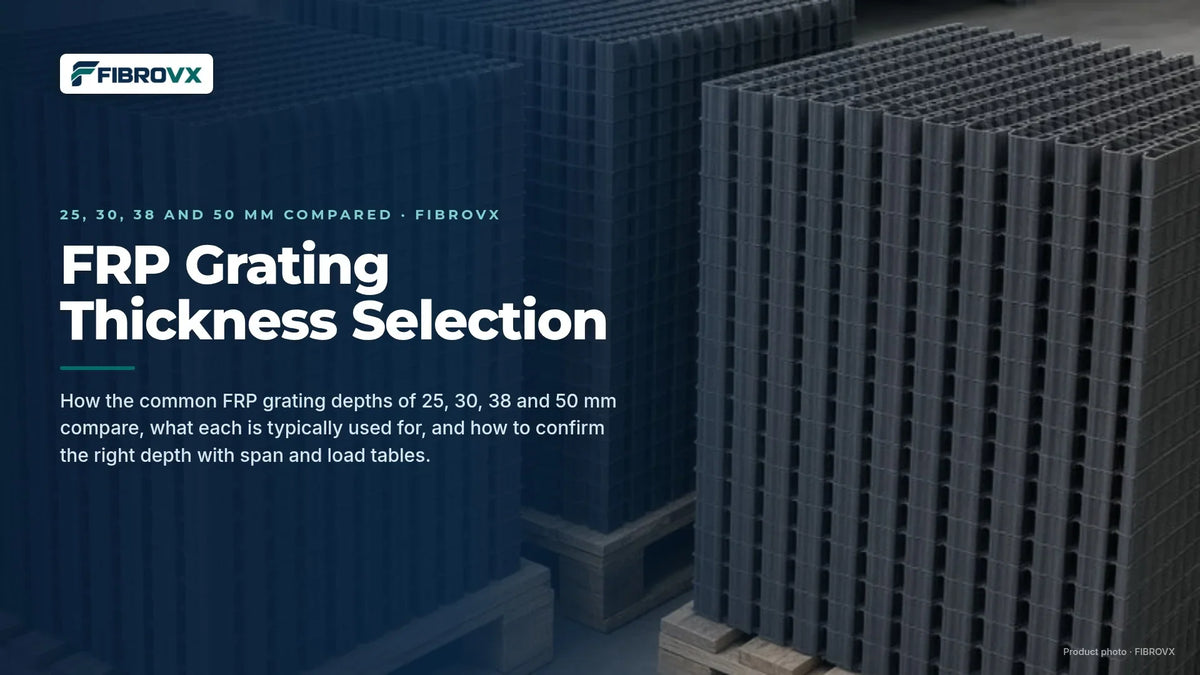
In short: FRP molded grating is commonly made in depths of 25, 30, 38 and 50 mm. Deeper grating is stiffer, so it spans further or carries more load at the same span, but it also weighs and costs more. The right depth comes from the clear span, the load and the allowed deflection, checked against the load table for the exact product. 38 mm is a common choice for industrial walkways, but it is not automatically right. FIBROVX makes molded grating in each of these depths and cuts panels to your layout.


What depth changes
Depth is the height of the bearing bars. Because stiffness rises steeply with depth, a small increase in depth gives a large increase in the span or load the grating can take. Depth also changes:
- weight per square meter, which affects handling and freight;
- material cost;
- the step at the edge of the panel, which matters for flush fits and trench covers.
The common depths compared

| Depth | Typical use | Notes |
|---|---|---|
| 25 mm | Short spans, light foot traffic, covers, shelving | Light and economical |
| 30 mm | Walkways with short to moderate spans | Between 25 and 38 mm |
| 38 mm | General industrial walkways and platforms | A common default |
| 50 mm | Longer spans and heavier loads | Heaviest of the four |
These are typical uses, not ratings. Always confirm with the load table.
How to choose
- Measure the clear span between the inside edges of supports.
- Set the load: uniform load for walkways, and any concentrated load such as a wheel or equipment foot.
- Set the deflection limit from your design basis. FRP is much less stiff than steel, so deflection usually governs.
- Read the load table for each depth with the same mesh and resin, and pick the shallowest depth that meets load and deflection at your span.
- Check panel weight and the support layout. Sometimes adding a support is cheaper than going deeper.
See how to read FRP grating load tables.

Why a little more depth goes a long way
A simple rule explains why depth is so powerful. For a solid rectangular bar of the same width and material, bending stiffness rises with the cube of the depth. Deflection under the same load falls in the same ratio.
| Depth | Stiffness compared with 25 mm (simple bar rule) | Deflection compared with 25 mm |
|---|---|---|
| 25 mm | 1.0 × | 100% |
| 30 mm | About 1.7 × | About 58% |
| 38 mm | About 3.5 × | About 28% |
| 50 mm | 8.0 × | About 13% |
So going from 25 mm to 38 mm makes the bar about three and a half times stiffer, and going from 38 mm to 50 mm makes it about 2.3 times stiffer again.
The effect on span is smaller, because deflection under a uniform load rises with the fourth power of the span. If deflection governs, a 38 mm bar can span about 37% further than a 25 mm bar at the same deflection, not three and a half times further.
This is a simplified rule for solid bars. Real molded grating has a mesh, tapered bars and resin-rich nodes, so the actual ratios differ. Use it to understand the trend, and use the load table for the decision.
Worked example: choosing a depth
A walkway has a 900 mm clear span, a uniform load of 2.87 kPa (60 psf) and a deflection limit of 6.4 mm (1/4 in). The load-table values below are hypothetical and only show the method. They follow the simple stiffness rule above.
| Depth (same mesh and resin) | Deflection at 900 mm, 2.87 kPa (hypothetical) | Meets 6.4 mm? |
|---|---|---|
| 25 mm | 7.5 mm | No |
| 30 mm | 4.3 mm | Yes |
| 38 mm | 2.1 mm | Yes, with a large margin |
On these numbers, 30 mm is the shallowest depth that passes. Before deciding, check the rest of the list:
- Concentrated load. If the walkway must also carry a 1.33 kN (300 lb) point load on a small footprint, check that case in the load table too. It can govern on short spans.
- Feel underfoot. A grating that only just meets the limit may feel lively. Some owners prefer extra margin.
- Consistency. If the rest of the plant uses 38 mm, one depth may simplify spares and edge details.
- Weight and cost. 30 mm is lighter and cheaper to buy and ship than 38 mm.
The result might be 30 mm for this walkway, or 38 mm if a point load or a plant standard applies. Either way, the choice is based on numbers rather than habit.
Loads to design for
In the US, the IBC (Table 1607.1) and ASCE/SEI 7 give minimum live loads that are often used for walkways:
| Use | Uniform load | Concentrated load |
|---|---|---|
| Catwalks for maintenance and service access | 40 psf (1.92 kPa) | 300 lb (1.33 kN) |
| Walkways and elevated platforms, other than exitways | 60 psf (2.87 kPa) | Not listed |
| Fire escapes | 100 psf (4.79 kPa) | Not listed |
Your design basis may require more, for example for equipment, carts or stored material. OSHA 29 CFR 1910.22 also requires walking-working surfaces to support their maximum intended load.
For deflection, many FRP grating load tables show a comfort limit such as 6.4 mm (1/4 in), the same 0.25 in that the NAAMM metal grating manual recommends for pedestrian comfort. Some specifications use a ratio of the span instead. Use the limit in your project documents.
Depth and mesh
Mesh also affects stiffness and open area. A 38 mm grating in 38 × 38 mm mesh behaves differently from the same depth in a mini mesh. Compare depths within the same mesh. See FRP grating mesh sizes.
Molded and pultruded grating
These depths refer to molded grating. Pultruded grating is made in its own range of depths and is often chosen for longer spans because its bearing bars are stiffer in one direction. See molded vs pultruded FRP grating.
Add a support or go deeper?
Shortening the span is therefore very effective. Halving the span cuts the deflection to one sixteenth, all else equal. Going up one step in the common depths (25, 30, 38, 50 mm) cuts it by a factor of only about 1.7 to 2.3 on the simple rule above.
So where deflection is the problem, compare two options:
- Deeper grating over the whole area: more material, more weight, possibly a new edge detail.
- An extra support beam at mid-span: steel or FRP structure cost, but the grating can stay shallow.
On a large platform, a shallower grating with closer supports can be the cheaper choice. On a small platform or a trench, a deeper grating is usually simpler. Ask for both options to be priced when the decision is close.
Trench covers and flush fits
Depth also controls the fit. Where grating sits in an angle frame or a trench, the depth must match the seat so the top is flush with the surrounding floor. A step at the edge is a trip hazard. If you change the depth, check the frame or seat at the same time.
Vehicle and wheel loads on trench covers are much more severe than foot traffic. Give the wheel load and the contact area, and ask for a check against that load.
Weight and handling
Deeper grating is heavier per square meter. That affects how many people are needed to lift a panel, how panels are packed and how much a container holds. See the FRP grating weight guide for how to estimate panel weights. If a 50 mm panel is too heavy to handle, a smaller panel size or an extra support may be better than a deeper section.
Customization
FIBROVX supplies FRP molded grating in 25, 30, 38 and 50 mm depths, with standard and custom panel sizes, colors, resins and surfaces. Send your span, load and layout and we will recommend a depth and panel plan.
Need a quote or a drawing check?
FIBROVX manufactures FRP products in our own factory in China and builds every item to order: sizes, resin system, color, molds and OEM branding. Send your application, dimensions or drawing, quantity and destination port.
Request a QuoteCommon mistakes
- Choosing depth by habit. Check the span and load.
- Using steel grating span tables. FRP has different stiffness.
- Ignoring concentrated loads.
- Comparing depths with different meshes.
- Forgetting the flush fit at trench covers and edges.
- Expecting span to grow as fast as stiffness. Stiffness rises with the cube of depth; span for the same deflection rises much more slowly.
- Skipping the point-load check on short spans.
Key terms
- Depth: Height of the grating bearing bars.
- Deflection: How much the grating bends under load.
- Concentrated load: A load applied over a small area.
Watch: FRP Grating Thickness Selection in 27 Seconds
FAQ
What is the most common FRP grating thickness?
38 mm is a common choice for industrial walkways, but the right depth depends on span and load.
Is 25 mm grating strong enough for walkways?
On short spans it can be. Check the load table for your span and deflection limit.
When should I use 50 mm grating?
For longer spans or heavier loads, when the load table shows shallower depths do not meet the criteria.
Can I mix depths on one platform?
Yes, but plan supports so the walking surface stays level.
How much stiffer is 38 mm grating than 25 mm?
On the simple bar rule, about three and a half times stiffer. Real molded grating differs, so compare load tables.
What deflection limit should I use?
Use your project's limit. Many FRP grating load tables show a comfort limit such as 6.4 mm (1/4 in).
Can FIBROVX recommend a depth for my project?
Yes. Send the span, loads, deflection limit and layout, and we will propose a depth, mesh and panel plan, and cut the panels to fit.
Is pultruded grating better for long spans?
Often, because its bearing bars are stiffer in one direction. Compare the load tables for both types at your span.
Related guides
- FRP Grating Guide
- FRP Grating Weight Guide
- FRP Grating RFQ Checklist
- How to Read FRP Grating Load Tables
- FRP vs Aluminum Grating
- Industries we serve
Sources
- ASCE/SEI 74-23, Load and Resistance Factor Design for Pultruded Fiber Reinforced Polymer (FRP) Structures: https://ascelibrary.org/doi/book/10.1061/9780784415771
- OSHA 29 CFR 1910.22, Walking-working surfaces: https://www.osha.gov/laws-regs/regulations/standardnumber/1910/1910.22
- NAAMM, Metal Bar Grating Manual (ANSI/NAAMM MBG 531-24; engineering manual MBG 534 uses 0.25 in for pedestrian comfort): https://naamm.org/publications/metal-bar-grating-manual/
- International Code Council, IBC 2021 Chapter 16, Structural Design (Table 1607.1 live loads): https://codes.iccsafe.org/content/IBC2021P2/chapter-16-structural-design
- ASCE/SEI 7, Minimum Design Loads and Associated Criteria for Buildings and Other Structures: https://www.asce.org/publications-and-news/asce-7