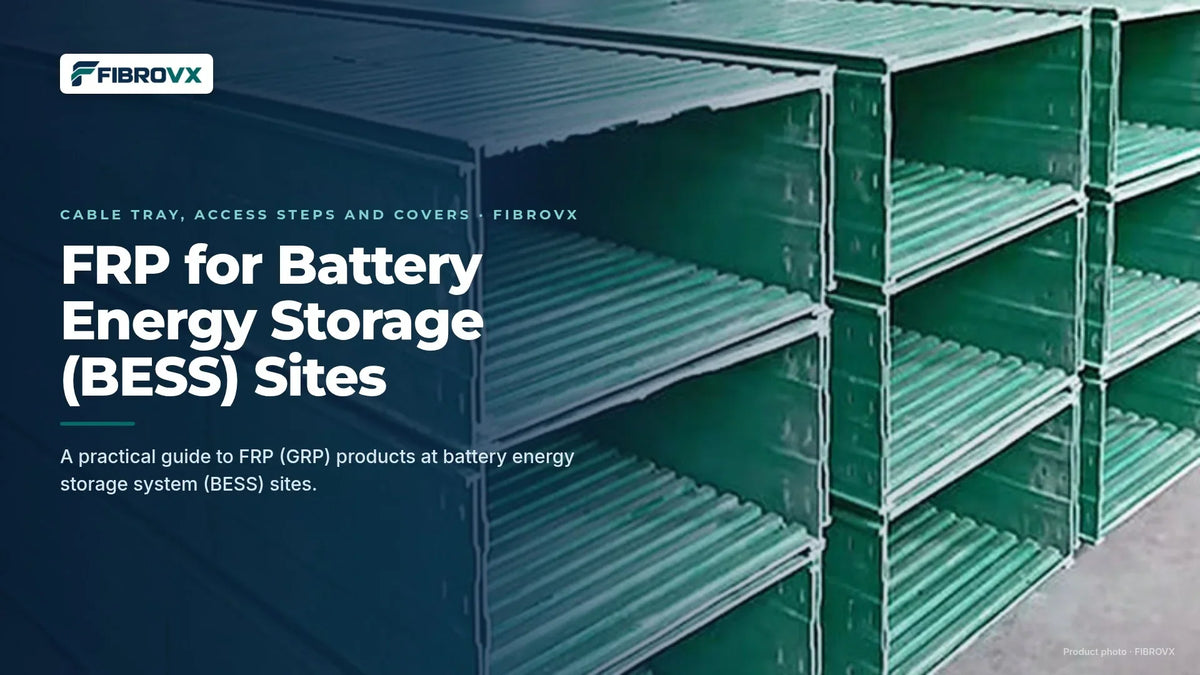
In short: A battery energy storage system (BESS) site is mostly an outdoor electrical yard: battery containers or cabinets, inverters, transformers and switchgear connected by cables in trays and trenches. FRP products help where metal would corrode or where a non-conductive part is preferred: cable trays and supports between equipment, access steps and platforms at container doors and skids, and covers over cable trenches and pits. The fire, spacing and access rules for the site come from NFPA 855 and local codes. FRP parts must fit that layout, not drive it.


What a BESS site looks like
Most utility-scale and commercial BESS projects use factory-built units. Batteries sit in containers or outdoor cabinets on concrete pads or piers. Power conversion systems (inverters), medium-voltage transformers and switchgear sit nearby. The site is linked by DC and AC cables, control and fiber cables, and grounding conductors.
These cables usually run:
- In cable trays above ground, on supports between units
- In concrete trenches with removable covers
- In conduit or direct buried for longer runs
Around the units, workers need safe access: steps up to raised container doors, platforms at skids, and covered trenches that they can walk over.
Why FRP at BESS sites
FRP (fiber reinforced plastic, also called GRP) brings three useful properties to an outdoor electrical yard:
- Non-conductive. FRP does not conduct electricity under normal conditions. A non-conductive tray, support, step or cover adds no extra conductive path near live equipment.
- Corrosion-resistant. It does not rust in rain, humidity, coastal air or de-icing salts.
- Light. Panels and trays can be handled by hand, without cranes, in the tight spaces between units.
FRP also needs no painting. It is often chosen where galvanized steel would need maintenance over a 20-year or longer project life.
The codes that shape the site
NFPA 855
In the US, the main standard is NFPA 855, Standard for the Installation of Stationary Energy Storage Systems. It covers fire protection, location, spacing, and access for ESS. According to NFPA, the standard applies to lithium-ion ESS above 20 kWh and to lead-acid ESS above 70 kWh.
Key layout points from NFPA's published guidance include:
- Location categories. Outdoor installations are "remote" (at least 100 feet from exposures such as buildings and walkways) or "near exposures".
- Separation. Indoors, the 2019 guidance describes 3 feet of clear space between each 50 kWh group and between groups and walls. Other arrangements can be allowed based on large-scale fire testing.
- Rooftops. A 2023 amendment for rooftop ESS calls for service walkways at least 5 feet wide from the roof access point to the system, and guards and handrails where required by local codes.
Rules change between editions and local adoptions. Always work from the edition your authority having jurisdiction (AHJ) has adopted.
Electrical code
Cables and trays must also meet NFPA 70, the National Electrical Code (NEC). Article 392 covers cable tray. Section 392.10(D) permits nonmetallic cable tray in corrosive areas and in areas requiring voltage isolation. A metal tray can serve as an equipment grounding conductor under NEC conditions; an FRP tray cannot, so the grounding path must come from a separate conductor.
Fall protection and stairs
Where workers climb steps or work on platforms, the US OSHA walking-working surfaces rules apply. Under 29 CFR 1910.25, standard stairs must have risers no higher than 9.5 inches and treads at least 9.5 inches deep. Under 29 CFR 1910.29, a guardrail top rail must be 42 inches (plus or minus 3 inches) high and withstand 200 pounds of force.
FRP cable trays and supports
Where trays are used
On a BESS site, FRP cable trays carry cables:
- Between battery containers and inverters
- From inverters to transformers and switchgear
- To auxiliary equipment such as HVAC units, fire systems and controls
- Along fences and pipe racks to the substation or point of connection
Trays can be ladder type for power cables, or trough and channel types with covers for control and fiber cables. Covers keep out sun, rain and debris.
Supports
FRP cable supports, such as brackets, channels and arms, hold trays and cables on posts, walls and trench sides. A fully non-conductive support system avoids mixing metal brackets into an FRP tray run.
Design points
- UV. Outdoor trays need a UV-resistant surface, and covers if cables need shade.
- Spans and loads. Give the cable weight and support span. Add wind, snow and ice loads.
- Expansion. Long runs in sun need expansion joints.
- Fire. If the project requires a fire-retardant tray, state the test standard.
- Grounding. Plan the separate grounding conductor along FRP runs.

Access steps and platforms
Container doors and skids
Battery containers and equipment skids often sit on piers or plinths. Their doors can be well above grade. Technicians need steps and small platforms to open doors and work safely.
FRP steps and platforms are built from:
- FRP stair treads with a slip-resistant nosing
- Grating for landings and platforms
- Pultruded profiles for stringers and frames
- Handrails where required
These are light enough to install between units by hand and do not corrode. They must leave the door swing, service space and emergency exit routes clear. Our guide to designing an FRP platform explains how the parts fit together.
Crossovers
Where cable trays or pipes run at ground level, FRP crossover steps let workers step over them safely.
Trench and pit covers
Cable trenches between units need covers that people can walk on and that can be lifted for cable work. FRP covers:
- Do not conduct electricity
- Do not rust in standing water
- Are light enough for one or two people to lift, depending on size
- Can be molded with a slip-resistant top
FRP molded grating is used for trench covers, and FIBROVX also makes FRP covers to drawing. State whether covers must carry vehicle loads or foot traffic only. Covers in vehicle routes need a separate design.

FRP vs galvanized steel at BESS sites
| Factor | FRP | Galvanized steel |
|---|---|---|
| Electrical conductivity | Non-conductive | Conductive; must be bonded |
| Corrosion outdoors | Does not rust | Coating wears over time |
| Weight | Light, hand installed | Heavy |
| Painting | Not needed | Repair over time |
| Grounding path | Separate conductor needed | Can serve as grounding conductor where permitted |
| Fire | Depends on resin; specify the test | Non-combustible |
Planning checklist
- Layout first. Fix unit spacing and access from NFPA 855, the local code and the battery maker's instructions.
- Electrical design. Confirm tray types and grounding with the electrical engineer.
- Loads. Cable weight, spans, wind, snow and foot traffic.
- Fire. State the fire test needed for trays, steps and covers.
- UV and climate. Outdoor exposure, temperature range and coastal air.
- Access. Step heights, landing sizes and handrails to OSHA and local codes.
- Maintenance. Covers that can be lifted, and trays with removable covers.
What to send for a quote
- Cable trays: type, width, side height, run length, fittings, covers, support span and cable load.
- Supports: bracket type, arm length, fixing method and load.
- Steps and platforms: height to door sill, door swing, landing size and handrail needs.
- Covers: trench width and length, load (foot or vehicle), surface and lifting method.
- Site: location, climate, UV exposure and any coastal conditions.
Need a quote or a drawing check?
FIBROVX manufactures FRP products in our own factory in China and builds every item to order: sizes, resin system, color, molds and OEM branding. Send your application, dimensions or drawing, quantity and destination port.
Request a QuoteFor more sectors, see our emerging industries page, the industries overview and our guide to FRP in data centers.
Related: Custom FRP Manufacturing: Sizes, Resins, Colors, Molds and OEM Explained; Solar Farm Cable Tray in Desert and Coastal Sites: UV, Sand, Salt and Heat; Lithium Refinery Corrosion: Where FRP Fits, Step by Step.
FAQ
Which standard governs BESS site layout in the US?
NFPA 855, Standard for the Installation of Stationary Energy Storage Systems, together with local codes. Work from the edition your authority having jurisdiction has adopted.
Is FRP cable tray allowed at BESS sites?
NEC Section 392.10(D) permits nonmetallic cable tray in corrosive areas and in areas requiring voltage isolation. An FRP tray cannot serve as a grounding conductor, so run a separate grounding conductor.
Can FRP trench covers take vehicle loads?
State whether covers carry foot traffic only or vehicles. Covers in vehicle routes need a separate design.
What OSHA rules apply to access steps at containers?
Under 29 CFR 1910.25, standard stairs need risers no higher than 9.5 in and treads at least 9.5 in deep. Under 1910.29, a guardrail top rail is 42 in (±3 in) high and withstands 200 lb.
Sources
- NFPA Journal, Energy Storage Systems (May/June 2019): https://www.nfpa.org/news-blogs-and-articles/nfpa-journal/2019/05/01/energy-storage-systems
- NFPA 855 (2023 edition), Tentative Interim Amendment 23-2, rooftop installations: https://docinfofiles.nfpa.org/files/AboutTheCodes/855/TIA_855_23_2.pdf
- Cable Tray Institute, Codes and Standards: https://www.cabletrays.org/codes-and-standards/
- ABB, Cable Tray Technical Guide (NEC 392.10(D)): https://library.e.abb.com/public/3d71fb96ede6403da4863aa740f133c8/Cable_Tray_Technical_Guide_2020_EN_web.pdf
- OSHA, 29 CFR 1910.25, Stairways: https://www.law.cornell.edu/cfr/text/29/1910.25
- OSHA, 29 CFR 1910.29, Fall protection systems criteria and practices: https://www.law.cornell.edu/cfr/text/29/1910.29