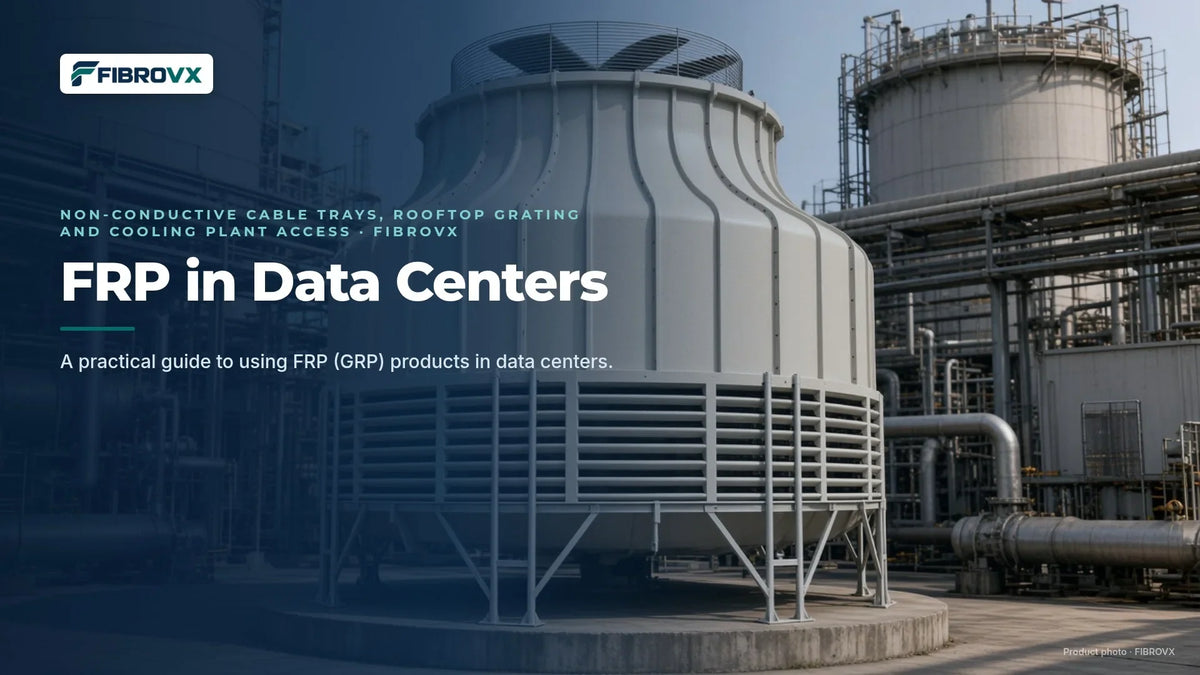
In short: FRP is not a replacement for everything in a data center. Inside the white space, metal cable trays and wire basket are the norm, and many codes limit plastic products in air-handling spaces. FRP earns its place where corrosion, electrical conductivity or weight is the problem: rooftop and outdoor cable routes, cooling towers and chiller yards, water treatment and chemical dosing rooms, battery and electrical rooms where a non-conductive support is wanted, and walkways, platforms and guardrails around rooftop plant. The US National Electrical Code permits nonmetallic cable tray in corrosive areas and where the conductivity of the tray is a concern. FIBROVX makes FRP cable trays, grating and handrail systems to order for these areas.


Why data centers are looking at FRP
A data center is a building full of electrical power and cooling equipment. Much of the infrastructure sits outside the IT halls: chillers, cooling towers, dry coolers, generators, fuel systems, transformers and pipe racks. Many of these are on the roof or in an open yard.
These areas share three problems that FRP (fiber reinforced plastic, also called GRP) can help with:
- Corrosion. Cooling tower drift, treated water, chemical dosing, coastal air and rain attack galvanized steel and aluminum over time.
- Electrical conductivity. In some locations, a non-conductive support or walking surface is preferred near live equipment.
- Weight. Rooftop structures have load limits. Lighter components reduce the load on the roof and make installation easier.
FRP does not rust, does not conduct electricity under normal conditions and weighs far less than steel. It also needs no painting.
Non-conductive FRP cable trays
What the code says
In the US, cable tray installation is governed by NFPA 70, the National Electrical Code (NEC), Article 392. Section 392.10(D) permits nonmetallic cable tray in corrosive areas and in areas requiring voltage isolation, that is, where the electrical conductivity of the tray is a concern. Other sections set the cables permitted in tray, fill limits and support rules.
Fiberglass cable tray products are made to standards such as UL 568 (nonmetallic cable tray systems), CSA C22.2 No. 126.2 (fiberglass cable tray) and IEC 61537 (cable tray and cable ladder systems). The older NEMA FG 1 standard for fiberglass cable tray was rescinded in November 2017, according to the Cable Tray Institute. Ask your supplier which standard a tray is tested to, and check what your project specification requires.
Grounding is different
A metal cable tray can, under conditions set out in the NEC, serve as an equipment grounding conductor. An FRP tray cannot. Where FRP tray is used, the grounding path must come from a separate conductor run with the cables. Include this in the electrical design from the start.
Where FRP trays fit in a data center
FRP cable trays suit:
- Rooftop cable routes to chillers, cooling towers, dry coolers and condensers, where rain, UV and drift corrode metal.
- Cooling tower and chiller yards at ground level, especially with treated water nearby.
- Water treatment and chemical dosing rooms that serve the cooling system.
- Coastal sites, where salt air shortens the life of galvanized steel.
- Utility tunnels and trenches with damp conditions.
- Electrical and battery areas, where a non-conductive support is preferred. Battery storage is covered in our guide to FRP for BESS sites.
Where metal trays usually stay
Inside the IT halls, the conditions are clean, dry and controlled. Metal trays and wire basket are standard there, and they can be bonded as part of the grounding system. Many air-handling spaces also restrict nonmetallic materials. Under the NEC, spaces used for environmental air have strict wiring rules, and the authority having jurisdiction (AHJ) decides what is accepted. Do not specify FRP tray in plenums or other air-handling spaces without confirming it with the designer and the AHJ.
Fire performance
Fire performance of FRP products depends on the resin and additives. If the project needs a fire-retardant tray, state the required test standard and rating in the inquiry. FIBROVX confirms the resin system and test data for each order, and does not publish generic fire ratings.

Rooftop grating, walkways and platforms
Why rooftop plant needs walkways
Data center roofs carry chillers, cooling towers, condensers and pipework. Technicians walk across the roof for inspection and maintenance. Walkways protect the roof membrane and give a defined, slip-resistant route. Platforms give safe access to equipment above roof level.
Why FRP grating
FRP molded grating is widely used on roofs and around cooling plant:
- No rust. It does not corrode in drift, treated water or salt air.
- Light. Panels can be carried by hand and installed with simple tools, which suits roofs.
- Slip-resistant surface. Molded grating has a textured or grit top.
- Non-conductive. Useful near electrical equipment on the roof.
- Cut on site. Panels can be cut around pipes and supports.
Grating, supports and fixings must be designed for the loads and spans of the project. Our guide to designing an FRP platform explains how grating, pultruded profiles and handrails work together.
Fall protection on roofs
Work near roof edges and openings is covered in the US by OSHA's walking-working surfaces rules. Under 29 CFR 1910.28, employers must protect workers from falls of 4 feet or more at unprotected sides and edges. Under 29 CFR 1910.29, a guardrail top rail must be 42 inches (plus or minus 3 inches) above the walking surface and withstand a force of at least 200 pounds. Midrails must withstand at least 150 pounds.
FRP handrail systems are a common choice for rooftop walkways and platforms, because they do not corrode and do not need painting. The system must be designed and tested to meet the loads that apply at your site.
Cooling plant access
Cooling towers
Many data centers reject heat through evaporative cooling towers. A cooling tower is a wet, corrosive place: it sprays and evaporates treated water all day. Drift and splash settle on the structure around it. Our guide to cooling tower sizing explains how towers are selected.
FRP products around cooling towers include:
- Access platforms and stairs to fan decks and basins
- Grating over basins and drains
- Handrails and guardrails
- Cable trays to fan motors and controls
- FRP cooling towers themselves, with FRP casings and basins
Chiller yards and pipe racks
Chiller yards and pipe racks often have walkways, crossovers over pipes and access platforms to valves. FRP grating and handrails resist rain and condensate, and do not need regular painting.
Water treatment rooms
Cooling water treatment uses biocides, scale inhibitors and sometimes acids. FRP grating, trench covers, cable trays and tanks resist these chemicals better than many metals, when the resin is selected for the chemicals used.

Benefits and limits
| Factor | FRP | Galvanized steel |
|---|---|---|
| Corrosion outdoors | Does not rust | Coating wears; rusts over time |
| Weight | Light | Heavy |
| Electrical conductivity | Non-conductive | Conductive; can be bonded |
| Grounding path | Separate conductor needed | Can serve as grounding conductor where permitted |
| Painting | Not needed | Repainting or regalvanizing over time |
| Air-handling spaces | Often restricted; check with AHJ | Generally accepted |
| Fire rating | Depends on resin; specify the test | Non-combustible |
Use FRP where its benefits matter: outdoors, near water and chemicals, and where conductivity or weight is a problem. Keep metal where the code or the grounding design calls for it.
Planning checklist
Before you specify FRP products for a data center, check:
- Code compliance. Confirm with the electrical designer and the AHJ where nonmetallic tray is permitted.
- Grounding. Plan a separate equipment grounding conductor along FRP tray runs.
- Fire. State the required fire test and rating.
- UV. Specify a UV-resistant surface for rooftop and outdoor products.
- Loads. Give the cable weight, support spans, wind and snow loads, and foot traffic loads.
- Thermal expansion. Long outdoor runs need expansion splices or joints.
- Roof interface. Agree how supports sit on the roof without damaging the membrane.
- Fall protection. Confirm guardrail heights and loads with your safety team.
What to send for a quote
- Cable trays: tray type (ladder, trough or channel), width, side height, run length, fittings list, covers, support span, cable load and the standard required.
- Grating: area, panel size, thickness or load and span, mesh type and surface, and color.
- Handrails: layout drawing, rail height, number of rails, post spacing, base fixing and toeboards.
- Cooling plant: drawings of the tower or chiller layout and the access points.
- Site: location, wind, snow and UV exposure, and whether the site is coastal.
Need a quote or a drawing check?
FIBROVX manufactures FRP products in our own factory in China and builds every item to order: sizes, resin system, color, molds and OEM branding. Send your application, dimensions or drawing, quantity and destination port.
Request a QuoteFIBROVX makes FRP cable trays, grating and handrail systems to order. See more emerging industries we serve and our industries overview. Dimensions, resin, test data and drawings are confirmed in writing for each item quoted.
Related: Custom FRP Manufacturing: Sizes, Resins, Colors, Molds and OEM Explained; Data Center Cooling: FRP Towers, Pipes and Rooftop Grating.
FAQ
Where does FRP cable tray fit in a data center?
Rooftop routes to chillers and cooling towers, cooling plant yards, water treatment rooms, coastal sites, damp tunnels and electrical or battery areas. Metal tray usually stays inside the IT halls.
Can FRP cable tray be used in plenums or air-handling spaces?
Do not specify it there without confirming with the designer and the authority having jurisdiction. The NEC sets strict wiring rules for spaces used for environmental air.
Does FRP cable tray need a separate grounding conductor?
Yes. A metal tray can serve as an equipment grounding conductor under NEC conditions; an FRP tray cannot, so a separate conductor must be run with the cables.
Which standards apply to fiberglass cable tray today?
UL 568, CSA C22.2 No. 126.2 and IEC 61537. NEMA FG 1 was rescinded in November 2017.
Sources
- Cable Tray Institute, Codes and Standards (NEC Article 392; UL 568; CSA C22.2 No. 126.2; IEC 61537; NEMA FG 1 rescinded 2017): https://www.cabletrays.org/codes-and-standards/
- ABB, Cable Tray Technical Guide (NEC 392.10(D) nonmetallic cable tray in corrosive areas and where conductivity is a concern): https://library.e.abb.com/public/3d71fb96ede6403da4863aa740f133c8/Cable_Tray_Technical_Guide_2020_EN_web.pdf
- OSHA, 29 CFR 1910.28, Duty to have fall protection and falling object protection: https://www.law.cornell.edu/cfr/text/29/1910.28
- OSHA, 29 CFR 1910.29, Fall protection systems and falling object protection criteria and practices: https://www.law.cornell.edu/cfr/text/29/1910.29