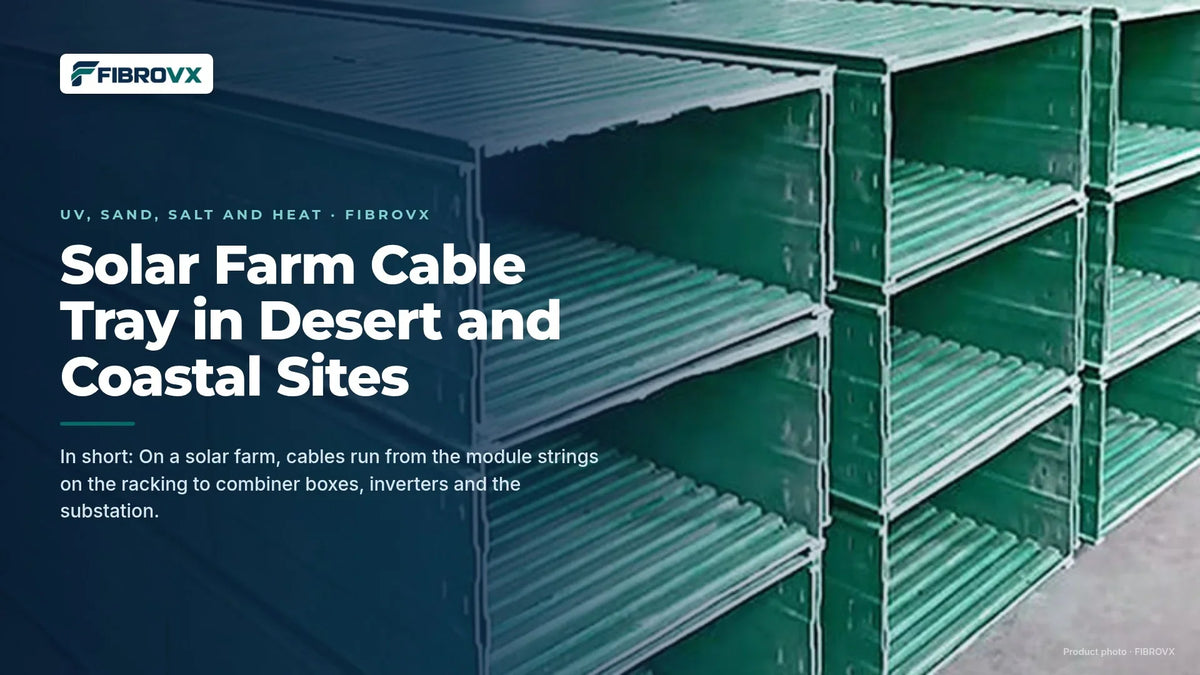
In short: On a solar farm, cables run from the module strings on the racking to combiner boxes, inverters and the substation. In deserts the main threats are UV, surface heat up to about 80 °C, sand abrasion and day-night temperature swings; corrosion of galvanized steel is usually low there. On the coast, salt raises steel corrosion sharply within about 1 km of the sea. FRP cable tray fits best on coastal and salt-affected sites, in trenches and on main runs that need covers against sun and sand, and wherever a non-conductive, non-rusting tray is preferred. String wire clips on the racking are a separate item with their own guidance.


How this guide fits with our others
This guide covers ground-mounted solar farms in desert and coastal climates. For solar plants built on water, read floating solar PV: FRP walkways and cable tray supports. For tray basics, see our FRP cable tray guide. Other sectors are on our industries page and emerging industries page.
Where cables run on a solar farm
A utility-scale plant has three levels of cable management:
- String wiring on the racking. DC cables from module to module and along the rows. These are held with clips, ties or hangers.
- Collection runs. From the end of each row to combiner boxes and inverters, often in cable tray, conduit or trenches.
- Main runs and the substation. AC cables from inverters to transformers and the substation, in trenches, ducts or tray on supports.
String wiring: follow the DOE guidance
The US Department of Energy published Solar PV cable management: best practices for DC-string cables in 2024. It reports that field inspectors found extensive failures of plastic cable ties, "even for those labeled UV-stabilized", some lasting only a few months, and that the degradation involves UV, heat, moisture and salts together. It cites NEC 2020 section 690.31(C), which requires exposed cables to be supported at intervals of no more than 600 mm (24 in.).
DOE's model specification lists stainless steel 316, hot-dip galvanized steel or PVDF for clips, hangers and trays, and stainless 316 or PVDF only near the coast. FRP is not on that list, and we do not offer FRP string clips. Where FRP fits is the next level up: collection and main runs, trenches, and the supports that carry them.
Desert sites: UV, heat, sand and cycling
What the climate does
HIS Technology, a solar cable maker, describes desert conditions as air temperatures above 60 °C, intense UV, sandstorms and large day-night swings. It reports cable surface temperatures of up to 80 °C in the day, falling below 10 °C at night, and says sand acts "like sandpaper" on cable surfaces. Its lab test cycle ran from −20 °C to +80 °C.
What it means for corrosion
The American Galvanizers Association summarizes ISO 9223 corrosivity categories. It lists C1 (very low) for certain deserts and C2 (low) for some arid and desert areas, with first-year zinc corrosion rates below 0.1 µm and 0.1–0.7 µm per year. In a dry inland desert, hot-dip galvanized tray is therefore unlikely to fail by corrosion. Be honest about this when comparing options. If your desert site is dry and far from the sea, the case for FRP rests on other points.
Where FRP helps in the desert
- Sun and sand protection. A covered tray shades cables and keeps blown sand off them. FRP covers and solid-bottom tray do not rust at cut edges or fixings. See ladder vs perforated vs solid-bottom cable tray for the trade-offs, including heat build-up under covers.
- UV. FRP itself needs UV protection outdoors. Ask for a UV-inhibited resin and a resin-rich surface; our UV degradation guide explains the options.
- Heat. Give us the highest surface temperature expected on the tray. Resin choice and load ratings depend on it; see FRP temperature limits by resin type.
- Weight and handling. FRP tray is light to carry along long rows, and it can be cut on site with standard power tools. Seal cut edges as described in our installation guide.
- Non-conductive. An FRP tray does not carry fault current. Your electrical engineer still sets the grounding and bonding design for the cables and metal parts.
Coastal sites: salt changes the picture
What ISO 9223 says
The AGA table places areas less than 1 km from the ocean in C4 (high), with zinc loss of 2.1–4.2 µm per year, and areas within a few hundred meters of the ocean or exposed coastline in C5 (very high), at 4.2–8.4 µm per year. CX (extreme), at 8.4–25 µm per year, covers the splash zone and sites with long periods of on-shore wind. AGA notes these rates are conservative, based on one-year exposures.
What it means for a solar plant
DOE refers to a solar system life of 30 years. AGA uses 100 µm as a typical minimum galvanized coating on structural steel. At C5 rates, simple division gives a coating life of roughly 12–24 years, before allowing for the drop in rate that often follows the first year. Thinner coatings on light tray sections would go faster. That gap is where FRP tray earns its place: it does not depend on a sacrificial coating.
What else to watch near the sea
- Fasteners. Use stainless 316 bolts and clips with FRP tray, in line with DOE's coastal advice for metal parts.
- Mixed metals. Avoid galvanized fittings on FRP tray in C5 zones; they will be the first part to fail.
- Salt deposits. Salt that settles on FRP tray does not start rust, so there is no red staining or loss of section at cut edges and bolt holes.
| Site condition | Main effect | What to specify |
|---|---|---|
| Desert UV | Surface erosion of polymers | UV-inhibited resin, resin-rich surface |
| Desert heat, 80 °C surfaces | Load rating and resin limit | Resin rated above site maximum |
| Sand and dust | Abrasion of cable jackets | Covered or solid-bottom tray |
| Inland dry desert | Low corrosion (C1–C2) | Galvanized steel may be enough |
| Coast under 1 km | High corrosion (C4–C5) | FRP tray, 316 fasteners |
| Splash zone, on-shore wind | Extreme corrosion (CX) | FRP tray and supports |

Above ground or in trenches?
Many solar plants bury collection cables directly or run them in ducts. Others use above-ground tray on posts along the rows, or concrete trenches with covers near inverter stations. Each route has its own weak points in harsh climates:
- Direct burial and ducts. No exposure to sun or sand once covered, but harder to inspect and repair. FRP has little role here apart from marker posts and covers at access points; see our guide to FRP marker posts for pipelines and cables.
- Above-ground tray on posts. Easy to inspect and extend, and well suited to rocky or shallow ground. It is fully exposed, so UV protection and covers matter. On coastal sites, the posts and brackets are as exposed as the tray, so specify them in FRP or stainless 316 too.
- Concrete trenches with covers. Common around inverter and transformer stations. The covers take foot traffic and sometimes vehicle wheel loads; give us the load class. Sand tends to collect in open trenches, so fully closed covers are worth considering in the desert.
Inspection over the plant life
DOE points out that for some roof arrays the only way to replace failed cable ties is to take much of the system apart, and that low-grade ties may need replacing several times over a 30-year life. Ground-mounted tray is easier to reach, but the lesson is the same: choose parts that last as long as the plant, because replacement costs more than the part.
For FRP tray on a solar farm, a simple yearly walk-down covers most needs:
- Look for surface chalking or fiber bloom on sun-facing faces, the first sign that UV protection is wearing. A UV-resistant coating can be applied before fibers are exposed.
- Check covers and clips after sandstorms or high winds, since loose covers can be blown off.
- Check fasteners near the coast for staining or loss of section.
- Check that sand has not built up in solid-bottom tray or trenches to the point that it traps heat around cables.
Our FRP cable tray guide covers general care. Plants that add battery storage can use the same tray family; see FRP for battery energy storage sites.
Standards for FRP cable tray
FRP tray is tested and specified under IEC 61537 internationally and UL 568 / CSA C22.2 No. 126.2 in North America; NEMA FG-1 was rescinded in 2017. Installation in the US follows NEC Article 392, with PV-specific rules in Article 690. Our cable tray standards guide explains each document. Tell us which one your client names.
Choosing tray type and size
- Load and span. Cable weight per meter and support spacing set the tray size. Use our load and span selection guide.
- Type. Ladder tray suits large cables and heat dissipation; solid-bottom with covers suits sun and sand.
- Supports. FRP cable supports on posts or trench walls, or on the racking where the structural designer agrees.
- Trench covers. Where cables run in concrete trenches, FRP covers or grating keep sand out and are light to lift.
- Comparisons. For a full comparison with steel options, see FRP vs galvanized and stainless cable tray.
What to send us
- Site location and distance from the sea, or the ISO 9223 category from your corrosion study.
- Climate data: maximum air and surface temperature, UV exposure, sand and wind.
- Cable schedule: sizes, weights and number of cables per run.
- Route drawings with support spacing, bends and tees.
- Tray type and covers, and the standard your client names.
- Fasteners and supports: material and fixing method.

How FIBROVX builds for solar projects
We make FRP cable trays, covers, fittings and supports to your route and cable schedule. Width, height, wall thickness, resin, UV protection and color are set per project. Non-standard sizes, special fittings and trench covers are custom / available on request; see custom FRP manufacturing. We do not claim any certification for solar plants. Tell us your client's requirements and we will state which tests and records we can supply for that order.
Need a quote or a drawing check?
FIBROVX manufactures FRP products in our own factory in China and builds every item to order: sizes, resin system, color, molds and OEM branding. Send your application, dimensions or drawing, quantity and destination port.
Request a QuoteFAQ
Is FRP cable tray better than galvanized steel in the desert?
Not for corrosion alone. ISO 9223 places dry deserts in low corrosivity categories. FRP's advantages there are covers against sun and sand, low weight and no rusting at cut edges.
How close to the sea does corrosion become a concern?
AGA's ISO 9223 summary places sites under 1 km from the ocean in C4 and those within a few hundred meters in C5.
Can FRP replace cable ties on the racking?
We do not offer FRP string clips. DOE recommends stainless 316, galvanized steel or PVDF devices, and 316 or PVDF near the coast.
Does FRP tray need UV protection?
Yes. Ask for a UV-inhibited resin with a resin-rich surface, and consider covers in strong sun.
How often should FRP tray on a solar farm be inspected?
A yearly walk-down for UV wear, loose covers, fastener condition and sand build-up suits most sites, plus a check after major storms.
What standard should I cite?
IEC 61537 for international projects, or UL 568 / CSA C22.2 No. 126.2 in North America.
Sources
- US Department of Energy, Solar PV cable management: best practices for DC-string cables (2024): https://www.energy.gov/sites/default/files/2024-07/pv-cable-management-best-practices.pdf
- HIS Technology, Thermal and mechanical resilience of solar cables in desert regions: https://his-technology.com/en/insights/thermal-and-mechanical-resilience-of-solar-cables-in-desert-regions
- American Galvanizers Association, HDG corrosion rates for ISO categories C1–C5/X (ISO 9223 table): https://galvanizeit.org/knowledgebase/article/hdg-corrosion-rates-for-iso-categories-c1-c5-x
- Cable Tray Institute, Codes and standards (NEMA FG-1 rescinded November 2017): https://www.cabletrays.org/codes-and-standards/
- IEC 61537:2023, Cable tray systems and cable ladder systems: https://webstore.iec.ch/en/publication/31963