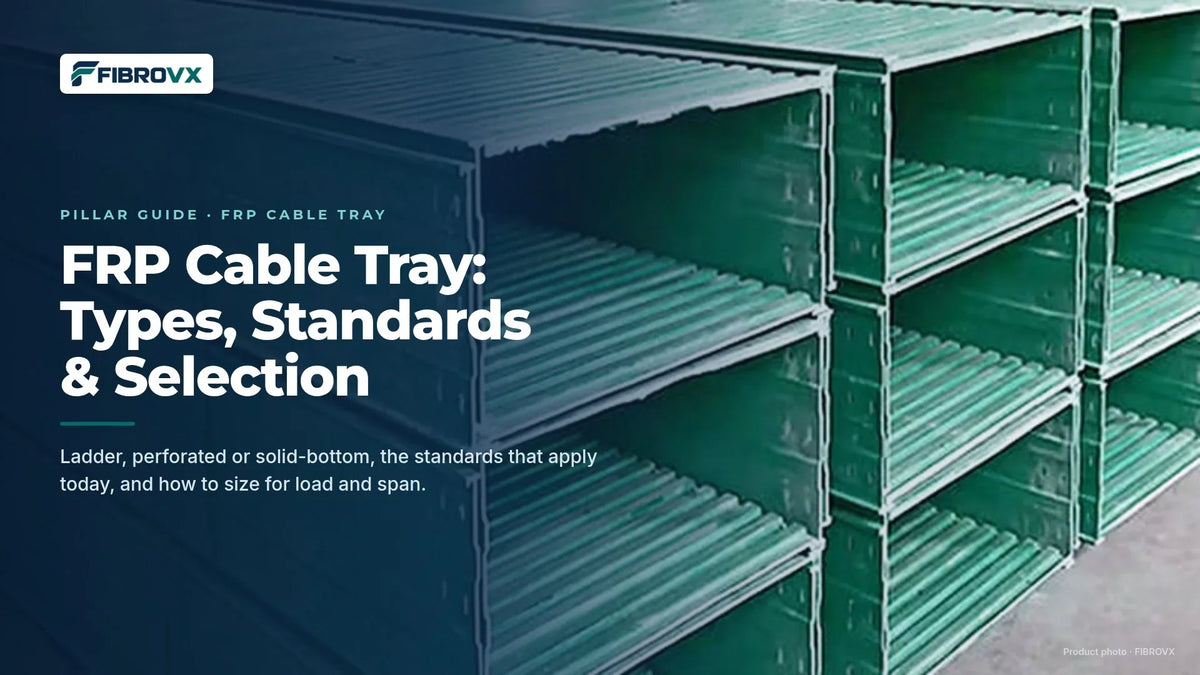
In short: FRP cable tray is a cable management system made from pultruded fiberglass side rails and rungs or bottoms. It does not rust, is non-conductive, and is light enough to install without heavy lifting equipment. That makes it a common choice for chemical plants, wastewater facilities, offshore platforms, coastal sites, tunnels and battery storage. Choose the tray type (ladder, perforated or solid bottom), then size the width, side-rail height and support span from the cable load. Confirm the standard your project specifies: UL 568 in North America or IEC 61537 internationally.

Why FRP instead of steel or aluminum?
Steel tray needs galvanizing or coating, and in wet, salty or chemical atmospheres that protection is consumed over time. Aluminum resists many atmospheres but is attacked by some acids and alkalis. FRP tray offers:
- Corrosion resistance across a wide range of chemicals, with the resin chosen to suit the environment
- Non-conductive construction, which reduces risk near energized equipment
- Low weight for faster installation and lower structural load
- No sharp burrs, so cable jackets are less likely to be damaged during pulling
FRP is not automatically the best choice everywhere. In dry indoor areas, steel may cost less to buy. In fire-rated routes, check the fire performance your code requires.

Types of FRP cable tray
Ladder tray
Two side rails joined by rungs at regular spacing. Ladder tray gives the best ventilation and heat dissipation, the lightest weight, and easy access for tying cables in and out along the run. It is the default for power and large control cables in industrial plants.
Perforated (ventilated trough) tray
A continuous bottom with slots or holes. It supports small cables better than rungs while still allowing some airflow and drainage.
Solid-bottom tray
A continuous closed bottom. It gives maximum physical protection and is used for instrumentation or data cables, or where dripping liquids or debris are a concern. Heat dissipation is lower, which may affect cable ampacity.
We compare the three in detail in Ladder vs Perforated vs Solid-Bottom Cable Tray.
Covers and fittings
A complete system includes straight sections plus horizontal and vertical elbows, tees, crosses, reducers, splice plates, covers, hold-down clamps and drop-outs. Covers protect cables from sunlight, falling objects and debris on outdoor routes.
Standards: what applies today
This is an area where older specifications often cite outdated documents.
- NEMA FG-1 (fiberglass cable tray) was rescinded in November 2017, according to the Cable Tray Institute. Projects that still cite it should be updated.
- UL 568 is the UL standard for nonmetallic cable tray systems in North America, and CSA C22.2 No. 126.2 is the Canadian specification for fiberglass cable tray.
- NEMA VE 2 is an installation guideline covering both metal and nonmetallic cable tray systems.
- IEC 61537:2023 covers cable tray and cable ladder systems for cable management, including load testing and classification.
- NFPA 70 (NEC) Article 392 governs cable tray installation in the USA, and local electrical codes apply elsewhere.
When your specification names a standard, send it with your inquiry. We will confirm which tests and documents are available for the exact tray we quote. We do not claim a listing or certification unless it can be documented for that product.

Sizing: load, span and width
- Cable load. Add up the weight of all cables per meter of tray, plus allowance for future cables.
- Support span. Choose the support spacing together with the tray size: a shorter span carries more load and deflects less. Load tables link span, load and deflection for each side-rail size.
- Width and side-rail height. Choose a width that gives the required cable fill and spacing, and a rail height that contains the cable bundle.
- Additional loads. Consider ice, wind, snow, and concentrated loads from people standing on tray during installation, which should be avoided.
- Supports. Pair trays with corrosion-resistant supports. Our FRP cable supports include brackets, channels and cantilever arms.
Grounding and bonding
Because FRP is an insulator, an FRP tray cannot be used as an equipment grounding or protective conductor, unlike some metal tray systems. Where the electrical design requires a ground path along the route, a separate grounding conductor must be run. Metal fittings and fixings should be bonded according to your electrical code. Consult the project's electrical engineer.
Fire and smoke performance
Standard FRP is combustible. Fire-retardant resin systems reduce flame spread, and low-smoke grades are used in tunnels and enclosed spaces. Ask for test results that match your specification. For example, flame spread under ASTM E84, or the national standard named in your project.

UV and outdoor use
For outdoor routes, specify UV-inhibited resin and a surface veil, and consider covers. Cut edges should be sealed with resin during installation.
Typical applications
- Chemical, petrochemical and fertilizer plants
- Water and wastewater treatment
- Offshore and coastal installations, ports and desalination plants
- Mining, pulp and paper, and metal finishing
- Tunnels and transport infrastructure
- Battery energy storage and solar farms
Customization
FIBROVX manufactures FRP cable trays to order. Options include ladder, perforated or solid bottom; custom widths, rail heights, lengths and rung spacing; resin type; color; covers; and complete fitting sets. OEM marking and packaging are available. See the full cable trays and supports collection.
RFQ checklist
- Tray type and quantity per size
- Width, side-rail height and section length
- Cable load (kg/m) and support span
- Environment: chemicals, outdoor or offshore exposure, temperature
- Fire requirements and named standard
- Fittings list, covers, supports and splice kits
- Color, packing and destination port
Need a quote or a drawing check?
FIBROVX manufactures FRP products in our own factory in China and builds every item to order: sizes, resin system, color, molds and OEM branding. Send your application, dimensions or drawing, quantity and destination port.
Request a QuoteKey terms
- Fitting: A tray component such as a bend, tee or reducer.
- Side rail: The longitudinal member on each side of the tray that carries the load between supports.
- Rung: A transverse member joining the side rails of a ladder tray.
- Splice plate: A plate that joins two tray sections end to end.
Key standards at a glance
| Standard / code | Status and scope | Where it applies |
|---|---|---|
| NEMA FG-1 | Rescinded November 2017 (Cable Tray Institute) | Update specs that still cite it |
| UL 568 | Nonmetallic cable tray systems | North America |
| CSA C22.2 No. 126.2 | Fiberglass cable tray | Canada |
| NEMA VE 2 | Installation guideline, metal and nonmetallic tray | Installation practice |
| IEC 61537:2023 | Cable tray and ladder systems, load testing and classification | International projects |
| NFPA 70 (NEC) Article 392 | Cable tray installation | USA |
| ASTM E84 (or the named national test) | Flame spread and smoke for fire-retardant resins | Where the project sets fire limits |
Watch: FRP Cable Tray in 27 Seconds
FAQ
Is FRP cable tray stronger than steel?
Not in stiffness. FRP trays are sized from load-deflection tables. With the correct side-rail size and support span, they carry typical industrial cable loads while avoiding corrosion.
Can FRP cable tray be used outdoors?
Yes. Specify UV-inhibited resin and a surface veil, and use covers where cables need protection from sunlight or debris.
Does FRP cable tray need grounding?
The tray itself is non-conductive and cannot serve as a grounding conductor. Run a separate grounding conductor where your design requires one, and bond metal parts according to your code.
Is NEMA FG-1 still valid?
No. The Cable Tray Institute lists NEMA FG-1 as rescinded in November 2017. Current references include UL 568 and IEC 61537.
What colors are available?
Gray is common. Other colors can be pigmented into the resin to order.
Can you supply fittings and supports?
Yes. We supply elbows, tees, reducers, covers, splice plates and FRP support systems, made to match the tray.
Related guides
- Ladder vs Perforated vs Solid-Bottom Cable Tray
- FRP Pultruded Profiles Guide
- What Is FRP?
- Technical Resources: datasheets and drawings on request
- FRP Cable Tray Standards: IEC 61537, UL 568 and Why NEMA FG-1 Is Rescinded
- FRP Cable Tray Load and Span Selection: A Step-by-Step Method
- Installing FRP Cable Tray: Supports, Splices and Cut-Edge Sealing
- FRP vs Galvanized Steel vs Stainless Cable Tray: Which Fits Your Site?
- Industries we serve
- Emerging industries we serve
- Solar Farm Cable Tray in Desert and Coastal Sites: UV, Sand, Salt and Heat
- Floating Solar PV: FRP Walkways, Cable Trays and Supports on Water
Sources
- Cable Tray Institute, "Codes & Standards" (NEMA FG-1 rescinded Nov 2017; UL 568; CSA C22.2 No. 126.2; NEMA VE 2; NEC Article 392): https://www.cabletrays.org/codes-and-standards/
- IEC, IEC 61537:2023 "Cable management – Cable tray systems and cable ladder systems": https://webstore.iec.ch/en/publication/31963