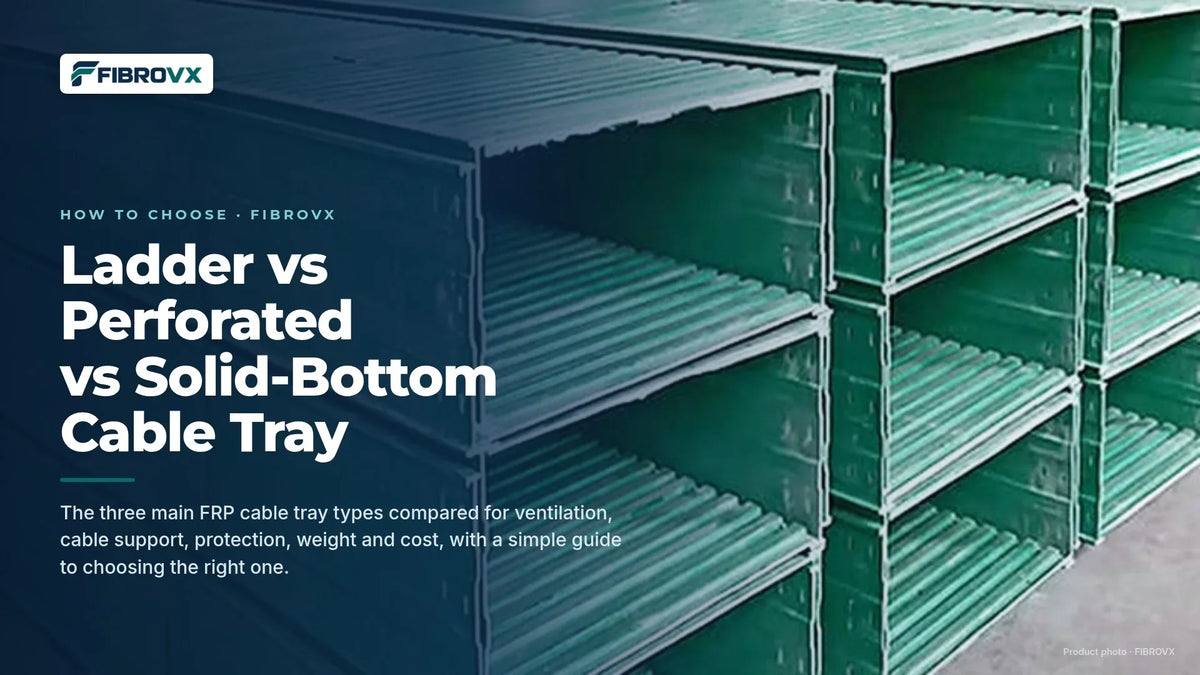
In short: Ladder tray has two side rails joined by rungs. It is light and has the best ventilation and access, so it is the default for power and large control cables. Perforated (ventilated trough) tray has a slotted bottom that supports small cables continuously while still allowing airflow and drainage. Solid-bottom tray has a closed bottom for maximum protection of sensitive cables from dripping liquids and debris, but it dissipates heat less well. All three are available in FRP, with covers and matching fittings.


The three types at a glance

Ladder cable tray
Two longitudinal side rails connected by transverse rungs at regular intervals.
- Pros: maximum airflow, lightest weight, easy cable entry and exit at any point, no water accumulation, easy to tie cables down
- Cons: small or flexible cables may sag between rungs. Less protection from falling debris unless covered.
- Typical use: power cables, large control cables, long runs in plants and outdoor installations
Perforated (ventilated trough) cable tray
A continuous bottom with slots or holes, plus side rails.
- Pros: continuous support for small cables, good airflow and drainage, better protection than ladder tray
- Cons: heavier than ladder tray, and cables can only exit at slots or fittings
- Typical use: mixed cable sizes, control and instrumentation cables
Solid-bottom cable tray
A continuous, non-ventilated bottom.
- Pros: maximum protection from dripping liquids, debris and dust.
- Cons: lowest heat dissipation, which can reduce cable ampacity. Water can collect without drain holes. Heaviest of the three.
- Typical use: instrumentation, data and communication cables; areas with dripping process liquids
Comparison table
| Factor | Ladder | Perforated | Solid bottom |
|---|---|---|---|
| Ventilation and heat dissipation | Best | Good | Lowest |
| Support for small cables | Fair | Good | Best |
| Protection from drips and debris | Low (unless covered) | Medium | High |
| Weight | Lightest | Medium | Heaviest |
| Cable access along run | Easiest | Moderate | Limited |
| Drainage | Free | Through perforations | Needs drain holes |

Heat and ampacity
Cable current rating (ampacity) depends on how well heat can escape. Ventilated trays allow more heat dissipation than solid-bottom trays. In the USA, NEC (NFPA 70) Article 392 sets cable fill limits for different tray types, and Article 310 and related tables cover ampacity. Other countries apply IEC 60364-5-52 or local codes. Your electrical engineer should confirm fill and ampacity for the chosen tray.
Covers
Covers can be added to any tray type. They protect cables from sunlight (UV), falling objects, ice and debris. Ventilated or peaked covers help shed water and snow outdoors. Remember that a solid cover reduces ventilation.
Why FRP for any tray type?
- No corrosion in chemical, coastal or offshore environments
- Non-conductive
- Light weight for easier installation
- Cut and drilled on site with standard tools (with dust protection, and cut edges sealed)
For standards, sizing, grounding and fire notes, see our FRP Cable Tray Guide.
How to choose
- What cables? Large power cables point to ladder tray. Small, mixed or instrument cables point to perforated or solid bottom.
- Heat? High-current circuits favor ladder tray.
- Environment? Dripping liquids, dust or debris point to solid bottom or covers.
- Access? Frequent cable additions favor ladder tray.
- Outdoors? Any type with UV-resistant resin. Consider covers.
Customization
FIBROVX makes FRP cable trays in ladder, perforated and solid-bottom types, with custom widths, side-rail heights, lengths, rung spacing, colors, covers and fittings. We also supply FRP cable supports. Browse the cable trays and supports collection.
Need a quote or a drawing check?
FIBROVX manufactures FRP products in our own factory in China and builds every item to order: sizes, resin system, color, molds and OEM branding. Send your application, dimensions or drawing, quantity and destination port.
Request a QuoteCommon mistakes when choosing tray type
- Choosing solid-bottom by default. A solid bottom protects cables, but it traps heat and water. If the cables are large power conductors, check the ampacity rules for the tray type before you choose it.
- Ignoring drainage outdoors. Solid-bottom trays outdoors need drain holes or a slight slope, otherwise water collects in the tray.
- Forgetting future cables. Size the tray width and fill for planned extensions, not only the first installation.
- Mixing cable types without separation. Power and instrument cables are often separated by barriers or run in separate trays. Follow the project's segregation rules.
- Leaving out covers where they matter. Covers protect against UV, falling debris and dripping liquids, but they also affect heat dissipation. Decide on covers as part of the tray selection, not afterwards.
- Using a load rating from a different product. Load and span data apply only to the tested tray. Always use the data for the tray you are buying.
Mixing tray types on one project
Many projects use more than one tray type. A typical arrangement uses ladder tray for main power routes, perforated tray for mixed branch circuits, and solid-bottom tray with covers for instrument cables in dirty or dripping areas. FRP fittings such as bends, tees and reducers are available for each type, and transitions between types can be detailed during design. Keeping one supplier for all types makes it easier to match side rail heights, widths, connectors and colors.
Key terms
- Side rail: The longitudinal side member of a tray that carries the load between supports.
- Rung: A cross member in a ladder tray on which the cables rest.
- Fill: The proportion of the tray cross-section occupied by cables. Electrical codes limit fill for some cable types.
- Ampacity: The current a cable can carry continuously without exceeding its temperature rating. Tray type and covers affect it.
- Fitting: A tray component that changes direction, width or elevation, such as a bend, tee, cross or reducer.
- Splice plate: A connector that joins two straight tray lengths.
Watch: Ladder vs Perforated vs Solid-Bottom Cable Tray in 27 Seconds
FAQ
Which cable tray type is most common?
Ladder tray is widely used for industrial power and control cables because of its ventilation, weight and access.
Can I mix tray types on one route?
Yes, with appropriate transition fittings. For example, solid bottom under a dripping process area and ladder tray elsewhere.
Does solid-bottom FRP tray shield cables from interference?
No. FRP is non-conductive and doesn't provide electromagnetic shielding. Use shielded cables or metal tray if shielding is required.
Does solid-bottom tray need drain holes outdoors?
Usually yes, to prevent water accumulation. Ask for drain holes when ordering.
Can covers be added later?
Yes, if the tray size and cover fixings are compatible.
Can FRP cable tray be used outdoors?
Yes. FRP does not rust and can be supplied with UV-resistant resin and surface veil for outdoor use. Covers add protection from sunlight and debris. Solid-bottom trays outdoors need drainage so that water does not collect.
Do FRP trays need grounding?
FRP itself is non-conductive, so the tray does not need bonding as a conductor. Any metallic parts, and the grounding of the cables themselves, must still follow the electrical code that applies to your project.
Related guides
- FRP Cable Tray Guide
- FRP Pultruded Profiles Guide
- What Is FRP?
- Technical Resources: datasheets and drawings on request
- FRP Cable Tray Load and Span Selection: A Step-by-Step Method
- FRP vs Steel vs Aluminum Cable Tray: Cost, Life and Weight Compared
- Emerging industries we serve
Sources
- Cable Tray Institute, "Codes & Standards" (UL 568, NEC Article 392 fill rules, Article 310 ampacity): https://www.cabletrays.org/codes-and-standards/
- IEC, IEC 61537:2023 "Cable tray systems and cable ladder systems": https://webstore.iec.ch/en/publication/31963