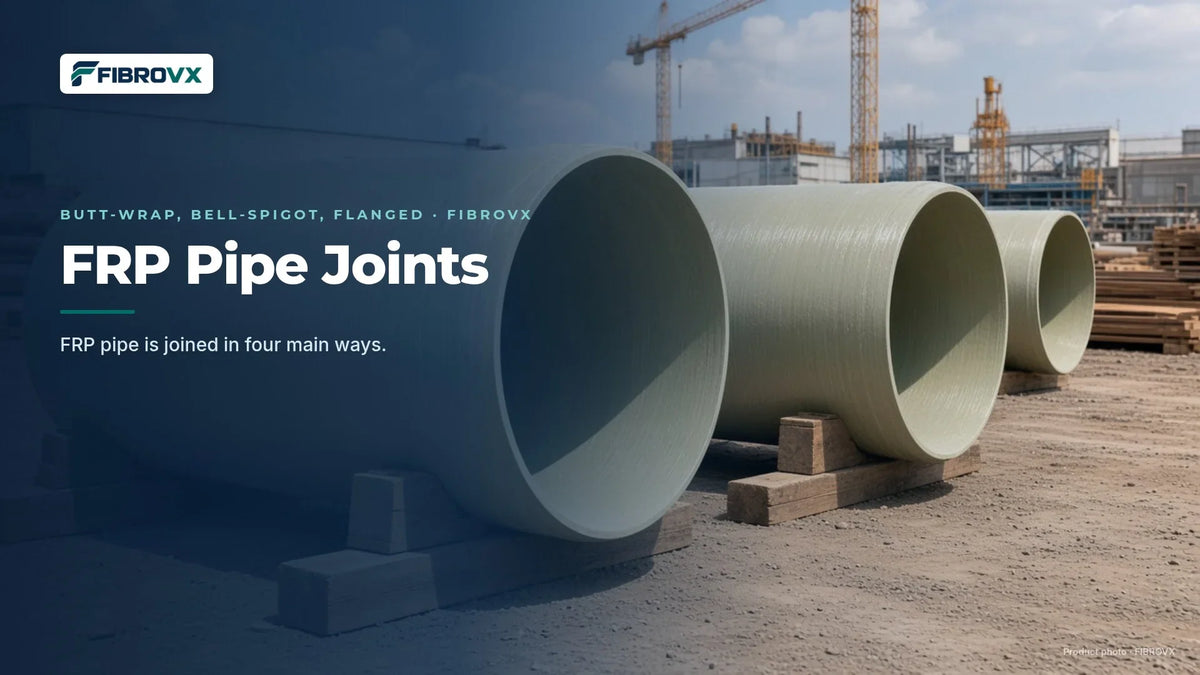
In short: FRP pipe is joined in four main ways. Adhesive bell-and-spigot joints are bonded. Butt-and-wrap joints are laminated over. O-ring (gasketed) bell-and-spigot joints are mainly for buried lines and need thrust restraint above ground. Flanged joints are used where the line must come apart. Choose by service, pressure, whether the line is buried or above ground, and maintenance needs.

What are the joint types?
| Joint | How it works | Typical use | Watch-outs |
|---|---|---|---|
| Adhesive bell-and-spigot | Tapered or straight spigot bonded into a bell with adhesive | Small and medium diameters, quick installation | Surface preparation, adhesive cure time and temperature |
| Butt-and-wrap | Pipe ends butted, then over-laminated with glass and resin | Large diameter, custom spools, chemical lines | Skilled laminators, cure time, inner seal in corrosive service |
| O-ring bell-and-spigot | Gasket seals the joint; it can move slightly | Buried water, sewer and cooling water | Not self-restrained: needs thrust blocks or restrained joints |
| Flanged | Contact-molded or stub-end flanges bolted with a gasket | Valves, pumps, equipment, removable spools | Bolt torque, flat-face mating, gasket choice |
Which joint should you use above ground?
Above ground, use restrained joints: adhesive, butt-and-wrap or flanged. Gasketed joints carry no axial load. Above ground they need extra restraint, or they can pull apart under pressure thrust.

What about flanges on FRP pipe?
- Full-face or lap-joint (stub-end) flanges: both are common.
- Mating to steel: use a flat-face mating flange, not a raised face, so the FRP flange is not bent when the bolts are tightened.
- Torque: tighten in a cross pattern to the manufacturer's values, in several passes.
- Standard: ASTM D4024 covers machine-made fiberglass (RTR) flanges.
How do you check a joint in the field?
- Procedure: a written bonding or laminating procedure and a qualified installer.
- Cure: Barcol hardness on laminated joints.
- Hydrotest: to the project test pressure before the line goes into service.
- Records: joint number, installer, date and adhesive batch.

How FIBROVX can help
Send us the line list with sizes, pressure, temperature and the joint type you need, and we will confirm the joint design and the spools we can supply. Request a quote. CIF by default, FOB on request.
Common mistakes
- Gasketed joints above ground without restraint: they can separate under thrust.
- Raised-face steel flanges against FRP: they can crack the FRP flange.
- Bonding in the cold or wet: follow the adhesive's cure limits.
- Over-torquing bolts: use the published values.

Key terms
- Spigot: the plain end of a pipe that goes into a bell.
- Thrust restraint: something that resists the axial force from pressure at bends and ends.
- Stub end: a short flanged collar used with a loose backing ring.
- Hydrotest: a pressure test with water.
Fittings and flanges for each joint
Flanged joints need drilling that matches valves and pumps: FRP flanges are drilled to HGJ 45 or GB/T 9112–9124 or your standard, 12–60 mm thick. Elbows run DN10–600 in 0.6 / 1.0 / 1.6 MPa. See fitting and flange dimensions.
Watch: Joints & Fittings in 27 Seconds
FAQ
What is the most common FRP pipe joint? For small and medium sizes, the adhesive bell-and-spigot joint. For large diameters and custom spools, butt-and-wrap is common.
Can O-ring joints be used above ground? Only with suitable thrust restraint. They are mainly used for buried pipelines.
Can FRP flanges bolt to steel flanges? Yes. Use a flat-face mating flange, the right gasket and controlled torque.
Which manual covers fiberglass pipe design? AWWA Manual M45 covers fiberglass pipe design for water service.
Related guides
- FRP pipe basics
- FRP vs HDPE vs steel pipe
- FRP thermal expansion design
- FRP duct design basics
- Request a quote
Sources
- A North American FRP manufacturer, Pipe joining systems
- AWWA Manual M45, Fiberglass Pipe Design: https://www.awwa.org
- ASTM D4024, Machine Made RTR Flanges: https://www.astm.org