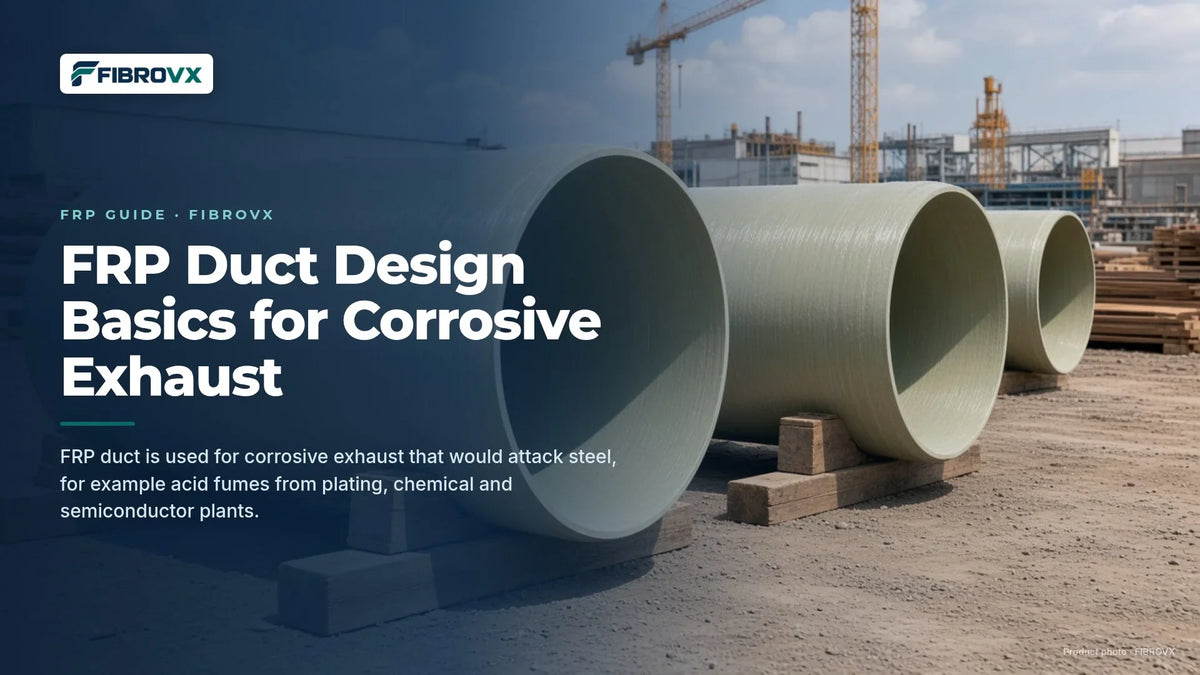
In short: FRP duct is used for corrosive exhaust that would attack steel, for example acid fumes from plating, chemical and semiconductor plants. Size it for air velocity and for the negative pressure (vacuum) from the fan. Choose the resin and corrosion barrier for the gas and condensate. Check the fire rules: in semiconductor fabs, FM Global calls for FM-approved duct (FM 4922) or sprinklers.

When is FRP the right duct material?
- Acid gases and mists: for example HCl, H₂SO₄ and chlorine-containing fumes, where steel would corrode.
- Wet exhaust: condensate collects in the duct and attacks it from the inside.
- Scrubber inlet and outlet runs: see the FRP scrubbers guide.
- Moderate temperatures: gas temperature must stay inside the resin's limit. See FRP temperature limits by resin type.
What design inputs do you need?
| Input | Why it matters |
|---|---|
| Gas composition and condensate | Sets the resin, veil and barrier |
| Design temperature, normal and upset | Must stay inside the resin limit |
| Airflow and duct diameter | Sets velocity, pressure loss and noise |
| Static pressure, especially negative | Vacuum can buckle thin-walled duct; set wall thickness and stiffeners |
| Support spacing and external loads | Duct self-weight, condensate, wind, snow, and people who walk on it |
| Fire requirements | May require FM-approved duct, sprinklers or a fire-retardant resin |

Why does negative pressure matter so much?
Most exhaust systems pull air with the fan downstream, so the duct runs under vacuum. A large round duct with a thin wall can buckle under quite a small vacuum. The designer adds wall thickness or external stiffening ribs to prevent this. Always state the fan's maximum suction, including blocked-damper cases, not just the operating point.
How are FRP ducts joined and supported?
- Butt-and-wrap joints: permanent laminated joints, common for long runs.
- Flanged joints: for removable sections, dampers and equipment connections.
- Supports: wide saddles or bands that spread the load. Allow for thermal expansion; FRP expands more than steel.
- Drains: at low points, so condensate does not pool.
See FRP pipe joints and FRP thermal expansion design.

What fire rules apply?
Standard FRP is combustible. For semiconductor cleanrooms, FM Global data sheet 7-7 calls for exhaust duct approved to FM Approval Standard 4922, or else internal sprinklers. Approved ducts can be used without sprinklers. Other sites may call for a fire-retardant resin with a stated ASTM E84 flame spread. See fire-retardant FRP resins and additives and semiconductor fab FRP ducts.
How FIBROVX can help
Send us a duct route sketch, the airflow, the gas data, the design pressure and vacuum, the temperature and any fire requirement. We will confirm what we can supply and which approvals apply. Request a quote. CIF by default, FOB on request.

Common mistakes
- Specifying only positive pressure: most exhaust ducts run under vacuum.
- Ignoring condensate: add slope and drains.
- Assuming any FRP is fire-approved: FM 4922 approval applies to specific listed products.
- Rigid anchoring at both ends: allow for thermal movement.
Key terms
- Static pressure: pressure in the duct relative to atmosphere; negative means suction.
- Stiffener: an external rib that raises resistance to buckling.
- FM 4922: FM Approvals standard for fume and smoke exhaust ducts.
- Condensate: liquid that condenses from the gas inside the duct.
Connecting duct to treatment and stack
Duct often leads to an RTO or scrubber and on to an FRP stack. Pipe-size branches use FRP elbows, tees and reducers.
Watch: FRP Duct Systems in 27 Seconds
FAQ
Can FRP duct run under vacuum? Yes, if the wall thickness and stiffeners are designed for the maximum negative pressure.
Do FRP ducts need sprinklers? It depends on the occupancy and the insurer. In semiconductor fabs, FM-approved (FM 4922) duct can be used without internal sprinklers. Other duct may need them.
What resin is used for FRP duct? Usually a vinyl ester chosen for the gas. A fire-retardant version is used where the specification requires it.
How are FRP ducts supported? With wide saddles or bands at set spacing, plus guides that allow thermal movement.
Related guides
- FRP scrubbers guide
- FRP fans for corrosive exhaust
- Semiconductor fab FRP exhaust ducts
- Acid fume scrubbers for plating and PCB plants
- Request a quote
Sources
- FM Approvals, FM Approved fume and smoke exhaust ducts (FM 4922): https://www.fmapprovals.com/Certification-Services/Certification-Benefits/fm-approved-fume-and-smoke-exhaust-ducts
- FM Global Data Sheet 7-7, Semiconductor Fabrication Facilities: https://www.fm.com
- ASME RTP-1, Reinforced Thermoset Plastic Corrosion-Resistant Equipment: https://www.asme.org