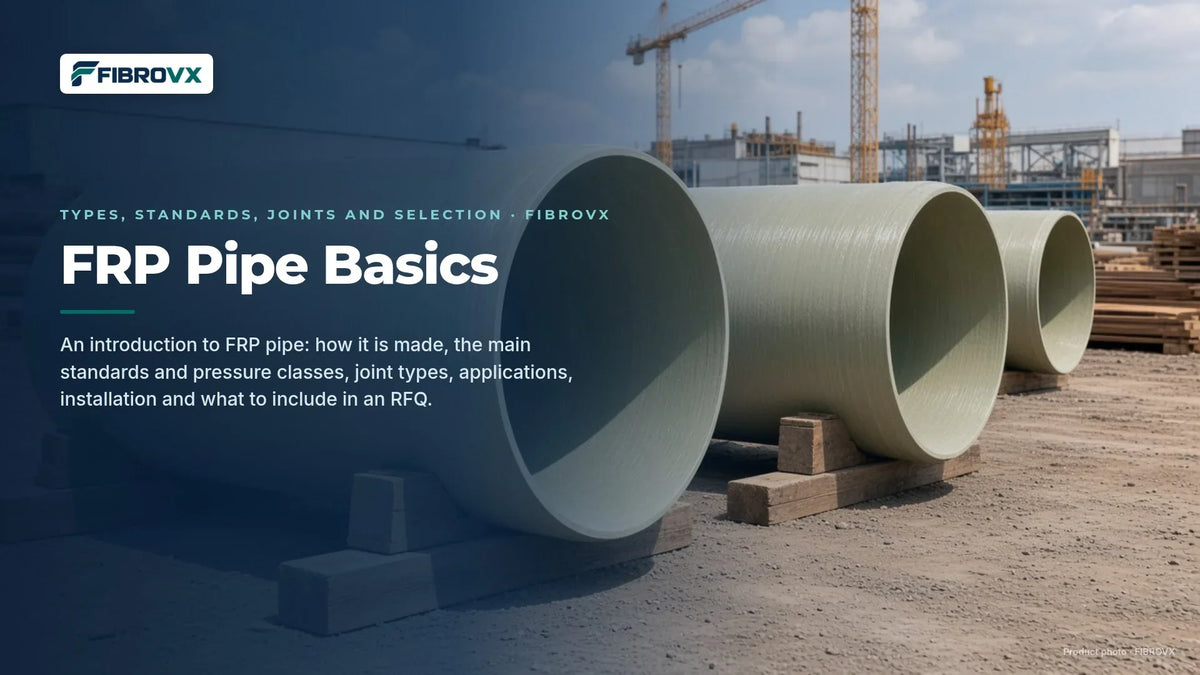
In short: FRP pipe (also called GRP or fiberglass pipe) is made from glass fibers and thermoset resin, usually by filament winding. It doesn't rust, it has a smooth bore that stays smooth over time, and it is much lighter than steel or ductile iron. Common standards include AWWA C950 for fiberglass pressure pipe in water service, with pressure classes from 50 to 450 psig in 50 psi steps, ASTM D2996 for filament-wound pipe, and ISO 14692 for petroleum and natural gas industries. Joints can be adhesive-bonded, flanged, or gasketed bell-and-spigot. Resin and liner are chosen for the fluid and temperature.


Where FRP pipe is used
- Chemical process lines and effluent
- Water and wastewater, including force mains and outfalls
- Desalination intakes, brine and seawater lines
- Cooling water circuits in power plants
- Fire water and seawater systems in oil and gas and offshore
- Scrubber recirculation and ducting
- Mining and fertilizer slurries (with abrasion-resistant liners)

How FRP pipe is made
Filament winding
Continuous glass rovings are wetted with resin and wound onto a rotating mandrel at controlled angles. A resin-rich liner with veil is applied first for corrosion resistance. Winding angle determines the balance of hoop (pressure) and axial strength. This is the most common method for industrial and pressure pipe. See How FRP Is Made.
Centrifugal casting
Resin, glass and sometimes fillers are placed inside a spinning mold. Centrifugal force compacts the wall. This method is used for some large-diameter gravity and pressure pipes.
Contact molding (fittings)
Elbows, tees and reducers are often hand laid-up or made with a combination of methods.
Key standards
| Standard | Scope |
|---|---|
| AWWA C950 (2025 edition) | Fiberglass pressure pipe for potable, raw and reclaimed water; nominal 1–156 in; pressure classes 50–450 psig in 50 psi increments |
| ASTM D2996 | Filament-wound fiberglass (glass-fiber-reinforced thermosetting resin) pipe |
| ISO 14692 | GRP piping in the petroleum and natural gas industries |
| BS EN 1796 / ISO 10639 | GRP pipe systems for water supply |
| BS EN 14364 / ISO 10467 | GRP pipe systems for drainage and sewerage |
When your project names a standard and pressure class, include it in your inquiry. We will confirm what we can design and test to. We don't claim third-party certification unless it is documented for your order.

Joint types
| Joint | Description | Typical use |
|---|---|---|
| Adhesive-bonded (taper/taper or socket) | Pipe ends bonded with adhesive | Process and industrial lines |
| Flanged | FRP flanges bolted together with gaskets | Connections to pumps, valves, tanks |
| Bell-and-spigot with elastomeric gasket | Push-fit, allows some movement | Water, sewer, buried lines |
| Laminated (butt-and-wrap) | Joint built up with glass and resin on site | Large diameters, repairs |
| Mechanical couplings | Sleeve couplings with gaskets | Some water and sewer lines |
See our FRP flanges.
Advantages
- Corrosion resistance inside and out, with no cathodic protection needed for the pipe itself
- Smooth bore with low friction losses that resists scaling in many services
- Light weight: lower transport and installation cost
- Non-conductive
- Long lengths, which means fewer joints
Limitations
- Lower stiffness: buried pipe design must consider soil support and deflection. Above-ground pipe needs proper support spacing.
- Temperature limits set by the resin
- Impact sensitivity: handle carefully and protect from point loads
- Thermal expansion greater than steel, so supports and anchors must allow for it
Installation basics
- Above ground: follow the manufacturer's support spacing; use wide, padded supports; anchor and guide for thermal expansion.
- Buried: use proper bedding and backfill, and compact as specified, since buried flexible pipe relies on side support from the soil.
- Joints: follow the bonding procedures, cure times and torque values exactly.
- Testing: hydrostatic testing according to the project specification.
RFQ checklist
- Fluid, concentration, temperature (normal and maximum) and pressure (including surge and vacuum)
- Diameter and length, and the routing drawing
- Standard and pressure class required
- Joint type and flange drilling standard
- Above ground or buried; soil and traffic loads for buried pipe
- Fittings list
- Quantity and destination port
Customization
FIBROVX manufactures FRP pipes and filament-wound products to order. Options include diameter, wall thickness, liner and resin, joint type, fittings and color. Browse the tanks, pipes and covers collection.
Need a quote or a drawing check?
FIBROVX manufactures FRP products in our own factory in China and builds every item to order: sizes, resin system, color, molds and OEM branding. Send your application, dimensions or drawing, quantity and destination port.
Request a QuoteHandling and installation tips
FRP pipe is light and easy to handle, but it needs care:
- Lift with fabric slings rather than chains or wire ropes, and avoid dropping pipes or striking them against hard objects.
- Store pipes on flat supports or timber bearers, away from sharp stones.
- Inspect pipe ends and liners for damage before joining.
- For buried pipe, follow the manufacturer's bedding and backfill requirements, because the soil supports the pipe.
- For above-ground pipe, support spacing, guides and anchors must allow for thermal expansion and the pipe's lower stiffness compared to steel.
- Pressure-test the completed line according to the project specification before putting it into service.
Key terms
- Liner: The resin-rich inner layer of the pipe wall that resists the conveyed fluid and gives a smooth bore.
- Structural wall: The filament-wound layer that carries internal pressure and external loads.
- Pressure class: The rated internal pressure for a pipe, as defined by the applicable standard.
- Stiffness class: A measure of the pipe's resistance to ring deflection, important for buried pipe.
- Bell-and-spigot: A joint where one pipe end (spigot) fits into the enlarged end (bell) of the next, sealed with a gasket.
- Mandrel: The rotating form onto which fibers are wound to make the pipe.
Catalog pipe range
- Sand-filled pipe (RPMP): DN300–2800
- Pressure classes: 0.6 / 1.0 / 1.6 MPa
- Stiffness classes: SN2500 / SN5000 / SN10000 (selected independently of pressure)
- Matching elbows, tees and reducers and flanges
See FRP piping systems and fitting and flange dimensions.
Watch: FRP Pipe Range in 27 Seconds
FAQ
What is the difference between FRP and GRP pipe?
None. Both describe glass-fiber reinforced thermoset pipe. See FRP vs GRP vs Fiberglass.
What pressure can FRP pipe handle?
It depends on the design. AWWA C950 covers pressure classes from 50 to 450 psi. Industrial and oil and gas pipe may be designed to other ratings under ISO 14692 or project specifications.
How is FRP pipe joined?
By adhesive bonding, flanges, gasketed bell-and-spigot joints, laminated joints or mechanical couplings, depending on the application.
Is FRP pipe suitable for hot fluids?
Within the resin's temperature limit. Tell us the maximum temperature, including upset conditions.
Is FRP pipe suitable for buried service?
Yes. FRP pipe is widely used for buried water and sewer lines. Buried FRP pipe is designed as a flexible pipe: the stiffness class and the bedding and backfill must be designed together.
Can FRP pipe be joined to steel or PVC pipe?
Yes, usually through flanged connections or suitable mechanical couplings. The joint must be designed for the pressure, temperature and any differences in thermal expansion.
Related guides
- FRP Storage Tanks Guide
- FRP Chemical Resistance Guide
- How FRP Is Made
- Technical Resources: datasheets and drawings on request
- FRP Pipe vs HDPE vs Steel Pipe for Corrosive Service
- FRP for Oil and Gas: Grating, Pipes and Tanks for Corrosive Sites
- Industries we serve
Sources
- AWWA, C950-25 "Fiberglass Pressure Pipe" (pressure classes 50–450 psig in 50 psi steps; 1–156 in): https://store.accuristech.com/standards/awwa-c950-25?product_id=3095611
- ASTM International, D2996 "Filament-Wound Fiberglass Pipe": https://store.astm.org/d2996-17.html
- ISO, ISO 14692 "Petroleum and natural gas industries – Glass-reinforced plastics (GRP) piping": https://www.iso.org/search.html?q=14692