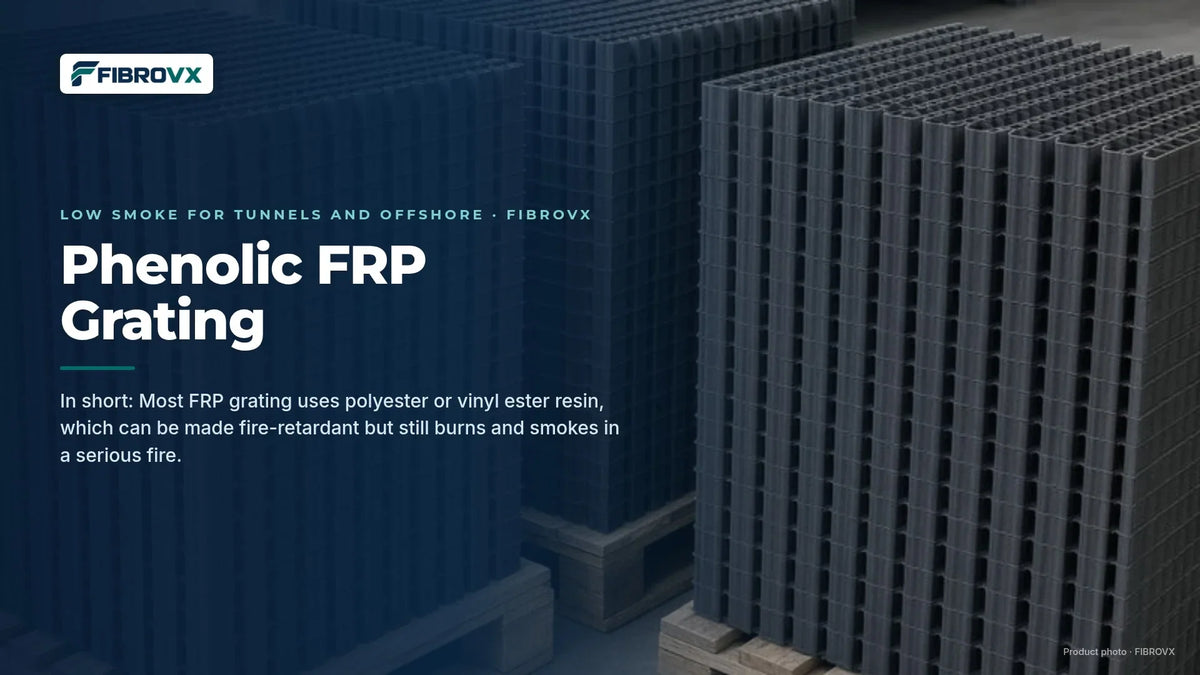
In short: Most FRP grating uses polyester or vinyl ester resin, which can be made fire-retardant but still burns and smokes in a serious fire. Phenolic resin behaves differently: it tends to form a carbon char, which slows burning and cuts smoke. A Newcastle University study found phenolic gratings took longer to ignite, gave off less flame and smoke and kept more strength after fire than polyester ones, though still below the target load at high heat. That is why phenolic is chosen where smoke and escape matter most: transit tunnels, offshore platforms and ships. Its limits are real: it is harder to make, its chemical resistance and colors differ from vinyl ester, and code approval depends on tests of the exact product. FIBROVX offers phenolic grating as custom / available on request.


How this guide fits with our others
This guide explains why and where to use phenolic grating. To read a fire test report, including ASTM E84 flame spread and smoke indexes, see FRP grating fire rating and ASTM E84. For resin basics, see polyester vs vinyl ester vs phenolic resin. Our pair article on data center cooling with FRP towers, pipes and grating covers a different setting where fire rules also shape FRP choices. Other sectors are on our industries page and emerging industries page.
Why smoke matters more than flame in some places
In open air, a grating fire is mainly a question of flame spread and structural strength. In an enclosed space, such as a rail tunnel, a ship's interior or an offshore module, smoke and toxic gases are often the bigger danger to people trying to escape. Rules for these places therefore look at smoke, toxicity and post-fire strength, not only flame spread.
How phenolic resin behaves in fire
Phenolic resins are thermosets made from phenol and formaldehyde. When heated, they tend to form a carbonaceous char rather than melting and dripping. The char shields the material underneath and holds the glass fibers together.
The 2013 study Post-fire integrity of composite gratings for offshore platforms (Journal of Reinforced Plastics and Composites, Newcastle University) tested pultruded phenolic/glass and polyester/glass gratings:
- The target: a load equal to a running person carrying a load, 150 kg combined, so that offshore workers and fire teams could walk on the grating after a fire.
- The exposure: beam elements were heated by a propane burner at 12.5, 37.5 and 100 kW/m² for up to 16 minutes, then tested for residual strength.
- The result: phenolic gratings showed longer ignition times, lower flame and smoke emission and greater post-fire strength than polyester ones.
- At 12.5 kW/m², all gratings stayed serviceable beyond 16 minutes.
- At higher heat fluxes, phenolic gratings kept some strength, helped by the char binding the fibers, but this was somewhat below the target level.
The honest reading: phenolic is clearly better than polyester in fire, but it is not fireproof, and post-fire strength must be proven by test for each use.
An example of published phenolic test data
To show the kind of values phenolic grating can reach, here is one manufacturer's published data for its pultruded phenolic grating. These are that maker's figures, not FIBROVX figures:
- ASTM E84 flame spread index of 5 or less and smoke developed index of 45 or less (non-UV-coated)
- UL 94 classification V-0
- NFPA 268 / ASTM E662 smoke density Ds at 4 minutes: 1.96 (flaming), 0 (non-flaming)
- Products of combustion in a toxicity test: 0 ppm hydrogen chloride and cyanides, 35 ppm carbon monoxide
For comparison, ASTM F3059's lowest marine grating level (L0) allows a flame spread index up to 20 and a smoke developed index up to 450 by ASTM E84. Any grating you buy must be tested in its own final form; never rely on another maker's data.

Tunnels and transit: NFPA 130
NFPA 130, Standard for Fixed Guideway Transit and Passenger Rail Systems, covers fire and life safety in stations, trainways and vehicles. Its objectives include protecting occupants while they evacuate and keeping structural integrity of stations and trainways for the time needed to evacuate.
Several NFPA 130 provisions call for noncombustible materials. In the 2023 edition, a material is noncombustible if, in the form used, it will not ignite, burn, support combustion or release flammable vapors in fire, or if it passes ASTM E136 at 750 °C. Ordinary polyester or vinyl ester FRP does not meet this.
Phenolic has been used to bridge that gap. A 2024 American Composites Manufacturers Association (ACMA) presentation on New York's Canarsie Tunnel rehabilitation describes FRP shells and shrouds that had to meet NFPA 130's noncombustible requirements. The manufacturer adapted its vacuum infusion process to use phenolic resin, with heated tooling and oven post-cure. The same presentation notes that epoxy-based FRP strengthening systems would likely not have met those requirements.
What this means: in a tunnel, the exact NFPA 130 clause, the authority having jurisdiction and the test report decide whether a phenolic grating or walkway can be used. Phenolic is the resin most likely to qualify among FRP options, but it is not automatic.
Offshore and marine: ASTM F3059 and USCG
ASTM F3059 covers FRP gratings in marine construction and shipbuilding. It applies to machinery spaces, cargo areas and on-deck areas, but not to accommodation, service and control spaces or other areas where smoke and toxicity are a concern. It defines structural fire integrity levels:
- Level 1 (L1): the highest level, for escape routes or areas where firefighting, emergency or rescue access is needed after a significant fire.
- Level 2 (L2): for areas where people may gather after the grating has been exposed to fire, such as temporary safe refuge or lifeboat embarkation stations; tested for post-fire load.
- Level 3 (L3): for egress routes or access during or shortly after a very limited fire not likely involving flammable liquids.
- Level 0 (L0): no fire integrity; ASTM E84 flame spread up to 20 and smoke developed up to 450, for walkways, catwalks and platforms in places such as cargo holds and tanks.
The structural criteria were developed by comparison with steel gratings rated for 4.5 kN/m² (94 lbf/ft²). The US Coast Guard's CG-ENG Policy Letter 01-18 requires ASTM F3059 in place of its older Policy File Memorandum on FRP gratings (PFM 2-98).
Classification societies issue their own type approvals. One published ABS type approval for an FRP grating line lists L2, L3 and L0 ratings to ASTM F3059 for open decks, ballast tanks, void spaces and pipe tunnels. Approvals are for named products and makers; they do not transfer.
Where phenolic grating is used

- Transit tunnels and stations: walkways, cable trough covers and shrouds where NFPA 130 or local codes require noncombustible or low-smoke materials.
- Offshore platforms: escape routes, muster areas and wellhead decks, where fire integrity levels apply.
- Ships and vessels: machinery spaces and open decks under ASTM F3059.
- Industrial plants: escape routes in refineries or chemical plants where an owner wants better fire behavior than fire-retardant polyester.
Phenolic or fire-retardant resin: how to choose
Many projects do not need phenolic. Fire-retardant polyester or vinyl ester grating can meet common flame spread targets in open industrial areas. Use these questions to decide:
- Is the space enclosed? Tunnels, ship interiors and enclosed modules make smoke the main risk. That points toward phenolic.
- Is the grating on an escape or rescue route? If people or fire teams must walk on it during or after a fire, a structural fire integrity level such as ASTM F3059 L1, L2 or L3, or an owner's post-fire load test, may apply.
- Does the code ask for noncombustible material? If so, the product must pass the named test, such as ASTM E136. Standard FRP will not; phenolic may, but only with test proof.
- What chemicals will it see? If strong acids or solvents are present, compare phenolic chemical data with vinyl ester; the fire choice must not create a corrosion problem.
- Is the area open air and outside escape routes? Fire-retardant polyester or vinyl ester is often enough, at shorter lead time.
Write the answer into the specification: the rule, the test, the level and who approves it. That avoids a late change when the authority or class surveyor reviews the design.
Installation and upkeep notes
- Fixings. Use stainless clips and fasteners suited to the site; see FRP grating clips.
- Cut edges. Seal field cuts with the resin the maker specifies, so the panel keeps its tested make-up.
- Coatings. Do not paint or coat phenolic grating without checking the fire report. As that maker's figures show, a UV coating changed the E84 result from 5/45 to 10/250.
- Damage after a fire. Any grating exposed to fire must be inspected and usually replaced, even if it held its load.
- Records. Keep test reports and approvals with the as-built file for inspectors.
Honest limits of phenolic grating
- Not fireproof. The Newcastle study found post-fire strength below target at high heat flux. Steel may still be required in some escape routes.
- Approval is product-specific. Each grating must be tested and approved in its final form. FIBROVX makes no ASTM F3059, USCG, classification or NFPA 130 claim for phenolic grating.
- Harder to make. Phenolic parts need controlled curing; the Canarsie project needed heated tooling and oven post-cure.
- Chemical resistance differs. Phenolic is chosen for fire behavior. For strong chemicals, compare its chemical data with vinyl ester before choosing.
- Color and finish. Phenolic parts are usually dark and may need a coating for UV or color, which can change fire results, as that maker's data (10/250 coated vs 5/45 uncoated) shows.
- Lead time. Phenolic grating is a special order, not stock.
What to send for a quote
- The governing rule (NFPA 130 clause, ASTM F3059 level, owner specification)
- Spans, loads and deflection limits
- Panel sizes and layout drawings
- Surface (grit) and color needs
- Chemical exposure
- Testing or third-party approval you will require
How we customize phenolic grating
For phenolic grating we work from your rule and layout: panel sizes, bar depth, mesh, grit surface and fixings. Testing to the standard you name can be arranged for the final product. Phenolic grating and related phenolic profiles are custom / available on request. For standard fire-retardant grating, see our FRP molded grating and FRP pultruded profiles, and our grating, profiles and access range.
Need a quote or a drawing check?
FIBROVX manufactures FRP products in our own factory in China and builds every item to order: sizes, resin system, color, molds and OEM branding. Send your application, dimensions or drawing, quantity and destination port.
Request a QuoteFire references at a glance
| Reference | What it covers | Key value |
|---|---|---|
| ASTM E84 (published phenolic data) | Flame spread / smoke developed | ≤ 5 / ≤ 45 uncoated; 10 / 250 with UV coating |
| ASTM E662 / NFPA 268 | Smoke density Ds at 4 min | 1.96 flaming; 0 non-flaming |
| ASTM F3059 L0 | Lowest marine level | Flame spread ≤ 20; smoke developed ≤ 450 |
| ASTM F3059 L1 / L2 / L3 | Structural fire integrity levels | Compared with steel gratings rated 4.5 kN/m² |
| NFPA 130 (2023) | Noncombustible definition | Passes ASTM E136 at 750 °C |
| Newcastle 2013 study | Post-fire integrity | Serviceable beyond 16 min at 12.5 kW/m² |
FAQ
Why does phenolic grating make less smoke?
Phenolic resin tends to char instead of burning freely, and research found lower flame and smoke emission than polyester grating.
Is phenolic grating noncombustible?
Not automatically. It must pass the test the code names, such as ASTM E136 for NFPA 130 noncombustibility.
What is an L2 or L3 grating?
They are ASTM F3059 structural fire integrity levels for marine FRP grating: L2 for post-fire assembly areas, L3 for egress during a limited fire.
Can I use phenolic grating in ship accommodation spaces?
ASTM F3059 does not cover accommodation, service and control spaces where smoke and toxicity are a concern.
Is phenolic as chemical resistant as vinyl ester?
Not in the same way. Compare chemical data for your service.
Do you supply certified phenolic grating?
We make no certification claim. Phenolic grating is custom / available on request, and testing can be arranged.
Related: FRP for Offshore and Marine: GRP Grating, Handrail and Ladders; FRP for Rail and Metro: Cable Troughs, Walkways and Signage Posts; Custom FRP Manufacturing: Sizes, Resins, Colors, Molds and OEM Explained.
Sources
- Post-fire integrity of composite gratings for offshore platforms, Journal of Reinforced Plastics and Composites, 2013 (Newcastle University): https://eprints.ncl.ac.uk/191979
- ASTM F3059, Fiber-Reinforced Polymer (FRP) Gratings Used in Marine Construction and Shipbuilding (scope; L0–L3; 4.5 kN/m²): https://www.vergalhaoboafibra.com.br/uploads/ASTM-F3059.pdf
- SAFETY4SEA, USCG publishes guidance on FRP gratings (Policy Letter 01-18 replaces PFM 2-98): https://safety4sea.com/uscg-publishes-guidance-on-fiber-reinforced-plastic-gratings/
- NFPA 130, 2023 edition preview (objectives; noncombustible material definition): https://nfpanorm.com/wp-content/preview/130%202023.pdf
- ACMA Composites Technology Day, Specialty applications of FRP composites on heavy civil/infrastructure projects (Canarsie Tunnel phenolic shrouds): https://acmanet.org/wp-content/uploads/2024/02/B3-Blaszak-CI-Tech-Day-Presentation-Blaszak-FINAL.pdf
- A US FRP grating manufacturer, phenolic grating brochure (example manufacturer test data)
- ABS Confirmation of Product Type Approval for one US manufacturer's FRP grating (ASTM F3059 L2, L3, L0)