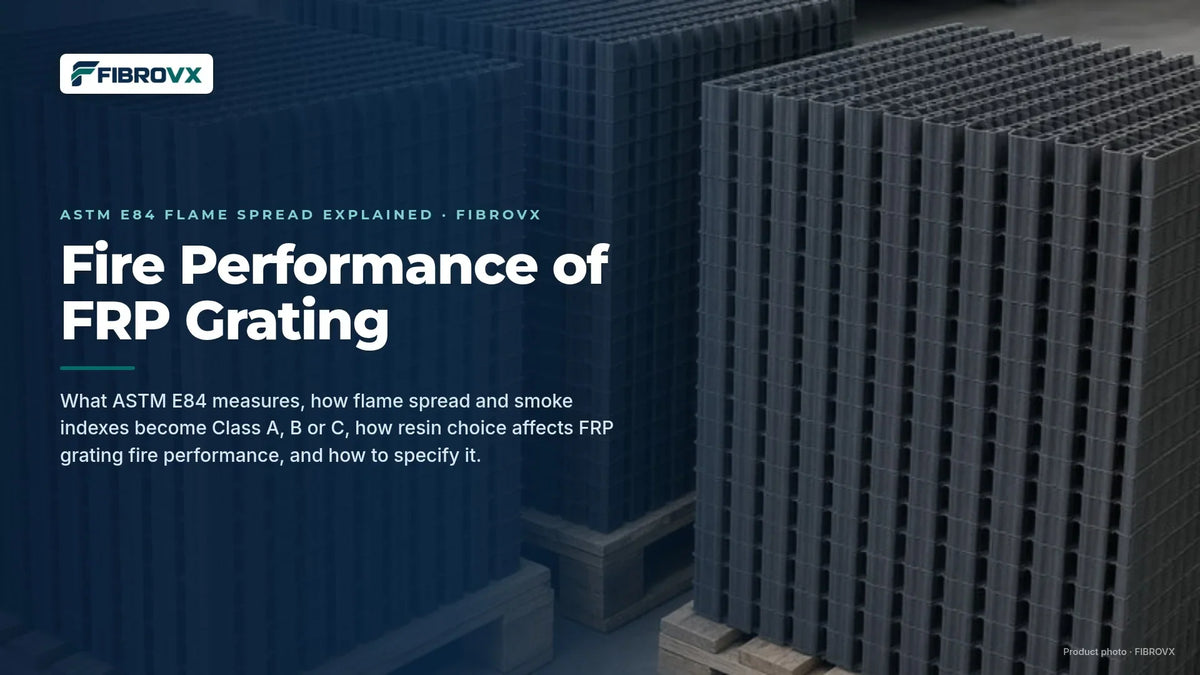
In short: ASTM E84 (also published as UL 723) is the "tunnel test" used in North America to compare how flame spreads across the surface of building materials. It gives a flame spread index (FSI) and a smoke developed index (SDI). Building codes group FSI into classes: Class A is 0–25, Class B is 26–75 and Class C is 76–200. FRP grating made with fire-retardant resin is commonly specified for a low flame spread rating. Ratings belong to a tested product, so always ask for the test report for the exact grating. FIBROVX makes grating with fire-retardant resin systems to order.


What ASTM E84 measures
The test uses a horizontal tunnel about 25 ft (7.6 m) long. A sample forms the ceiling of the tunnel, a gas burner ignites one end, and the test runs for 10 minutes. The lab measures how far and how fast the flame front travels and how much smoke passes the exhaust. Results are compared with reference materials: inorganic reinforced cement board is set at 0 and red oak flooring at 100.

Flame spread classes
| Class | Flame spread index | Notes |
|---|---|---|
| Class A (I) | 0–25 | Lowest flame spread |
| Class B (II) | 26–75 | |
| Class C (III) | 76–200 |
Codes such as the International Building Code and NFPA 101 use these classes for interior finishes and usually also limit the smoke developed index, commonly to 450. Which class is required depends on the code, the occupancy and where the material is used.
Worked example: reading a test report
Suppose two grating products have ASTM E84 reports. The numbers below are hypothetical and show only how to read the results.
| Report | Flame spread index | Smoke developed index | Class | Meets "Class A, SDI 450 max"? |
|---|---|---|---|---|
| Grating 1 | 15 | 300 | A | Yes |
| Grating 2 | 20 | 550 | A | No; smoke is over the limit |
| Grating 3 | 35 | 250 | B | No; flame spread is over 25 |
Grating 2 shows why the smoke index matters. It is Class A for flame spread but fails a specification that also limits smoke. Grating 3 has low smoke but falls in Class B.
When you read a report, also check:
- the product description: grating type, depth, mesh and resin must match what you are buying;
- the specimen mounting: ASTM E84 gives guidance on mounting methods, and the method can affect results, so the report should state it;
- the test date and laboratory, and whether the report is complete or only a summary.
Where the classes are used in codes
ASTM E84 classes are best known from building codes. In the International Building Code (IBC), Section 803 uses ASTM E84 or UL 723 to classify interior wall and ceiling finishes, and Table 803.13 sets the class needed by occupancy and location. Interior floor finishes are handled differently. IBC Section 804 classifies them by critical radiant flux, tested to NFPA 253 (ASTM E648 is the equivalent test), into Class I and Class II.
Industrial grating on a platform is often outside these interior-finish rules. But owners and engineers still write an ASTM E84 limit into grating specifications, because it is a well-known way to compare products. So the requirement usually comes from the project specification, not from the code table. Read the exact clause, and ask the engineer if it is unclear which test applies.
How resin affects fire performance
Standard polyester and vinyl ester resins burn. Fire performance improves with:
- fire-retardant resin formulations and additives;
- phenolic resin, which is used where low smoke and low toxicity matter, such as tunnels and offshore.
Fire-retardant additives can affect other properties, such as color or chemical resistance, so the resin choice balances fire and service needs. See polyester vs vinyl ester vs phenolic resin.
Other fire tests
ASTM E84 is not the only test. Projects may refer to:
- ASTM E84 / UL 723 in North America;
- EN 13501-1 reaction-to-fire classes in Europe;
- IMO and USCG rules for marine and offshore grating;
- smoke and toxicity tests for tunnels and enclosed spaces.
Check which test your project requires before ordering.

Marine and offshore: ASTM F3059
For ships and marine construction, ASTM F3059 is the specification for FRP gratings. The US Coast Guard Policy Letter 01-18 requires ASTM F3059 for the testing and approval of FRP gratings, in place of the older Policy File Memorandum PFM 2-98.
ASTM F3059 adds structural fire integrity tests on top of surface flammability. It defines levels:
| Level | Intended use (summary) |
|---|---|
| L1 | Highest level; escape routes and areas needing access for firefighting or rescue after a significant fire |
| L2 | Areas where people may assemble after a fire, such as temporary safe refuge or lifeboat embarkation stations |
| L3 | Egress and access routes during or shortly after a very limited fire |
| L0 | No fire integrity level; ASTM E84 flame spread index 20 or less and smoke developed index 450 or less |
Note that the L0 limit on flame spread (20) is tighter than the Class A limit (25). If your project is marine or offshore, state the ASTM F3059 level and the flag or class authority rules that apply.
Comparing common fire tests
| Test | What it does | Typical result |
|---|---|---|
| ASTM E84 / UL 723 | 25 ft tunnel; flame spread across the surface | Flame spread index and smoke developed index |
| NFPA 253 / ASTM E648 | Radiant panel test for floor coverings | Critical radiant flux; Class I or II |
| EN 13501-1 | European reaction-to-fire classification | Classes A1 to F; floorings A1fl to Ffl; smoke and droplet sub-classes |
| ASTM F3059 | Marine FRP grating specification | Fire integrity level L0 to L1 |
| ASTM D635 | Small-bar horizontal burning test for plastics | Burning rate and extent |
A result from one test does not convert into another. A Class A E84 report does not give a European class, and a European class does not satisfy an E84 clause. If a project names more than one test, each one needs its own report.
How to specify
- the test standard (for example ASTM E84);
- the required flame spread class or index limit;
- any smoke developed limit;
- the resin system, or ask the supplier to propose one;
- a test report covering the exact product type, resin and depth.
Sample specification wording
A clear clause looks like this:
FRP grating shall have a flame spread index of 25 or less and a smoke developed index of 450 or less when tested in accordance with ASTM E84. The supplier shall provide a test report for the same grating type, resin system and depth.
Change the numbers, the test and the product description to suit your project. Avoid the words "fire rated" or "fireproof" on their own, because they do not say which test or limit applies.
Fire performance and other properties
Fire-retardant systems can change other properties, so confirm the whole package:
- Chemical resistance. Some fire-retardant formulations behave differently in chemical service. Check the resin maker's guidance for your chemicals.
- Color. Additives can limit the colors available. Agree the color with a sample.
- UV exposure. Outdoor grating should have UV protection whatever the resin.
- Smoke and toxicity. Where smoke and toxic gases matter, such as tunnels or enclosed spaces, phenolic resin is often considered.
Customization
FIBROVX makes FRP molded grating with standard and fire-retardant resin systems, in the depth, mesh, color and surface you need. Tell us the fire test and class your project requires and we will propose a resin system.
Need a quote or a drawing check?
FIBROVX manufactures FRP products in our own factory in China and builds every item to order: sizes, resin system, color, molds and OEM branding. Send your application, dimensions or drawing, quantity and destination port.
Request a QuoteCommon mistakes
- Writing "fire rated" without a test or class.
- Assuming all FRP grating is Class A. It depends on the resin.
- Ignoring smoke limits.
- Accepting a report for a different product.
- Assuming one test covers another. E84, EN 13501-1 and ASTM F3059 are separate.
- Missing the floor-finish rules. Interior floor finishes use the radiant panel test in the IBC.
Key terms
- Flame spread index (FSI): Number from ASTM E84 showing how fast flame spreads.
- Smoke developed index (SDI): Number from ASTM E84 showing how much smoke is produced.
- Fire-retardant resin: Resin formulated to slow burning.
- UL 723: UL's edition of the same tunnel test.
Watch: FRP Grating ASTM E84 Fire Ratings in 27 Seconds
FAQ
What does Class A mean for FRP grating?
A flame spread index of 0 to 25 in the ASTM E84 test.
Is FRP grating fireproof?
No. FRP is combustible, but fire-retardant resins can give low flame spread ratings.
Is ASTM E84 the same as UL 723?
They describe the same tunnel test method.
Does Europe use ASTM E84?
Europe generally uses EN 13501-1 reaction-to-fire classes.
What smoke developed index is usually required?
Many codes and specifications use a smoke developed index of 450 or less together with the flame spread class. Check your project documents.
Which fire standard applies to FRP grating on ships?
ASTM F3059. US Coast Guard Policy Letter 01-18 requires it for FRP gratings in place of PFM 2-98.
Can FIBROVX make grating for a specific fire requirement?
Yes. We make grating with standard and fire-retardant resin systems. Tell us the test and limit, and we will propose a resin and tell you clearly what test documents are available for it.
Does grating depth change the fire result?
It can. A report applies to the tested construction, so ask for one that covers the grating type, resin and depth you are buying.
Related guides
- FRP Grating Guide
- Polyester vs Vinyl Ester vs Phenolic Resin
- FRP Grating RFQ Checklist
- FRP Grating Thickness Selection
- Industries we serve
- Phenolic FRP Grating: Low Smoke for Tunnels and Offshore
Sources
- ASTM E84, Standard Test Method for Surface Burning Characteristics of Building Materials: https://www.astm.org/e0084-23.html
- UL 723, Test for Surface Burning Characteristics of Building Materials: https://www.shopulstandards.com/ProductDetail.aspx?productId=UL723
- International Code Council, IBC Chapter 8, Interior Finishes: https://codes.iccsafe.org/content/IBC2021P2/chapter-8-interior-finishes
- ASTM F3059, Fiber-Reinforced Polymer (FRP) Gratings Used in Marine Construction and Shipbuilding: https://www.astm.org/standards/f3059.htm
- SAFETY4SEA, USCG Policy Letter 01-18 on FRP gratings (replaces PFM 2-98 with ASTM F3059): https://safety4sea.com/uscg-publishes-guidance-on-fiber-reinforced-plastic-gratings/
- ASTM E648, Critical Radiant Flux of Floor-Covering Systems Using a Radiant Heat Energy Source: https://www.astm.org/e0648-19ae01.html
- ASTM D635, Rate of Burning and/or Extent and Time of Burning of Plastics in a Horizontal Position: https://www.astm.org/d0635-22.html