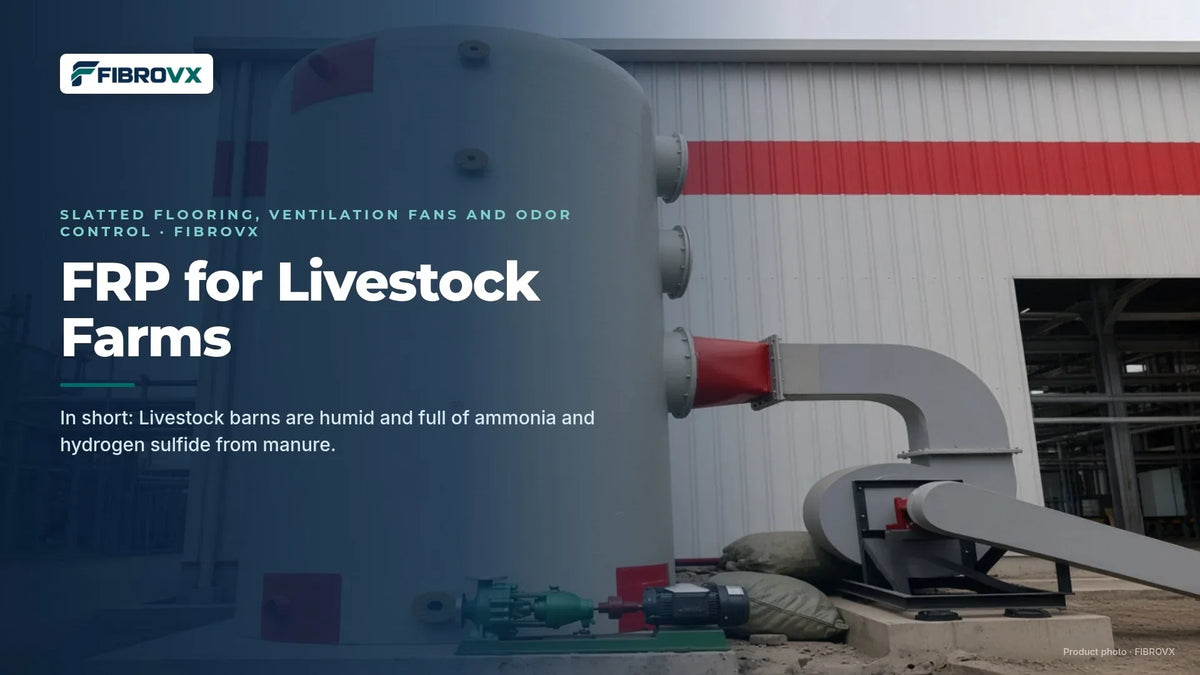
In short: Livestock barns are humid and full of ammonia and hydrogen sulfide from manure. Extension guidance warns that moisture and manure gases make steel rust, galvanized metal corrode and copper parts disintegrate, and it lists fiberglass among the materials that last. That is why FRP is a good fit for barn ventilation fans, odor control units and other wet-area parts. University of Minnesota Extension reports that biofilters can cut barn odor and hydrogen sulfide by as much as 95% and ammonia by about 65%. FIBROVX makes FRP fans, bio-deodorization units and daylight roofing sheets. Slatted flooring for animals is a future category: custom and available on request, designed to the welfare rules and loads of each project.


Why barns are hard on equipment
A livestock barn combines moisture, dust and manure gases around the clock:
- Ammonia from urine and manure, which is corrosive.
- Hydrogen sulfide from stored manure, toxic and corrosive, released in large amounts when pits are agitated or pumped.
- High humidity from animals, washing and evaporative cooling.
- Dust and manure that coat surfaces and hold moisture against them.
- Frequent washing with pressure washers and disinfectants.
Washington State University Extension's guide on hog-barn fans puts it plainly: moisture and manure gases will cause steel to rust, galvanized metal to corrode and copper in thermostats, switches and exposed wires to disintegrate. It shows fan hoods on one barn rusted through in about three years. The same guide says most plastics, fiberglass, aluminum, stainless steel, or steel kept clean and painted, should last at least 10 years.
Where FRP fits on a livestock farm

| Location | FRP item | Catalog status |
|---|---|---|
| Walls, pits, roof | Exhaust and circulation fans | FRP fans |
| Exhaust air | Biofilter / bio-deodorization unit | Bio-deodorization units |
| Roof | Daylight panels | Transparent roofing sheets |
| Walkways, pits, drains | Grating and covers | Molded grating, custom covers |
| Animal pens | Slatted flooring | Custom, available on request |
| Structures | Brackets, frames, purlins | Pultruded profiles, purlins |
Ventilation fans
Ventilation is the core of barn climate control. It removes moisture, heat and gases. Kansas State University's fan guidance recommends that, when ordering new fans for livestock buildings, buyers consider fans built of fiberglass, stainless steel, plastic or epoxy-coated housings. It also recommends totally enclosed (TE) motors so washing water and dirt cannot get into the windings.
Our FRP fans come in centrifugal and axial designs, including wall and roof-mounted types. For a barn, tell us the airflow and static pressure, the gas environment, the mounting and the motor voltage and frequency for your country. Fan sizing for animals is set by the barn's ventilation design; we build the fan to that duty. See our FRP fans selection guide.
Odor control with biofilters
Odor is often what neighbors notice first. University of Minnesota Extension reports that biofiltration can reduce odor and hydrogen sulfide from livestock and poultry facilities by as much as 95% and ammonia by 65%. A biofilter passes barn exhaust air through a moist bed of organic media, usually compost and wood chips, where microbes break down the odor compounds.
Two design factors matter most, according to the same guide: the contact time the air spends in the media, and the moisture content of the media. In its dairy case study, performance dropped when the media dried out. Biofilters are easiest to fit on mechanically ventilated barns or on pit fans.

Our FRP bio-deodorization units are enclosed biofilter units with a moist media bed. Our product page lists food and agricultural processing among typical uses. For an inquiry, tell us the airflow, the odor compounds such as hydrogen sulfide and ammonia, the footprint and the water and drainage available. Read biofilter vs chemical scrubber to compare technologies.
Daylight roofing
FRP transparent roofing sheets bring natural light into barns and match common metal roof profiles. Agricultural buildings are a listed use. See FRP transparent roofing sheets.
Slatted flooring: custom, on request
Slatted floors let manure fall through into a pit or channel below. Most are concrete, plastic or metal. FRP slatted flooring is not a catalog item. We can review custom designs on request, but animal flooring has strict rules.
Welfare rules. In the European Union, Directive 2008/120/EC sets dimensions for concrete slatted floors for pigs kept in groups:
| Pig category | Max opening width | Min slat width |
|---|---|---|
| Piglets | 11 mm | 50 mm |
| Weaners | 14 mm | 50 mm |
| Rearing pigs | 18 mm | 80 mm |
| Gilts after service and sows | 20 mm | 80 mm |
These figures apply to concrete slats in the EU. Other countries, species and materials have their own rules and codes of practice. Any FRP floor would have to be designed to the rules that apply to your farm, which usually means openings and slat widths quite different from industrial grating. Standard molded grating is not an animal floor.
Loads and grip. Animal floors need to carry the animals, equipment and people, resist hoof wear, and give secure footing when wet. Those requirements are set per project with the farm's designer.
If you want to explore FRP slats, send the species and weight range, the applicable welfare rules, the pen layout, spans and the manure system. We will say honestly whether a custom FRP design is practical.
Manure gas safety
Any work around slatted floors and manure pits must respect manure gas hazards:
- Hydrogen sulfide is the most hazardous manure gas, according to a USDA NRCS fact sheet; its threshold limit value is 10 ppm, and lethal concentrations of 500 to 600 ppm are hard to detect by smell.
- Gas levels can increase a thousandfold during agitation and emptying, the same fact sheet notes.
- Ontario's agriculture ministry advises keeping at least 30 cm (1 ft) between the manure surface and the bottom of the slats, and not agitating until there are at least 60 cm (2 ft).
- Never enter a manure pit without proper testing, equipment and training.
FRP equipment does not change these rules. Install and maintain barn equipment only with the gas safety procedures in place.
Getting custom FRP for a farm
- Describe the barn. Species, numbers, ventilation type, climate.
- Define the duty. Fan airflow and static pressure; biofilter airflow and gases; roof profile.
- State the rules. Welfare, building and electrical requirements.
- Send drawings and quantities.
- Review the quotation. Resin, design and test data are confirmed in writing.
Every FIBROVX item is made to order. Product pages include reference properties and load examples. The specification and any required test or certification evidence must be confirmed for the quoted item. See custom FRP manufacturing and Emerging Industries.
Need a quote or a drawing check?
FIBROVX manufactures FRP products in our own factory in China and builds every item to order: sizes, resin system, color, molds and OEM branding. Send your application, dimensions or drawing, quantity and destination port.
Request a QuoteCommon mistakes
- Galvanized fans in pit exhaust. They corrode fast in manure gases.
- Open motors. Use totally enclosed motors in washed barns.
- Dry biofilter media. Performance drops when the media dries out.
- Using industrial grating as animal flooring. Animal floors follow welfare rules.
- Ignoring gas safety during pit work. Agitation releases dangerous hydrogen sulfide.
Key terms
- Biofilter: A bed of moist organic media that treats odorous air using microbes.
- Contact time: How long air stays in the biofilter media.
- Slatted floor: A floor with gaps that let manure pass into a pit or channel.
- Totally enclosed (TE) motor: A motor sealed against water and dirt.
FAQ
Are fiberglass fans good for livestock barns? Yes. Extension guidance lists fiberglass among the materials that resist barn corrosion and recommends considering fiberglass housings when buying new fans.
How much can a biofilter reduce barn odor? University of Minnesota Extension reports up to 95% for odor and hydrogen sulfide and about 65% for ammonia, depending on design and media moisture.
Do you sell FRP slatted floors? Not as a catalog item. Custom designs are available on request, built to the welfare rules that apply to your farm.
Can FRP grating be used as animal flooring? Standard grating is not designed as animal flooring. Animal floors must meet welfare rules for openings, slat widths and footing.
Can you supply fans and a biofilter together? Yes. We quote fan, ducting and unit packages to your design.
Related guides
- FRP Fans Selection Guide
- Biofilter vs Chemical Scrubber
- FRP Transparent Roofing Sheets
- FRP Purlins for Corrosive Roofs
- Vertical Farming and Aquaculture: FRP Tanks, Grating and Racks
Sources
- Washington State University Extension, Maintenance and Operation of Ventilation Fans for Hog Barns: http://hdl.handle.net/2376/12644
- Kansas State University, Fan Selection and Maintenance: http://hdl.handle.net/2097/21648
- University of Minnesota Extension, Biofilter Design Information: http://hdl.handle.net/11299/212362
- Directive 2008/120/EC, minimum standards for the protection of pigs, Article 3 (legislation.gov.uk copy): https://www.legislation.gov.uk/eudr/2008/120/body/adopted/data.html
- USDA NRCS Pennsylvania, Safety and Emergency Response for Manure Management Systems: https://www.nrcs.usda.gov/sites/default/files/2022-08/NRCS-PA-ENG-FS-10%20Safety_and_emergency_response-_%2310_Final.pdf
- Ontario Ministry of Agriculture, Food and Agribusiness, Hazardous gases on agricultural operations: https://www.ontario.ca/page/hazardous-gases-agricultural-operations