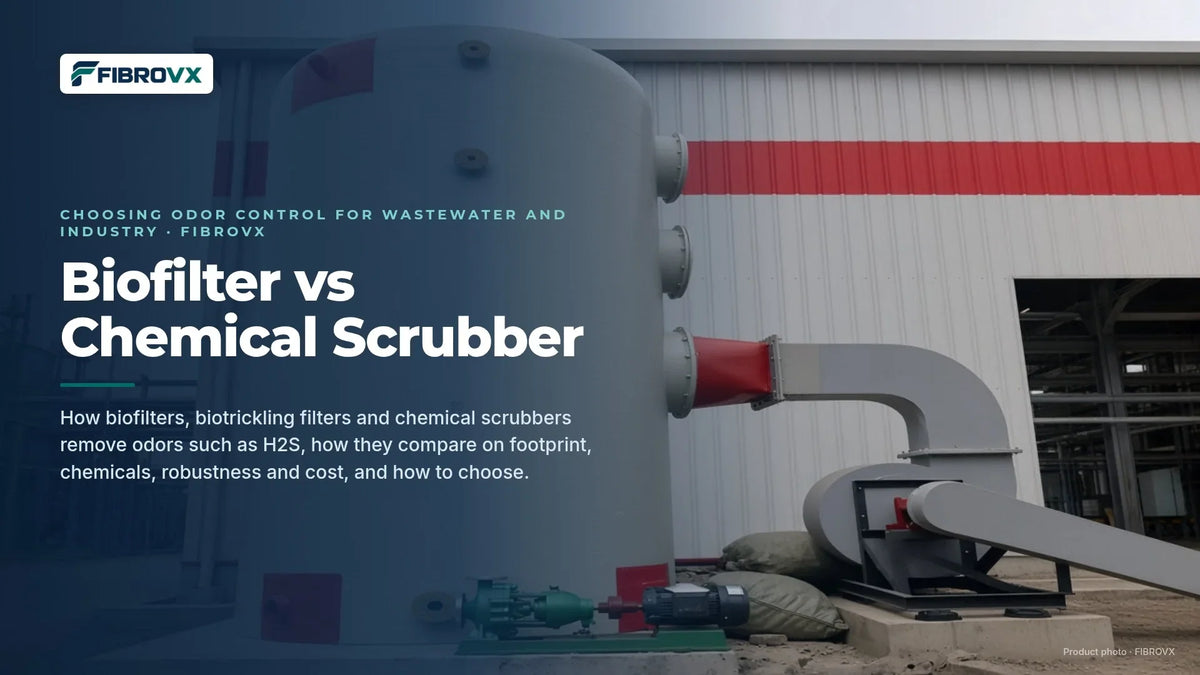
In short: Chemical scrubbers absorb odorous gases into a liquid dosed with chemicals such as sodium hydroxide and sodium hypochlorite. They are compact and robust, with short gas residence times, but they need ongoing chemical supply and handling. Biofilters pass air through a moist bed of organic or inorganic media where microbes oxidize the odorants. They use few chemicals and have low running costs, but need more space. Biotrickling filters sit in between: inert packing with recirculated water supports microbes, in a more compact unit. One full-scale review found average empty-bed residence times of about 48 s for biofilters versus about 20 s for chemical scrubbers. Choose by odor load, footprint, chemical handling preferences and life-cycle cost.


The odor problem
Odors at wastewater plants, pumping stations, sludge facilities, composting sites and many industries come mainly from hydrogen sulfide (H2S), ammonia, mercaptans and other sulfur and organic compounds. H2S has a very low odor threshold and is also toxic and corrosive. Odor control systems collect air from covered sources and treat it before discharge.

How each technology works
Chemical scrubber
Air flows up through a packed tower against a recirculating scrubbing liquid. For H2S, the liquid is usually sodium hydroxide, often with sodium hypochlorite as an oxidant. For ammonia, it is dilute acid. Multi-stage scrubbers treat mixed odors. Chemical scrubbers are among the most mature odor treatment techniques, and can operate at gas retention times as low as about 1–2.5 s according to a 2021 review in Water. See our FRP Scrubbers Guide and FRP acid fume scrubbers.
Biofilter
Humidified air passes through a bed of media such as compost, bark, peat or engineered inorganic media. A biofilm of microorganisms on the media oxidizes H2S and organic odorants. Moisture, pH and temperature must be maintained, and media is replaced periodically.
Biotrickling filter
Air passes through inert packing (plastic or inorganic) while water is continuously or intermittently trickled over it. Microbes grow on the packing, and the recirculating liquid supplies moisture and nutrients and removes by-products such as sulfuric acid from H2S oxidation. Biotrickling filters are more compact than biofilters. In a well-known study, an existing chemical scrubber was converted to a biotrickling filter that treated H2S at gas contact times of about 1.6–2.2 s (Gabriel and Deshusses, PNAS 2003).
See our FRP bio-deodorization units.
Residence time and footprint
Residence time (empty bed residence time, EBRT) is the media volume divided by air flow. It largely sets the size of the unit. A 2021 review of full-scale odor treatment at wastewater plants (Senatore et al., Water 13(24):3503) reported average EBRTs of:
| Technology | Average EBRT (full-scale data) |
|---|---|
| Biofilter | 48 ± 30 s |
| Biotrickling filter | 22.2 ± 26.2 s |
| Chemical scrubber | 20 ± 8.1 s |
| Bioscrubber | 7.5 ± 2.5 s |
These are averages across reported installations, not design values. A larger EBRT means a larger media volume and footprint, which is why biofilters usually need the most space.

Side-by-side comparison
| Factor | Biofilter | Biotrickling filter | Chemical scrubber |
|---|---|---|---|
| Footprint | Largest | Medium | Smallest |
| Chemicals | Minimal | Minimal (nutrients, pH control) | Continuous (NaOH, NaOCl, acid) |
| Start-up | Weeks (biomass) | Weeks (biomass) | Immediate |
| Response to load spikes | Moderate | Good | Very good |
| High H2S loads | Limited (acidification) | Good | Good |
| Operating cost | Low | Low to moderate | Higher (chemicals) |
| Maintenance | Media replacement, moisture control | Packing cleaning, nutrients | Chemical handling, instruments |
| Waste streams | Leachate, spent media | Acidic bleed | Spent scrubbing liquid |
The same review reported investment and operating costs per unit air flow that were generally lower for biological systems than chemical scrubbers, with wide variation by site.
When to choose which
Choose a chemical scrubber when:
- Space is tight
- Odor loads fluctuate strongly or start-up must be immediate
- Mixed odors such as ammonia and H2S need staged chemistry
- The site can store and handle chemicals safely
Choose a biofilter when:
- Space is available
- Loads are moderate and steady
- Low operating cost and minimal chemicals are priorities
Choose a biotrickling filter when:
- H2S loads are high, but chemical use should be minimized
- Space is limited compared to a biofilter
- An existing chemical scrubber could be converted
Combined systems, such as a biotrickling filter followed by a polishing stage, are common where outlet odor limits are strict.
Why FRP for odor control?
H2S, sulfuric acid formed by biological oxidation, and chemical scrubbing liquids all corrode carbon steel and concrete. FRP vessels, ducts, fans and grating resist these environments and are light enough for rooftop or modular installation. See FRP fans and the air pollution and odor control collection.
Design data to provide
- Air flow rate (m³/h) and sources
- H2S, ammonia and other odorant concentrations (average and peak)
- Odor emission limits, such as OU/m³ or ppm at the outlet
- Available footprint and height
- Utilities: water, power, chemicals, drainage
- Climate: temperature range (affects biological systems)
Customization
FIBROVX builds odor control systems in FRP: chemical scrubbers, biofilter and biotrickling filter vessels, fans, ducting and access platforms. Units are sized from your data. We don't quote removal performance without process data.
Need a quote or a drawing check?
FIBROVX manufactures FRP products in our own factory in China and builds every item to order: sizes, resin system, color, molds and OEM branding. Send your application, dimensions or drawing, quantity and destination port.
Request a QuoteKey terms
- EBRT: Empty bed residence time: media volume divided by air flow rate.
- Removal efficiency: The percentage of a pollutant removed between inlet and outlet.
- Biofilm: The layer of microorganisms living on the media or packing that degrades the odorants.
- Leachate / bleed: Liquid draining from a biological system, often acidic when treating H2S.
- Odor unit (OU): A measure of odor concentration based on dilution to the detection threshold.
FAQ
Which is cheaper: biofilter or chemical scrubber?
Biological systems usually have lower operating costs because they use few chemicals. Capital cost depends on size and site. Biofilters need more space.
Can biofilters handle high H2S?
Very high H2S can acidify biofilter media. Biotrickling filters or chemical scrubbers are often preferred for high loads.
How long does a biological system take to start up?
Usually several weeks for the biomass to establish. Chemical scrubbers work immediately.
Can a chemical scrubber be converted to a biotrickling filter?
Yes. Conversions have been documented in research and practice, depending on the tower design.
What does EBRT mean?
Empty bed residence time: the volume of media divided by the air flow rate. It indicates how long air spends in the media.
Are FRP vessels suitable for biofilters?
Yes. FRP resists the moist, acidic conditions that develop in biological odor control systems, and FRP vessels can be made in modular sizes for transport.
Related guides
- FRP Scrubbers Guide
- What Is a Mist Eliminator?
- FRP Chemical Resistance Guide
- Technical Resources: datasheets and drawings on request
- Odor Control Covers for Wastewater Tanks: Flat, Dome and Arch
- FRP for Wastewater Treatment Plants: Covers, Grating and Odor Control by Plant Area
- How to Size a Packed Bed Scrubber: Airflow, Velocity and L/G Ratio
- Industries we serve
- Odor and VOC Rules in the EU, US and China: What They Mean for Scrubbers
Sources
- Senatore V. et al., "Full-Scale Odor Abatement Technologies in Wastewater Treatment Plants (WWTPs): A Review", Water 2021, 13(24), 3503 (average EBRTs; scrubber retention 1–2.5 s; cost ranges): https://www.mdpi.com/2073-4441/13/24/3503
- Gabriel D., Deshusses M.A., "Retrofitting existing chemical scrubbers to biotrickling filters for H2S emission control", PNAS 2003, 100(11):6308–6312: https://pmc.ncbi.nlm.nih.gov/articles/PMC164442/