In short: A mist eliminator (demister) removes liquid droplets carried in a gas stream. It is used at the outlet of scrubbers, absorbers, evaporators, cooling towers and desulfurization towers. Droplets hit the surfaces of the eliminator, coalesce and drain away. Chevron (vane) eliminators use zig-zag blades. Standard designs can capture essentially all droplets larger than about 15 µm, and they resist fouling. Mesh pads use knitted wire or plastic and capture finer droplets (fine mesh can efficiently capture droplets down to about 5 µm), but they foul more easily. Combinations of mesh and vane are used for higher efficiency. Selection depends on droplet size, gas velocity, fouling and allowable pressure drop.


Why mist eliminators matter
- Emissions: droplets carry dissolved acids, salts or reagents out of the stack.
- Equipment protection: droplets damage fans, ducts and downstream equipment through corrosion and deposits.
- Product and water recovery: captured liquid returns to the process.
- Visible plume and drift: less liquid loss from cooling towers and scrubbers.

How they work
Most mist eliminators rely on inertial impaction. Gas changes direction as it passes through vanes or around wires, while heavier droplets keep going straight, strike a surface and stick. As droplets collect, they coalesce into larger drops that drain by gravity. Very fine droplets follow the gas more easily, which is why efficiency falls as droplet size decreases.
Velocity matters. Too low, and droplets follow the gas. Too high, and collected liquid is torn off and re-entrained. Every design has an optimal velocity range, often expressed using the Souders-Brown equation (a "K-factor").
Types of mist eliminators
Chevron (vane) mist eliminators
Parallel zig-zag blades, made of FRP, polypropylene, PVC or stainless steel, arranged in modules. Gas flows horizontally or vertically.
- Typical performance: one manufacturer's data shows 100% removal above about 15 µm for standard vanes and above about 8 µm for double-pocket vanes with drainage pockets (BCE data, under design conditions).
- Strengths: low pressure drop, resistance to fouling, easy washing, robust in slurry and FGD service
- Limits: vane units are generally not efficient for mist droplets smaller than about 20 µm unless enhanced designs are used (a mist eliminator manufacturer). Cut-off sizes vary by design: one vendor rates standard vanes to about 15 µm, while another treats about 20 µm as the practical lower limit.
See our mist eliminators and demisters.
Mesh pad demisters
Knitted mesh of metal or plastic wire, layered into pads.
- Typical performance: The same manufacturer reports that a pad of 0.011 in (0.28 mm) wire is 90% efficient for 6 µm droplets, and that suitable mesh can efficiently capture droplets as small as 5 µm.
- Strengths: high efficiency for fine droplets, compact
- Limits: fouls more easily with solids or scaling. Narrower operating velocity range.
Tube-bundle demisters
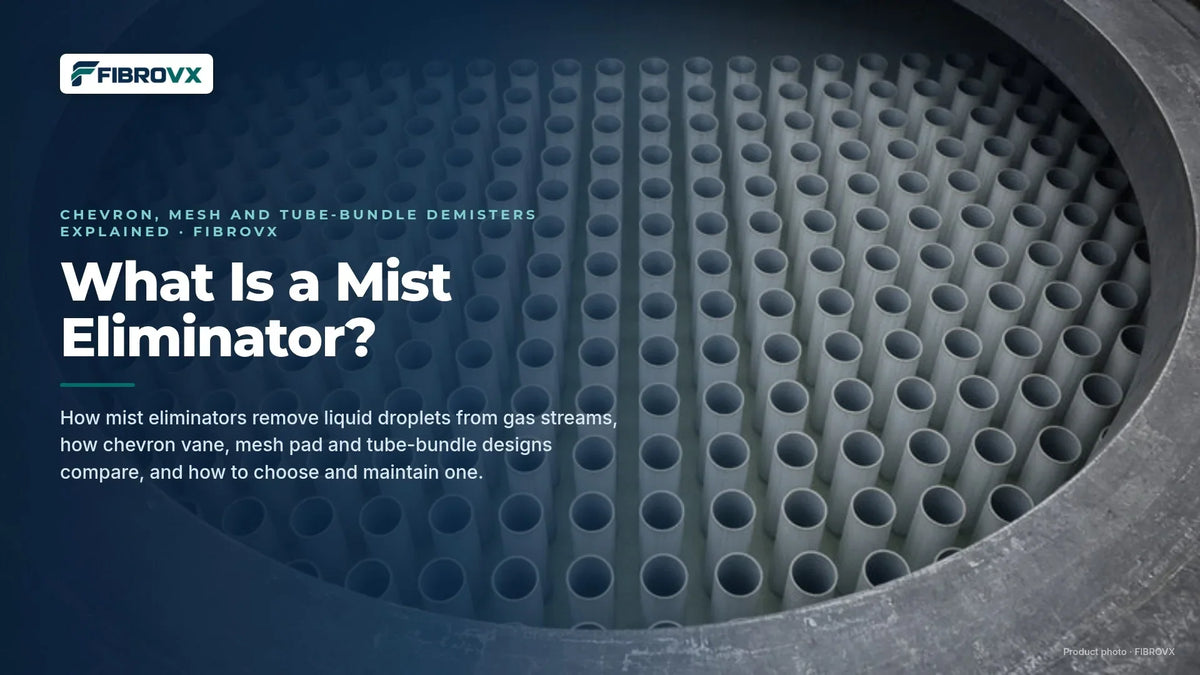
Arrays of vertical tubes fitted with swirl vanes or separators, installed across the upper section of wet FGD absorbers. The gas is accelerated and spun inside each tube, so droplets and dust-laden droplets are thrown to the tube wall by centrifugal force and drain away. They are used to remove fine mist and dust from saturated gas; published field tests show their performance falls at low load. See our tube-bundle demisters.
Combination (mesh + vane)
A mesh pad upstream acts as a coalescer, growing fine droplets that a downstream vane unit then removes. This lets the system combine the fine-droplet capture of mesh with the higher capacity of vanes.

Comparison
| Factor | Chevron vane | Mesh pad | Tube bundle | Mesh + vane |
|---|---|---|---|---|
| Fine droplet capture | Moderate | High | Moderate | Highest |
| Fouling resistance | High | Low | High | Moderate |
| Pressure drop | Low | Low to moderate | Low | Moderate |
| Washability | Easy | Harder | Easy | Moderate |
| Typical service | Scrubbers, FGD, cooling towers | Clean gas, fine mist | Wet FGD, high solids | High-efficiency needs |
Materials
- FRP: chemically resistant, used in acid and scrubber service
- Polypropylene and PVC: economical, with temperature limits
- Stainless steel and alloys: higher temperatures and solvent service
Wash systems
In fouling services, spray nozzles periodically wash the eliminator to remove deposits. Wash frequency, water quality and coverage are part of the design.
Selection data
- Gas flow rate, temperature and pressure
- Liquid load and droplet size distribution (if known)
- Solids content and scaling tendency
- Vessel orientation and dimensions
- Allowable pressure drop
- Required outlet liquid loading or emission limit
Customization
FIBROVX makes chevron and tube-bundle eliminators in FRP and plastics to fit your vessel. Options include blade profile, module size, support beams, wash headers and orientation. We use published design methods for selection and don't claim efficiency without your process data. Browse the air pollution and odor control collection.
Need a quote or a drawing check?
FIBROVX manufactures FRP products in our own factory in China and builds every item to order: sizes, resin system, color, molds and OEM branding. Send your application, dimensions or drawing, quantity and destination port.
Request a QuoteThe five questions that decide the type
1. What droplet size must you remove?
This is the first filter. The same manufacturer's mesh and vane design guide states that vane units are "generally not efficient for mist droplets smaller than about 20 microns", while mesh pads can capture droplets as small as about 5 microns. In its example, a mesh pad of 0.011-inch (279 µm) wire is 90% efficient for 6 µm droplets.
If most of the liquid arrives as large spray droplets, as it does above a spray zone or packed bed, a chevron may be enough. If the problem is a fine mist or aerosol, a chevron alone will not solve it.
2. Are solids or scale present?
Slurry droplets, gypsum, salts and dust collect on any surface that catches liquid. The same manufacturer's guide says vane units are preferred where there are "viscous or foaming liquids, lodging or caking of solids, slugs of liquid, or violent upsets". Mesh pads, with their fine wires and small open spaces, are the type most likely to plug in these conditions.
In wet FGD and lime or limestone scrubbers, solids are always present, so chevrons with wash systems are the usual starting point. Tube bundle demisters were developed for the same service.
3. What is the gas velocity, and how far does it change?
All three types depend on inertia: droplets that cannot follow the gas path hit a surface and drain. Capture efficiency rises with velocity until the velocity becomes high enough to strip captured liquid off and carry it on. That upper limit is why every demister is sized to a design velocity range, often using the Souders-Brown K-factor method described in the same manufacturer's guide.
Turndown matters too. A unit sized for full load may see much lower velocity at part load. A 2020 field study of a tube bundle demister retrofit on a 670 MW coal-fired unit found high combined dust removal at high load, but efficiency fell significantly and slurry droplet content increased at low load.
4. How much pressure drop can the fan accept?
Chevrons usually have the lowest pressure drop of the three. Mesh pads add more, and the drop rises as they load or foul. Tube bundle designs add swirl vanes and separators and need the fan to supply that drop.
5. How much space and access do you have?
Chevrons can be mounted horizontally (gas flowing up) or vertically (gas flowing across), in one or two stages. Mesh pads are thin but need support grids and access for removal. Tube bundle demisters sit across the whole upper section of an absorber and need height for the tubes and the wash system. Check manway sizes: every module must pass through them.
A decision sequence
- Set the target. Outlet droplet or mist load, dust, opacity or a carryover limit at the fan.
- Check the droplet size. Mostly above 20 µm: chevron. Fine mist: mesh, mesh plus chevron, or tube bundle in FGD.
- Check the solids. Solids, slurry or scale: avoid mesh alone; use chevron or tube bundle with washing.
- Check the velocity range. Include minimum and maximum load. Ask how performance changes at part load.
- Check pressure drop and fan margin. Confirm the existing fan can supply the new drop if you upgrade.
- Check the space. Height, supports, wash headers and manway size.
Common mistakes
- Sizing on average gas flow only. Peaks in gas velocity can cause re-entrainment, so size for the realistic maximum.
- Ignoring washing. Units in services with solids or salts need a wash system. Without it, deposits build up and pressure drop rises.
- Choosing mesh for dirty service. Mesh pads capture finer droplets but foul more easily than vanes. In fouling service, a vane unit or a washable combination may last longer.
- Poor sealing at the vessel wall. Gaps around the mist eliminator let gas bypass it, so droplets escape untreated.
Inspection and maintenance
Monitor pressure drop across the mist eliminator. A steady rise usually indicates fouling. Inspect at shutdowns for deposits, damaged blades or mesh, and displaced sections. Check seals for bypass gaps and keep wash nozzles clear. Wash or replace as needed, and check that support beams and hold-down fixings are in place.
Key terms
- Entrainment: Liquid droplets carried along by a gas stream.
- Re-entrainment: Captured liquid being picked up again by the gas, usually when velocity is too high.
- Souders-Brown K-factor: An empirical constant used to estimate the allowable gas velocity through a mist eliminator.
- Pressure drop: The loss of gas pressure across the mist eliminator.
- Coalescence: Small droplets merging into larger drops or a liquid film.
Beyond the mist eliminator
Mist eliminators catch droplets; submicron mist needs a wet ESP. Both sit in FRP towers and discharge to FRP stacks.
Watch: Towers, WESP & Stacks in 27 Seconds
FAQ
Is a mist eliminator the same as a demister?
Yes. The terms are used interchangeably.
Which captures smaller droplets: mesh or chevron?
Mesh pads typically capture finer droplets. Chevrons are more robust in fouling services.
What causes mist eliminator flooding?
Excessive gas velocity or liquid load, or plugging, can cause re-entrainment and carry-over.
How often should a mist eliminator be washed?
It depends on solids and scaling. Use pressure drop monitoring to set wash intervals.
Do scrubbers always need a mist eliminator?
Most wet scrubbers include one, to limit droplet carry-over to fans and stacks. See FRP Scrubbers Guide.
Can mist eliminators be made in FRP?
Yes. FRP and plastic mist eliminators are used in corrosive services such as acid scrubbers, where metals would corrode.
Related guides
- FRP Scrubbers Guide
- Biofilter vs Chemical Scrubber
- FRP Cooling Towers Guide
- Technical Resources: datasheets and drawings on request
- FRP Desulfurization Towers: Wet FGD Basics
- Industries we serve
Sources
- BCE, "Mist Elimination Equipment" (Fertilizer Society, 2018) (standard vanes 100% above 15 µm; double-pocket vanes above 8 µm): https://fertiliser-society.org/wp-content/uploads/2021/01/BCE_Mist-Elimination-Equipment_2018.pdf
- A mist eliminator manufacturer, "Mesh & Vane Mist Elimination" (0.011 in wire 90% at 6 µm; mesh down to 5 µm; vanes generally not efficient below about 20 µm; Souders-Brown K-factor)
- The Application and Performance Evaluation of Tube Bundle Demister in Desulfurization Tower System, IOP Conf. Ser.: Earth Environ. Sci. 555 012051 (2020) (670 MW unit; efficiency lower at low load): https://doi.org/10.1088/1755-1315/555/1/012051