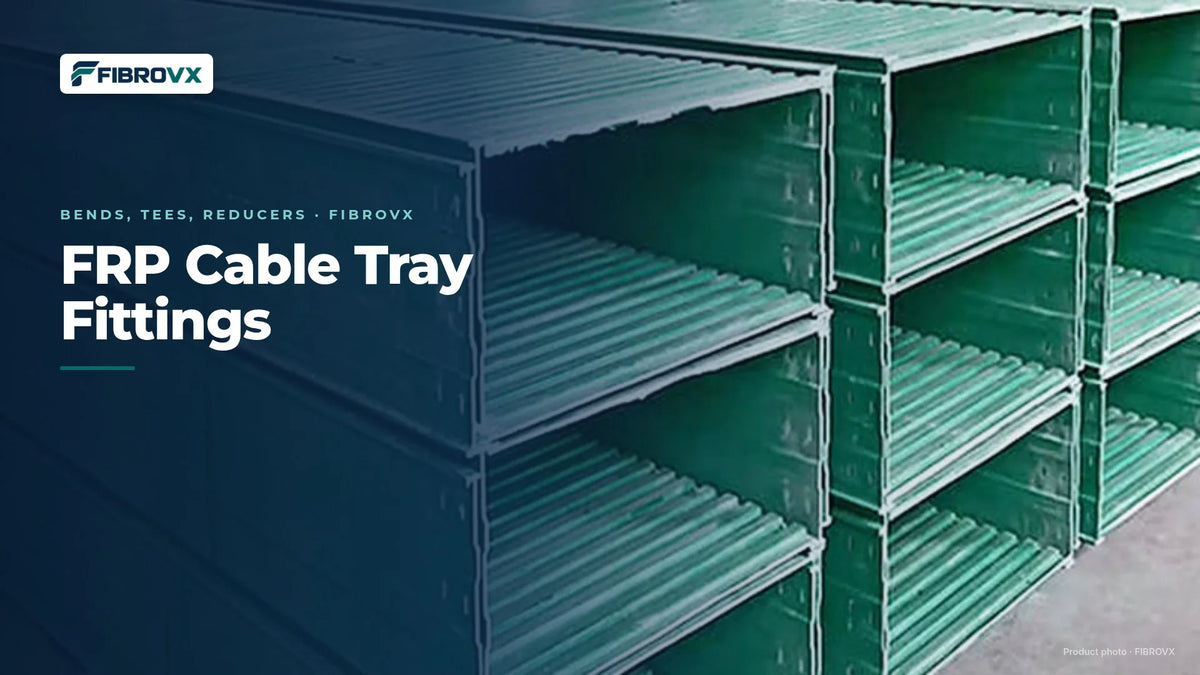
In short: FRP cable tray systems use standard fittings to change direction, level and width: horizontal bends (often 30°, 45°, 60° and 90°), vertical inside and outside bends, tees, crosses and left, right or straight reducers. Common radii are 12, 24 and 36 in (about 300, 600 and 900 mm). Choose a radius that respects the minimum bending radius of your largest cable.

What fittings are available?
| Fitting | What it does | Typical options |
|---|---|---|
| Horizontal bend | Changes direction in the same plane | 30°, 45°, 60°, 90°; radius 12/24/36 in |
| Vertical inside bend | Turns the run upward (concave) | 30°, 45°, 60°, 90° |
| Vertical outside bend | Turns the run downward (convex) | 30°, 45°, 60°, 90° |
| Horizontal tee | Branches the run in three directions | Same or reduced branch width |
| Horizontal cross | Branches in four directions | Same width |
| Reducer | Changes tray width | Left, right or straight (centered) |
Exact angles, radii and part numbers vary by manufacturer. Check the catalog for the system you buy.
How do you choose the radius?
- Cable bending radius: the fitting radius must be at least the minimum bending radius of the stiffest cable. Cable makers give this as a multiple of cable diameter.
- Space: larger radii need more room, so check clashes early.
- Consistency: using one radius across the project makes ordering and installation easier.

How are fittings supported?
Fittings need supports close to each end. Many manufacturers recommend a support within a set distance of each end of a bend, and at the middle of larger bends. Follow the manufacturer's guidance and the applicable tray standard (in North America, UL 568 / CSA C22.2 No. 126.2; NEMA FG 1 was rescinded in 2017). See installing FRP cable tray.
How do you list fittings on an RFQ?
- Tray type and size: ladder, perforated or solid bottom, with width and side-rail height. See ladder vs perforated vs solid bottom.
- Resin and color: polyester or vinyl ester, fire-retardant if required.
- Each fitting: type, angle, radius, width and quantity.
- Accessories: splice plates, covers, hold-down clamps and fasteners.
See the FRP cable tray guide and FRP cable tray standards.

How FIBROVX can help
Send us your cable tray layout or a bill of materials, and we will quote straight lengths, fittings and accessories together. Request a quote. CIF by default, FOB on request.
Common mistakes
- Choosing the radius for space only: check cable bending radii first.
- No supports near bends: fittings sag or crack.
- Mixing brands: splice plates and side rails may not match.
- Forgetting covers on fittings: order fitting covers as well as straight covers.

Key terms
- Inside bend: a vertical bend that turns the tray upward.
- Outside bend: a vertical bend that turns the tray downward.
- Reducer: a fitting that changes tray width.
- NEMA FG 1: the former US standard for fiberglass cable tray systems, rescinded in 2017; UL 568 / CSA C22.2 No. 126.2 is now cited in North America.
FAQ
What radius should FRP cable tray bends be? 12, 24 and 36 in are common. Choose based on the minimum bending radius of your largest cable.
What is the difference between inside and outside vertical bends? An inside bend turns the run upward, and an outside bend turns it downward.
Are fittings the same resin as straight lengths? They should be. Specify the same resin and fire rating for the whole system.
Which standard covers fiberglass cable tray? In North America, UL 568 / CSA C22.2 No. 126.2 (NEMA FG 1 was rescinded in 2017). IEC 61537 covers cable tray systems internationally.
Related guides
- FRP cable tray guide
- Installing FRP cable tray
- FRP cable tray load and span
- FRP cable tray standards
- Request a quote
Sources
- A US FRP cable tray manufacturer, Ladder tray and fittings
- A US cable tray manufacturer, Fiberglass cable tray catalog
- NEMA FG 1, Fiberglass Cable Tray Systems (rescinded 2017): https://www.nema.org