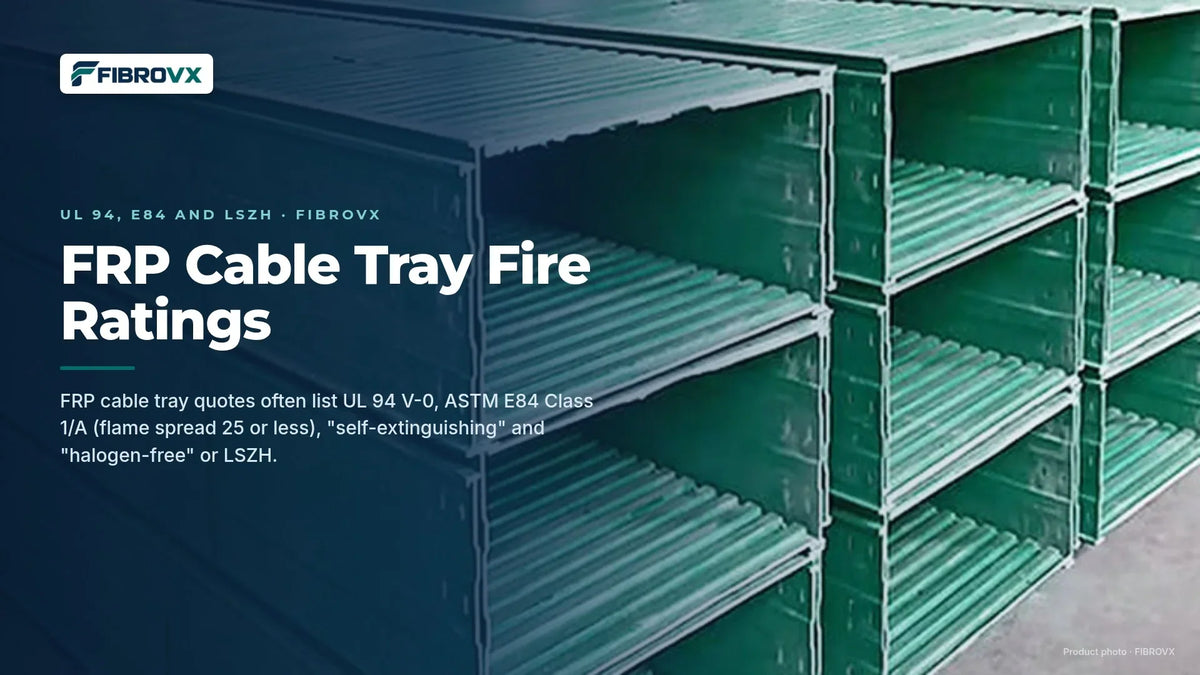
In short: FRP cable tray quotes often list UL 94 V-0, ASTM E84 Class 1/A (flame spread 25 or less), "self-extinguishing" and "halogen-free" or LSZH. These are different tests. UL 94 is a small-specimen material test; E84 is a tunnel test of flame spread and smoke; the LSZH tests IEC 60754 and IEC 61034 were written for cables, not trays. Ask for the report for the exact resin and product.

What claims appear on tray quotes?
- UL 94 V-0: common on fire-retardant and phenolic tray.
- ASTM E84 Class 1/A: flame spread index 25 or less.
- Self-extinguishing: often backed by ASTM D635.
- Halogen-free / low smoke: often for tunnels and metros.
What does UL 94 V-0 mean?
| Criterion | V-0 | V-1 | V-2 |
|---|---|---|---|
| Afterflame, each application | ≤10 s | ≤30 s | ≤30 s |
| Total afterflame, 5 specimens | ≤50 s | ≤250 s | ≤250 s |
| Afterflame + afterglow after 2nd | ≤30 s | ≤60 s | ≤60 s |
| Flaming drips ignite cotton | No | No | Yes |
UL 94 uses 125×13 mm specimens at a stated thickness. A V-0 rating applies to that material at that thickness, not automatically to a whole tray system.

What does ASTM E84 measure?
E84 measures flame spread and smoke along a tunnel. Class A (Class 1) means a flame spread index of 0–25. See ASTM E84 for FRP and fire-retardant resins.
Can a tray be LSZH?
"Low smoke" for cables usually means at least 60% light transmission in the IEC/BS EN 61034 3 m cube test. "Halogen-free" for cables means low halogen acid gas to IEC 60754 (for example HCl 0.5% max in BS cable standards). These are cable tests. For trays, ask which test was run, on what sample, and the result. Phenolic resin is the usual choice where low smoke matters: phenolic FRP.

What should you ask for?
- Report for the exact resin: not a different product.
- Lab name and report number: so it can be traced.
- Thickness tested: for UL 94.
- Current standards: for structure, UL 568 / IEC 61537. NEMA FG 1 was rescinded in 2017, so treat it as historical.
How FIBROVX can help
Tell us the fire rule for your project and we will match resin and test reports. Request a quote. CIF by default, FOB on request.

Common mistakes
- Treating V-0 as a system rating: it is a material rating at one thickness.
- Accepting "LSZH" without a test: ask what test and what result.
- Citing NEMA FG 1 as current: it was rescinded in 2017.
- Using a report for another resin: it does not cover your tray.
Key terms
- Afterflame: time a specimen keeps burning after the flame is removed.
- LSZH: low smoke zero halogen.
- Phenolic: resin with low smoke and good fire performance.
FAQ
Is UL 94 V-0 the same as ASTM E84 Class A? No. UL 94 is a small vertical burn test; E84 is a tunnel test of flame spread and smoke.
Can FRP cable tray be halogen-free? Some resin systems are. Ask for the test method and result, since LSZH tests were written for cables.
What flame spread is Class A? A flame spread index of 0–25 in ASTM E84.
Which resin is best for low smoke? Phenolic is the usual choice for tunnels and offshore.
Related guides
- FRP cable tray standards
- FRP cable tray guide
- ASTM E84 for FRP
- Phenolic FRP for low smoke
- Request a quote
Sources
- A compounder, UL 94 V-0, V-1 and V-2 flammability standard
- UL Solutions, Combustion (fire) tests for plastics: https://www.ul.com/services/combustion-fire-tests-plastics
- Eland Cables, Smoke density testing for cables (IEC/BS EN 61034): https://www.elandcables.com/the-cable-lab/independent-cable-testing-and-inspection-services/smoke-density-testing-for-cables
- ACI, Low smoke halogen free cables: are you getting the performance you expect?: https://www.aci.org.uk/technical-articles-and-updates/low-smoke-halogen-free-cables
- A Chinese manufacturer, fiberglass cable tray
- A Chinese manufacturer, FRP cable tray specification (B2B listing)