In short: An EV charging site is mostly buried and hidden infrastructure: conduits, cable trenches, pull boxes and equipment pads feeding the chargers. Fiberglass (FRP) helps in three places. Covers for cable trenches and pull boxes are light, non-conductive and have no scrap value; choose a load tier that matches where vehicles can drive. Cable supports and tray carry power and data cables in transformer and switchgear areas without rusting. Barriers keep people away from open trenches during work. Charger impact protection is a different job: the NEC requires equipment to be protected from physical damage, and many sites use steel or concrete bollards for that. FIBROVX makes covers, cable supports and telescopic barriers to order; FRP bollards are custom and available on request.


How power reaches an EV charger
A typical public or fleet charging site has the same chain of parts:
- Utility supply and transformer, often on a concrete pad.
- Switchgear or distribution panel, sometimes in a shelter or container.
- Feeders run underground in conduit or in covered cable trenches to each charger or power cabinet.
- Pull boxes or handholes at bends and long runs, so cables can be pulled and spliced.
- Chargers (EVSE) on islands or pedestals next to parking bays.
- Data cables for payment, network and load management, usually alongside the power cables.
NEC Article 625 covers the conductors and equipment outside the vehicle that connect it to the supply, and the installation of charging equipment. Like all equipment, chargers must be installed according to the maker's instructions (NEC 110.3(B)) and protected where they are likely to be damaged (NEC 110.27(B) and related sections). Your electrical engineer and the authority having jurisdiction (AHJ) decide what each site needs.

Cable trench and pull box covers
Charging sites often use open-top cable trenches, especially at large fleet depots and bus garages where many high-power cables run to rows of chargers. Covered trenches make it easy to add chargers later. Pull boxes are used at bends and long conduit runs.
FRP or composite covers suit these locations because:
- They are light. One or two workers can lift a cover to inspect or add cables. Cast iron and concrete covers often need lifting gear.
- They do not conduct. A cover over power cables that cannot become energized is a sensible choice.
- They have no scrap value. Metal covers are stolen in many cities, leaving dangerous open holes.
- They resist corrosion. De-icing salt and standing water do not rust them.
- They can be colored and marked. Covers can carry "Electric" or "EV" markings and your logo.
Choose the right load
The most important decision is the load class. A cover in a planted island sees only foot traffic. A cover in a parking bay or drive aisle can be run over by cars, vans, buses or trucks.
In the US, grade-level enclosures and covers are commonly specified to ANSI/SCTE 77, which defines tiers for non-deliberate traffic:
| Tier | Typical location | Vertical design load |
|---|---|---|
| Light duty | Pedestrian only | (3,000 lb test load) |
| Tier 5 | Sidewalk, occasional non-deliberate vehicles | 5,000 lb |
| Tier 8 | Sidewalk, non-deliberate vehicles | 8,000 lb |
| Tier 15 | Driveway, parking, off-roadway, occasional heavy vehicles | 15,000 lb |
| Tier 22 | Off-roadway, occasional heavy vehicles | 22,500 lb |
Covers in drive aisles where vehicles cross deliberately are normally specified to AASHTO H-20 or a local road standard. Enclosure makers note that polymer and fiberglass covers are not recognized for those deliberate-traffic locations, so place trenches and pull boxes in islands, verges and bay ends where you can. Outside the US, EN 124 classes apply. Our FRP manhole covers vs cast iron guide explains the EN 124 classes, and our telecom infrastructure guide covers SCTE 77 in more detail.
FIBROVX makes FRP manhole covers to order. For trench covers, tell us the trench width, length of run, frame or rebate detail, location and the load class your engineer specifies. We confirm in writing what we can supply and what test data we can provide for the item quoted. We do not claim ratings we have not tested.
Trench cover tips
- Slip resistance. Covers in walkways and bays get wet and oily. Ask for a gritted or textured surface.
- Seating. A cover must sit flat in its frame without rocking. Rocking covers crack and become trip hazards.
- Locking. Public sites often need bolt-down or locking covers to stop tampering.
- Drainage. Trenches collect water. Plan drainage so cables are not sitting in water.
- Access for growth. Leave space in the trench for future cables when charger numbers grow.
Cable supports and tray in equipment areas
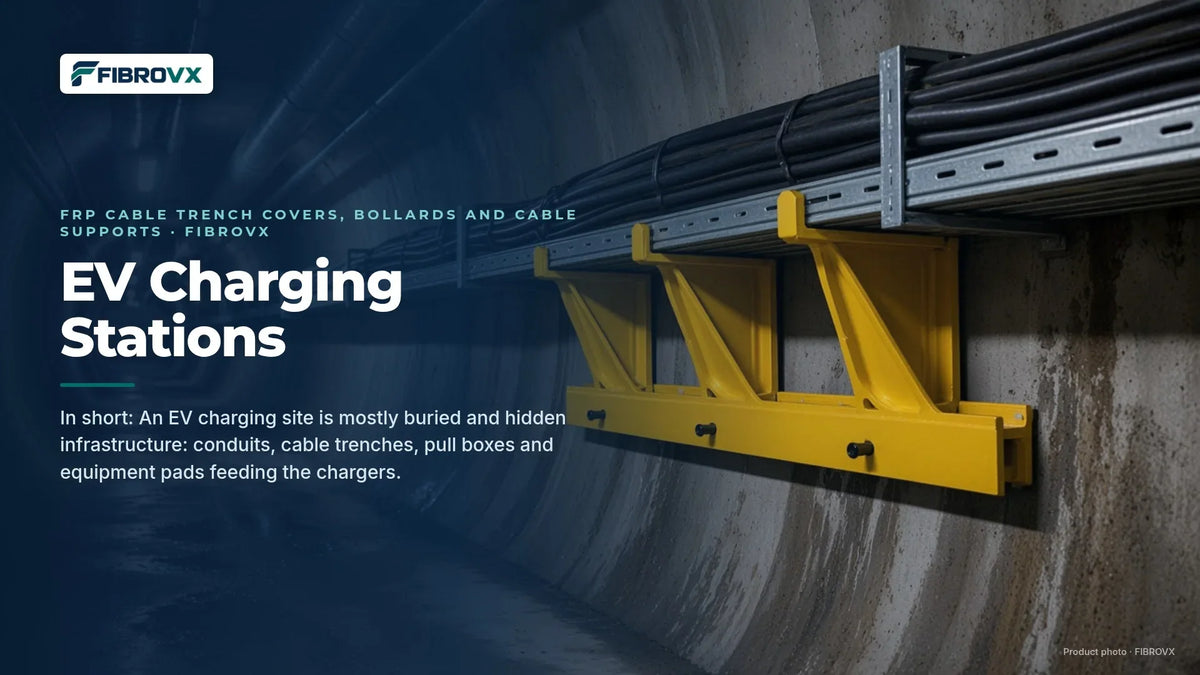
At larger sites, power cables leave the switchgear through cable tray, ladders or supports before going underground. In containerized power cabinets and canopy structures, cables may also run overhead. FRP cable supports and cable trays suit these spaces because they do not rust in outdoor or coastal locations and they do not need bonding as metal tray does (follow your grounding design for the installation as a whole).
Points to specify:
- Cable weight and future capacity. High-power DC charging cables are heavy. Allow for more chargers later.
- Span and support spacing. FRP is less stiff than steel. See our cable tray load and span guide.
- UV exposure. Outdoor tray needs UV-stabilized resin or a surface veil.
- Standards. Nonmetallic tray is commonly specified to IEC 61537, UL 568 or CSA C22.2 No. 126.2. See the FRP cable tray standards guide.
- Installation. Our cable tray installation guide covers supports, splices and cut-edge sealing.
Bollards and barriers: two different jobs
People often say "bollards" for two different things, and it is worth separating them.
Impact protection for chargers. The NEC requires equipment exposed to physical damage to be protected, but it does not name a method. Bollards are one common approach; wheel stops, curbs, raised islands and location choices are others. The charger maker's instructions and the AHJ set what is needed. Where a vehicle could strike a charger, designers usually choose steel-pipe or concrete-filled bollards, or a tested barrier system, because the job is to stop or absorb a vehicle impact.
Guidance and delineation. Lighter posts that guide drivers, mark bays and keep pedestrians on paths do not need to stop a vehicle. FRP is a good material here: it does not rust, it can be colored through, and it is non-conductive near electrical equipment. FRP bollards and delineator posts are custom and available on request from FIBROVX; they are not a standard catalog item, and we do not offer them as impact-rated charger protection.
Temporary barriers during work. During installation and maintenance, open trenches and live cabinets need to be fenced off. FRP telescopic barriers extend quickly across an opening and are non-conductive. See our guide to FRP telescopic barriers for electrical safety zones.
Marking buried cables
Underground feeders at charging sites are power cables, so red is the APWA color for electric lines. Warning tape above buried conduit and permanent markers at the site edge help future excavators. See our FRP marker posts guide.

What to send for a quote
FIBROVX builds each order to your requirements. Please send:
- Site layout showing trench runs, pull boxes and equipment areas.
- Cover details: clear opening, trench width, frame type and load class for each location.
- Cable support details: cable schedule, weight per meter, spans and environment.
- Barriers: extended length, height and color.
- Custom items, such as FRP delineator posts or bollards, with drawings.
- Color, logos and markings, quantity and delivery destination.
Browse Tanks, Pipes & Covers, Cable Trays & Supports and Building & Site Products, or read about custom FRP manufacturing.
Need a quote or a drawing check?
FIBROVX manufactures FRP products in our own factory in China and builds every item to order: sizes, resin system, color, molds and OEM branding. Send your application, dimensions or drawing, quantity and destination port.
Request a QuoteCommon mistakes
- Sidewalk-tier covers in a drive aisle. Match the load class to where vehicles actually go.
- Composite covers in deliberate traffic. Use road-rated products there, or move the pull box.
- Light posts as charger protection. Impact protection needs a solution the AHJ accepts.
- No room to grow. Charging sites expand; leave space in trenches and trays.
- Skipping drainage. Water in trenches shortens cable life.
Key terms
- EVSE: Electric vehicle supply equipment, the charger and its connector.
- Pull box / handhole: A small underground box for pulling and splicing cables.
- AHJ: Authority having jurisdiction, the official who approves the installation.
- SCTE 77: The ANSI/SCTE specification that defines load tiers for grade-level enclosures and covers.
FAQ
Can FRP covers be used in EV parking bays? In many cases, yes, if the cover's load tier suits the vehicles. Deliberate drive-over locations usually need road-rated products.
Do you sell FRP bollards? FRP bollards and delineator posts are custom and available on request. They are for guidance, not impact-rated charger protection.
Are bollards required at EV chargers? The NEC requires protection from physical damage but does not name bollards. The charger maker and the AHJ decide what is needed.
Do FRP cable trays need grounding? FRP does not conduct, but follow your engineer's bonding and grounding design for the installation.
Can covers carry our logo? Yes. Color, logos and markings are part of the custom specification.
Related guides
- FRP Telescopic Barriers for Electrical Safety Zones
- FRP Manhole Covers vs Cast Iron
- FRP Cable Tray Load and Span Selection
- FRP for Telecom Infrastructure
- Industries we serve
Sources
- NFPA 70, NEC Article 625, Electric Vehicle Power Transfer System (scope text): https://cdn.lsicloud.net/warshauers/EV%20Chargers/Article-625.pdf
- Electrical Contractor Magazine, Required bollards (NEC 110.27(B) physical-damage protection): https://www.ecmag.com/magazine/articles/article-detail/codes-standards-required-bollards-cccs-wireways-and-more
- ANSI/SCTE 77, Specification for Underground Enclosure Integrity (preview): https://webstore.ansi.org/preview-pages/SCTE/preview_ANSI+SCTE+77+2017.pdf
- Chapman Electric, ANSI load ratings for underground pull boxes: https://shop.chapmanelectric.com/resources/ansi-load-ratings-pull-boxes
- APWA, Uniform Color Code (PDF): https://www.apwa.org/wp-content/uploads/Uniform-Color-Code-1.pdf