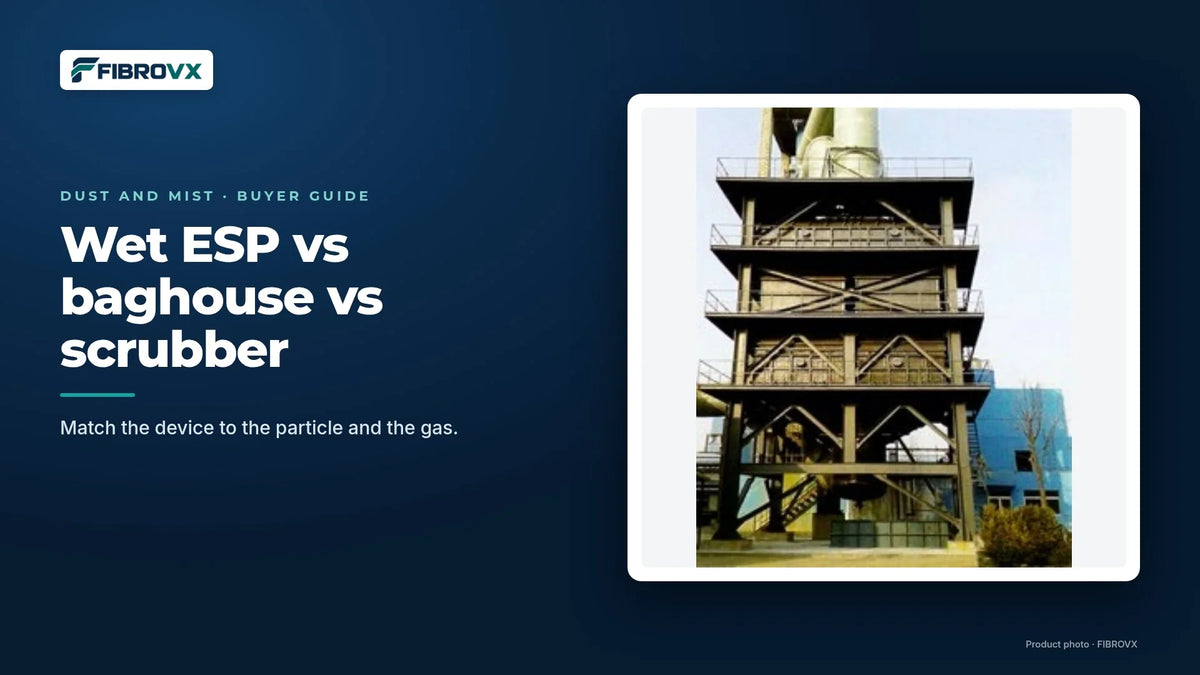
In short: Use a baghouse for dry dust, a packed-bed scrubber for soluble acid or alkaline gases, and a wet ESP for fine particles, acid mist and aerosols in saturated gas. Many plants combine them: a scrubber removes the gas, and a wet ESP after it catches the fine mist the scrubber lets through.

Three different jobs
| Baghouse | Packed-bed scrubber | Wet ESP | |
|---|---|---|---|
| Best for | Dry dust | Soluble gases: HCl, SO₂, NH₃, H₂S | Fine dust, acid mist, aerosols, PM2.5 |
| Gas condition | Dry, above dew point | Wet or dry | Saturated / wet |
| How it works | Fabric filter bags; periodic cleaning into hoppers | Gas contacts a liquid over packing | High-voltage field charges particles; electrodes are washed |
| Pressure drop | Per filter design | 400–1,200 Pa (catalog) | Low (catalog) |
| FIBROVX product | Baghouse | FRP scrubber | Wet ESP |
Baghouse dust collectors
A baghouse filters dust-laden gas through fabric bags. Dust builds up on the outside of the bags and is knocked off periodically into the hoppers while clean gas leaves through the outlet. Bags are chosen for gas temperature and dust type. Wet, sticky or condensing gas blinds the bags, so a baghouse is placed where the gas is dry.
Packed-bed scrubbers
A scrubber brings exhaust into contact with a recirculated liquid over packing. Soluble and reactive gases move into the liquid. Catalog design references: superficial velocity 1.0–1.5 m/s, packing layers of 1.0–1.2 m, pressure drop 400–1,200 Pa, and a series from 1,500 m³/h (Φ600) to 50,000 m³/h (Φ3500). A mist eliminator at the top stops droplets, but very fine mist can pass through.
Wet electrostatic precipitators

A wet ESP charges fine particles and droplets in a high-voltage field and collects them on honeycomb tube electrodes that are flushed with water. The catalog notes high collection efficiency at low pressure drop, no moving parts, no re-entrainment of dust, and a compact design that can be combined with scrubbers. Typical uses: power, steel, smelting, cement, sulfuric acid, titanium dioxide, glass, ceramics and rare-earth plants.
Combining them
A common layout for acid processes is scrubber first (gases), then a wet ESP (fine mist and PM2.5), then an FRP stack. For dry dust plus acid gas, a baghouse runs upstream while the gas is still dry. See the VOC & dust emission control range.
Watch: Wet ESP vs Baghouse vs Scrubber in 27 Seconds
FAQ
Can a scrubber remove PM2.5?
Only partly. Fine particles and sub-micron mist often pass a packed bed, which is why a wet ESP is added after it.
Why not use a baghouse on wet gas?
Moisture makes dust stick to the bags and blinds them.
Values in this guide are catalog design and selection references. Final sizes, laminate and performance are confirmed in writing in the quotation for your operating data.
Related guides
Next step: Send gas flow, temperature, moisture, dust load and the pollutants. Send it through our quote form and we will reply with a sized proposal.