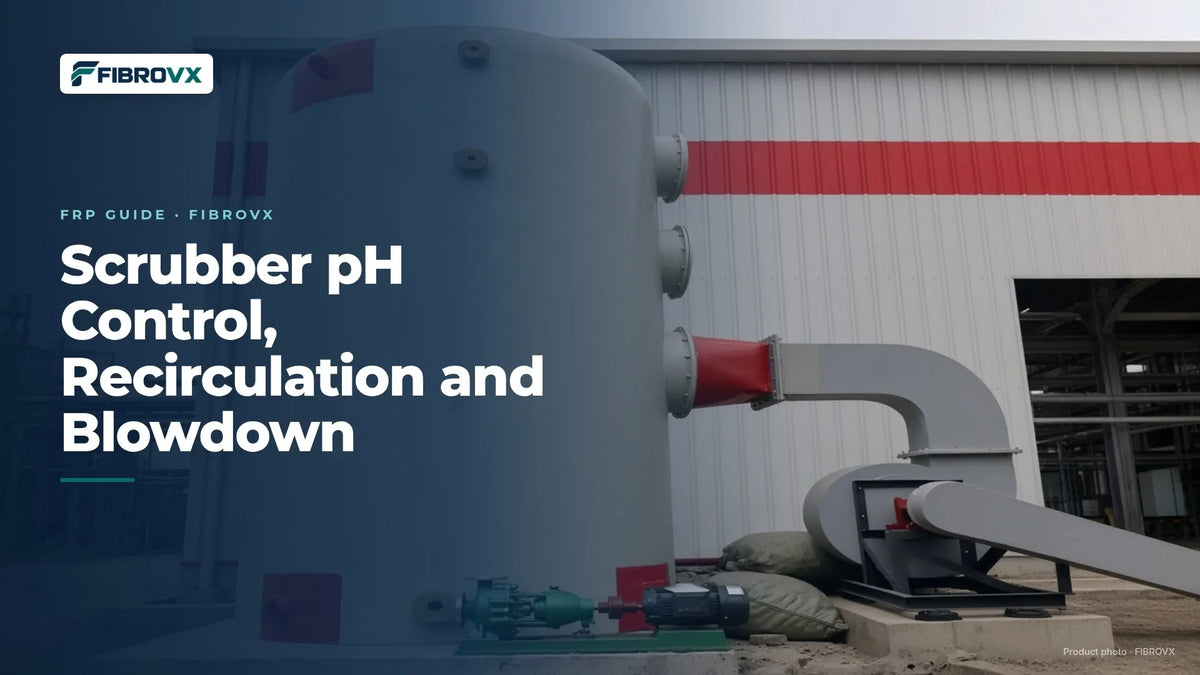
In short: A wet scrubber recirculates liquid over its packing. pH control doses a reagent to keep the liquid able to absorb the target gas: usually caustic soda (NaOH) for acid gases and an acid such as sulfuric acid for ammonia. Blowdown removes some liquid to keep dissolved salts below their limit, and fresh make-up water replaces it. Pick the pH set point and the blowdown rate for the chemistry, and confirm them in commissioning.

Which reagent for which gas?
| Target gas | Typical scrubbing liquid | Notes |
|---|---|---|
| HCl | Water or dilute caustic | HCl is very soluble; caustic neutralizes it |
| SO₂, HF, Cl₂ | Caustic soda solution | Chlorine also forms hypochlorite, which affects the materials you can use |
| NH₃ and amines | Dilute sulfuric acid | Forms ammonium sulfate in the blowdown |
| H₂S (odor) | Caustic, often with an oxidant such as hypochlorite | Usually needs pH control at a higher set point |
Set points and reagents must be confirmed by the process designer for your gas mix. These are typical starting points, not design values.
How does pH control work?
- pH probe: in the sump or recirculation line, with a sample point that is easy to reach for calibration.
- Dosing pump: controlled by the pH controller to add reagent.
- Alarms: high and low pH, and low reagent level.
- Maintenance: clean and calibrate probes regularly, because fouled probes are a common cause of poor control.

Why is blowdown needed?
Absorbing gas and adding reagent makes salts (for example sodium chloride or ammonium sulfate) that build up in the liquid. If they get too concentrated they can crystallize, plug the packing and nozzles, and reduce absorption. Blowdown, often controlled by conductivity or density, keeps them in range. Make-up water replaces the blowdown and the water lost by evaporation.
What should recirculation look like?
- Liquid rate: enough to wet the packing fully (set by the packing supplier's minimum wetting rate).
- Distributor: even spread across the bed. Poor distribution means poor absorption.
- Strainers: to protect the nozzles.
- Pump materials: compatible with the liquid, for example FRP or lined pumps.
See packed bed scrubber sizing.

How FIBROVX can help
Send us the gas composition, flow and outlet limits, and we will propose the scrubber, sump, dosing and instrument package. Request a quote. CIF by default, FOB on request.
Common mistakes
- Running without calibrating probes: drift gives false readings.
- Too little blowdown: salts crystallize and plug the packing.
- Too much blowdown: wastes water and reagent.
- Wrong materials for oxidants: hypochlorite needs suitable resins and parts.

Key terms
- Set point: the pH value the controller holds.
- Blowdown: liquid removed to limit dissolved solids.
- Make-up: fresh water added to the sump.
- Wetting rate: liquid flow per unit area needed to wet the packing.
FAQ
What pH should an acid gas scrubber run at? It depends on the gas and the reagent. The process designer sets it, and it is confirmed during commissioning.
Which chemical neutralizes ammonia in a scrubber? Usually dilute sulfuric acid, which forms ammonium sulfate.
How is blowdown controlled? Usually by conductivity or density measurement, which opens a blowdown valve.
Why does my scrubber packing plug? Often because of salt build-up from too little blowdown, or particles in the inlet gas.
Related guides
- FRP scrubbers guide
- Packed bed scrubber sizing
- Venturi vs packed bed scrubber
- Biofilter vs chemical scrubber
- Request a quote
Sources
- US EPA, Air Pollution Control Technology Fact Sheet: Packed-Bed/Packed-Tower Wet Scrubber: https://www3.epa.gov/ttncatc1/dir1/fpack.pdf
- US EPA, CAM Technical Guidance: Wet Scrubbers for Gaseous Control: https://www.epa.gov/air-emissions-monitoring-knowledge-base