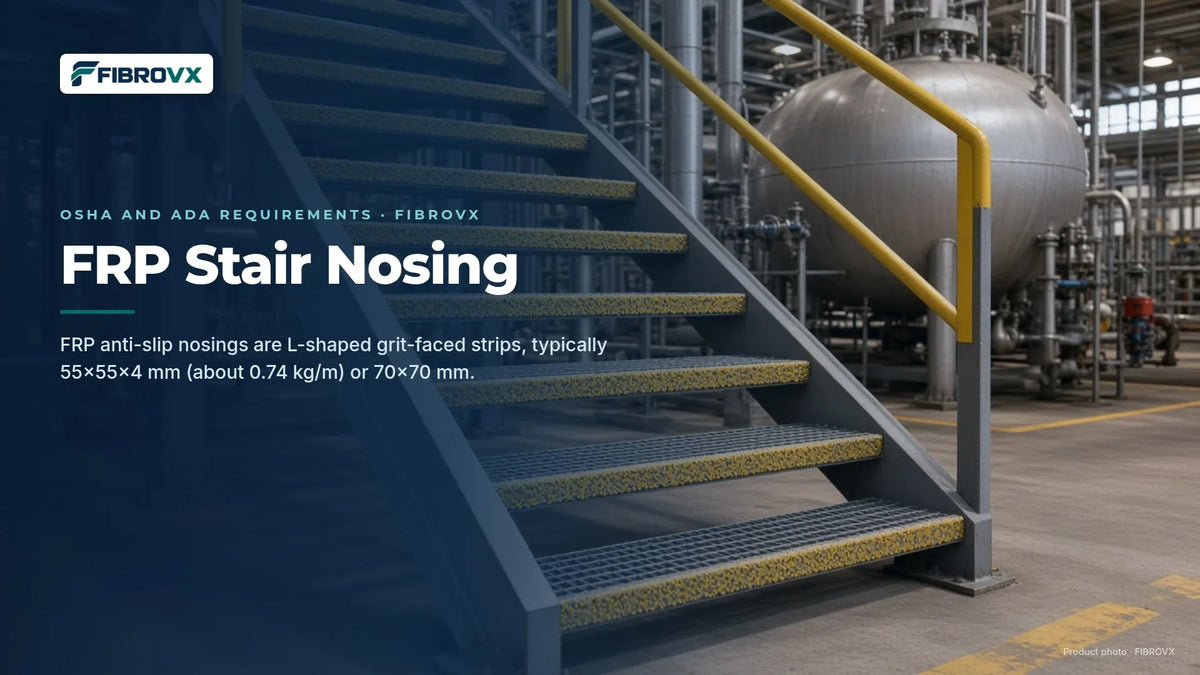
In short: FRP anti-slip nosings are L-shaped grit-faced strips, typically 55×55×4 mm (about 0.74 kg/m) or 70×70 mm. OSHA 1910.25 limits standard industrial stairs to 9.5 in (24 cm) maximum riser and 9.5 in minimum tread at 30–50°. Where the ADA applies, risers are 4–7 in, treads at least 11 in, nosing radius at most ½ in and projection at most 1½ in. A nosing must not upset uniform riser heights.

If you are still deciding between full treads, nosings and tread covers, start with FRP stair treads vs nosings vs tread covers.
What does OSHA require for stairs?
| Item | Requirement |
|---|---|
| Angle | 30–50° from horizontal |
| Riser height | 9.5 in (24 cm) maximum |
| Tread depth | 9.5 in (24 cm) minimum |
| Width | 22 in (56 cm) minimum |
| Uniformity | uniform risers and treads between landings |
OSHA 1910.22 also requires walking surfaces free of hazards such as spills, ice and corrosion, which is where anti-slip nosings help.
What does the ADA require?
| Item | Requirement |
|---|---|
| Risers | 4–7 in (100–180 mm), uniform |
| Treads | 11 in (280 mm) minimum |
| Nosing radius | ½ in (13 mm) maximum |
| Nosing projection | 1½ in (38 mm) maximum |
| Riser slope | 30° maximum from vertical |
The ADA also advises visual contrast on nosings for people with low vision. ADA applies to public facilities; industrial service stairs usually follow OSHA.

Which FRP nosing sizes are common?
| Size (mm) | Approx. kg/m |
|---|---|
| 55 × 55 × 4 L | 0.74 |
| 30 × 70 × 4 | 0.63 |
| 70 × 70 L | varies |
| 345 × 55 × 4 tread cover | 3.85 |
Surfaces use emery or carborundum grit; yellow, black and white are common. Compare with treads and covers: treads vs nosings vs covers.
How do you fit nosings and stay compliant?
- Fit every tread: so risers stay uniform; a nosing on some treads only changes riser heights.
- Check top and bottom risers: a 4 mm nosing changes these by about 4 mm.
- Keep the projection: within 1½ in where ADA applies.
- Fix firmly: with adhesive and screws suited to the substrate.
For slip testing see slip resistance testing.

How FIBROVX can help
Send stair dimensions and substrate and we will quote nosings or tread covers. Request a quote. CIF by default, FOB on request.
Common mistakes
- Fitting only worn treads: risers stop being uniform.
- Ignoring top and bottom risers: they change too.
- Low-contrast colors: yellow or white edges are easier to see.
- Weak fixing: loose nosings are a trip hazard.

Key terms
- Nosing: the leading edge of a tread.
- Riser: vertical height of one step.
- Tread depth: horizontal depth of one step.
- Grit: abrasive surface for slip resistance.
FAQ
What is the OSHA maximum riser height? 9.5 in (24 cm) for standard stairs under 1910.25.
What is the ADA nosing projection limit? 1½ in (38 mm) maximum, with a radius of ½ in maximum.
What size are FRP stair nosings? Commonly 55×55×4 mm, about 0.74 kg/m, and 70×70 mm.
Does OSHA require nosings? It requires safe, hazard-free walking surfaces; anti-slip nosings are a common way to achieve that on stairs.
Related guides
- Treads vs nosings vs covers
- Slip resistance testing
- FRP grating surface options
- FRP handrail systems
- Request a quote
Sources
- OSHA 29 CFR 1910.25, Stairways: https://www.osha.gov/laws-regs/regulations/standardnumber/1910/1910.25
- OSHA 29 CFR 1910.22, General requirements: https://www.osha.gov/laws-regs/regulations/standardnumber/1910/1910.22
- US Access Board, 2010 ADA Standards, 504 Stairways and 505 Handrails: https://www.access-board.gov/ada/#ada-504
- A Chinese manufacturer, FRP stair nosing sizes
- GRP anti-slip stair nosing 55×55 / 70×70 mm listing