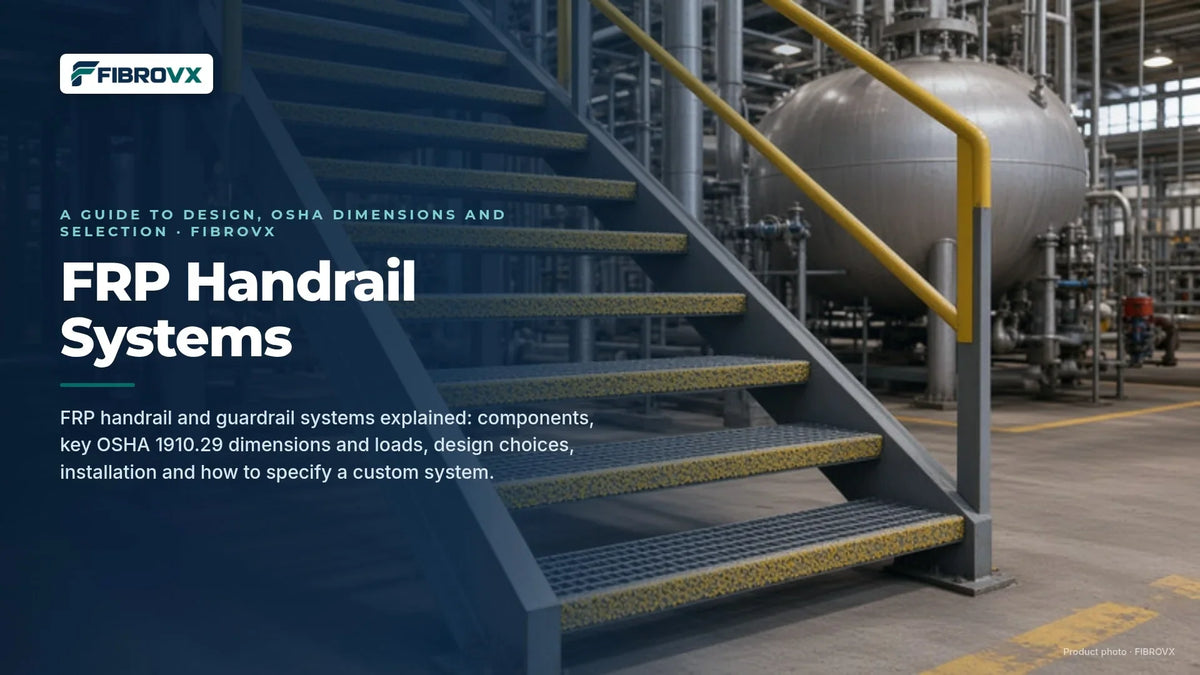
In short: FRP handrail systems are guardrails and stair rails made from pultruded fiberglass rails and posts joined with molded connectors. They do not rust, are non-conductive, stay comfortable to touch, and are pigmented safety yellow (or another color) throughout. In the USA, OSHA 29 CFR 1910.29 requires guardrail top rails at 42 in ±3 in (107 cm), withstanding a 200 lb (890 N) load, with midrails and intermediate members withstanding 150 lb (667 N). Other countries have their own rules, such as ISO 14122-3 for machinery access. Size posts, spacing and fixings so the complete system meets the code that applies to your site.


Why FRP handrails?
- Corrosion resistance in wastewater, chemical, coastal and offshore areas where galvanized steel deteriorates
- Electrical insulation near live equipment
- Low thermal conductivity: rails don't get as hot or cold to the touch as metal
- High visibility: color runs through the profile, with no painting needed for corrosion protection
- Light weight: easier installation on existing structures

System components
| Component | Description |
|---|---|
| Top rail | Round or square pultruded tube; the main load-bearing rail |
| Midrail | Intermediate rail roughly midway between top rail and walking surface |
| Posts | Square or round tubes at set spacing |
| Toeboard (kick plate) | Prevents objects falling from the platform edge |
| Connectors | Molded or fabricated FRP fittings joining rails and posts |
| Base plates and brackets | Fix posts to the deck (top-mounted) or the edge (side-mounted) |
| Fasteners | Stainless steel bolts or rivets, plus adhesive where specified |
| Gates and openings | Self-closing gates at ladder openings, removable sections |
See our FRP handrail systems.
OSHA guardrail requirements (USA, general industry)
The following are from 29 CFR 1910.29(b), which covers guardrail systems in general industry:
- Top rail height: 42 in (107 cm), plus or minus 3 in, above the walking-working surface
- Top rail strength: capable of withstanding a force of at least 200 lb (890 N) applied in a downward or outward direction within 2 in (5 cm) of the top edge, at any point along the top rail. When the load is applied, the top rail must not deflect to a height below 39 in (99 cm).
- Midrails, screens and intermediate members: withstand at least 150 lb (667 N) applied in any downward or outward direction
- Midrail position: midway between the top rail and the walking-working surface
- Openings: intermediate vertical members (balusters), when used instead of midrails, no more than 19 in (48 cm) apart, and other intermediate members arranged so openings are no more than 19 in (48 cm) wide
- Toeboards (where used for falling object protection): at least 3.5 in (9 cm) high and able to withstand 50 lb (222 N)
- Surfaces: smooth enough to prevent punctures, lacerations or snagging of clothing
Stair rail systems and handrails on stairs have separate requirements in 1910.29(f). Fall protection for ladder openings uses gates or offsets per 1910.29(b)(13). Always confirm the current regulation text for your jurisdiction.

Other codes
- ISO 14122-3: permanent means of access to machinery: stairs, stepladders and guardrails
- EN ISO 14122 is adopted in Europe, and national building codes may also apply
- Australia: AS 1657 covers fixed platforms, walkways, stairways and ladders
- UK: BS 6180 (barriers in and about buildings) and the Work at Height Regulations
Tell us which code applies, and we will design the post spacing and connections to suit.
Design choices
Round vs square rail
Round top rails are comfortable to grip and common for stair handrails. Square tube systems are often more economical and simpler to connect. Many projects use a round top rail with square posts.
Post spacing
Post spacing affects whether the system meets the load requirement. Typical FRP systems specify a maximum post spacing based on testing or calculation for that system. Do not exceed the manufacturer's spacing.
Mounting
- Top-mounted on the deck: simple and common
- Side-mounted on the edge: saves walkway width
- Embedded or cast-in: for concrete
Fixings
Use stainless steel fasteners. Bonded-and-bolted connections are common, and every cut end should be sealed.
Installation basics
- Set out post positions per the layout drawing and manufacturer spacing.
- Fix base plates to a sound structure. Anchor capacity matters as much as the rail.
- Assemble rails into connectors and bolt or rivet as specified.
- Seal all cut ends and drilled holes with resin.
- Fit toeboards and gates.
- Inspect alignment and connection tightness.
Maintenance
Inspect connectors and anchors periodically. Wash off contamination. For long outdoor exposure, check for surface weathering. A UV coating can refresh older rails.
Customization
FIBROVX supplies handrail systems to your layout: rail and post profiles, colors (safety yellow, gray, green and others), mounting types, gates, toeboards and pre-cut kits with assembly drawings. We also supply FRP ladders, molded grating and pultruded profiles for complete platforms. Browse the grating, profiles and access collection.
Need a quote or a drawing check?
FIBROVX manufactures FRP products in our own factory in China and builds every item to order: sizes, resin system, color, molds and OEM branding. Send your application, dimensions or drawing, quantity and destination port.
Request a QuoteCommon mistakes
- Using the wrong fixing for the substrate. Base plates must be anchored with fixings suited to concrete, steel or FRP structure, and to the loads.
- Spacing posts too far apart. Post spacing is set by the rail and post sections and the required loads. Don't extend spacing beyond the design.
- Leaving out toeboards. Where tools or materials can fall from a platform, toeboards may be required.
- Not planning gates. Openings at ladders and access points need gates or offsets.
Key terms
- Guardrail: A barrier that prevents falls from an edge.
- Stair rail: A barrier along the open side of a stair.
Watch: FRP Handrail Systems in 27 Seconds
FAQ
How high must a guardrail be under OSHA?
42 in plus or minus 3 in (107 cm) above the walking-working surface, per 29 CFR 1910.29(b)(1).
What load must an FRP guardrail withstand?
Under OSHA, the top rail must withstand at least 200 lb (890 N) applied downward or outward, and midrails and other intermediate members 150 lb (667 N).
Is FRP handrail as strong as steel?
FRP handrail systems are designed with appropriate profiles and post spacing to meet the required loads. They are less stiff than steel, so systems are verified for deflection as well.
What color are FRP handrails?
Safety yellow is most common, but gray, green and other colors can be pigmented to order.
Can FRP handrails be used outdoors?
Yes, with UV-inhibited resin and a surface veil. Periodic inspection is recommended.
Related guides
- FRP Ladders and Cage Ladders
- FRP Pultruded Profiles Guide
- FRP Grating: Complete Guide
- Technical Resources: datasheets and drawings on request
- Designing an FRP Platform: Grating, Profiles and Handrail
- FRP for Offshore and Marine: GRP Grating, Handrail and Ladders
- Industries we serve
- Offshore Wind Transition Piece: GRP Grating, Handrail and Ladders
Sources
- OSHA, 29 CFR 1910.29 "Fall protection systems and falling object protection – criteria and practices": https://www.osha.gov/laws-regs/regulations/standardnumber/1910/1910.29
- ISO 14122-3 "Safety of machinery – Permanent means of access to machinery – Part 3: Stairs, stepladders and guard-rails" (ISO catalog: https://www.iso.org/search.html?q=14122-3)
- Standards Australia, AS 1657:2018 "Fixed platforms, walkways, stairways and ladders": https://www.standards.org.au/standards-catalogue/standard-details?designation=as-1657-2018