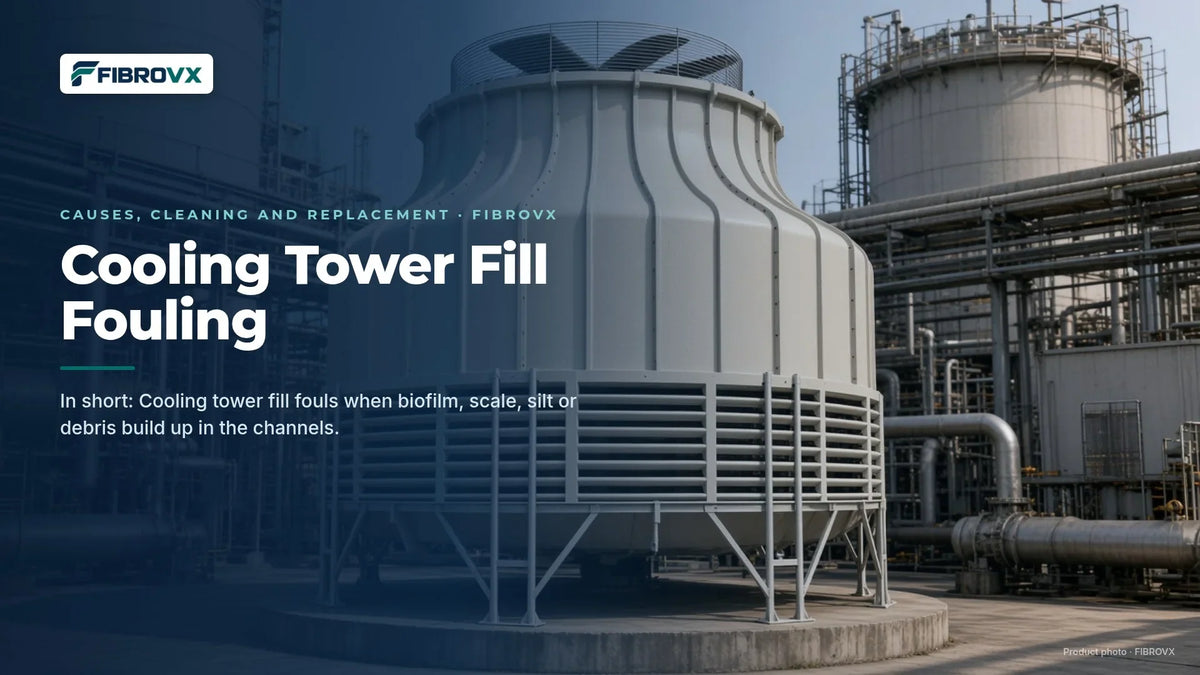
In short: Cooling tower fill fouls when biofilm, scale, silt or debris build up in the channels. Fouled fill cools poorly, gets heavy, and can collapse. It also harbors bacteria, including Legionella. You can often clean mild fouling, but heavily fouled, sagging or brittle fill should be replaced. Fine-flute film fill cools best but clogs fastest in dirty water. Low-clog film fill or splash fill suits poorer water. Fill is commonly made of PVC or PP, not FRP. FIBROVX supplies fill media sized to your tower and water quality, alongside FRP cooling towers and components.


What fill does, and why it fouls
Fill (also called packing) spreads hot water into thin films or droplets so air can cool it by evaporation. The more surface area, the better the cooling. That same surface area, in a warm, wet, aerated place, is an ideal spot for deposits and microbes.
There are two main types. Our film vs splash fill guide covers them in detail:
- Film fill: closely spaced corrugated sheets. High efficiency, but narrow channels clog more easily.
- Splash fill: bars or grids that break water into droplets. Lower efficiency, but much more tolerant of dirty water.
The four main types of fouling

1. Biological fouling (biofilm). Bacteria, algae and fungi form a slimy layer on the fill. Biofilm traps other particles and grows fast in warm water. It also shelters Legionella from disinfectants. CDC lists sediment and biofilm, temperature, water age and disinfectant residual as the key factors in Legionella growth in cooling towers.
2. Scale. When water evaporates, dissolved minerals concentrate. If the concentration goes too high, minerals such as calcium carbonate deposit as hard scale. Scale stiffens and weighs down the fill and blocks channels.
3. Silt and sediment. Airborne dust, sand and suspended solids in make-up water settle in the fill, especially where biofilm makes surfaces sticky. Towers near construction sites, roads or farms take in a lot of dust.
4. Debris. Leaves, insects, broken fill pieces and corrosion products block the top of the fill or the distribution system.
Oil and process leaks can also foul fill, and they feed bacteria.
Warning signs
- Higher cold-water temperature for the same load and weather, or a drop in the approach temperature.
- Uneven water distribution: dry patches or channeling seen through the louvers or from above.
- Visible deposits on the top and air inlet face of the fill.
- Sagging or collapsed fill packs. Fouled fill can become several times heavier than clean fill.
- Increased fan motor current or reduced airflow, as the fill blocks the air path.
- Biofilm or slime in the basin and on the drift eliminators.
- High bacteria counts in water tests.
Inspecting the fill
- Check the top of the fill under the distribution system: deposits, debris, nozzle damage.
- Look at the air inlet face for scale and silt.
- Lift a sample pack if possible. Compare its weight with a clean pack, and look into the channels.
- Check the supports. Sagging fill may mean overloaded supports, not just fouling.
- Check the condition of the plastic. Brittle, cracked or deformed fill should be replaced, not cleaned.
- Record findings with photos so you can track changes.
Follow your safety procedures. Work inside a cooling tower can expose people to aerosols and bacteria, so use the protective equipment your water management program requires.
Cleaning: what works
Cleaning works best when fouling is caught early and the fill is still sound.
- Low-pressure flushing. Removes loose silt and soft biofilm from the top layers. High-pressure jets can deform and damage thin fill sheets, so use low pressure and wide nozzles.
- Online biodispersants and biocides. Your water treatment provider can dose chemicals to loosen biofilm while the tower runs.
- Off-line chemical cleaning. Circulating a cleaning solution can remove scale and biofilm. Choose chemicals compatible with the fill plastic, and follow the fill maker's guidance.
- Remove and soak. Small packs can sometimes be lifted out, soaked and flushed.
Cleaning has limits. Hard scale deep in fine-flute film fill is very hard to remove without damaging the fill. Cleaning may restore only part of the original performance.
Replace or clean?

Clean when:
- Fouling is light and mostly on the surface.
- The fill is not sagging, cracked or brittle.
- Cleaning chemicals compatible with the fill are available.
Replace when:
- Fill packs are sagging, collapsed or broken.
- The plastic is brittle or deformed from age, UV or heat.
- Deposits block the inner channels.
- Cleaning has been tried and performance did not recover.
- You want to change to a fill type that better suits your water.
The U.S. Department of Energy's Federal Energy Management Program lists cooling tower management among its best practices for water efficiency. Clean, well-maintained fill is part of running a tower efficiently.
Choosing replacement fill
FIBROVX supplies cooling tower fill media to suit your tower. To choose the right fill, consider:
Water quality. Poor water with high suspended solids, biological load or oil needs a more open fill. Fine-flute film fill suits clean water only.
| Water quality | Suggested fill direction |
|---|---|
| Clean, well treated | Fine-flute film fill for best cooling |
| Moderate solids | Wider-flute or low-clog film fill |
| Dirty, high solids or oily | Splash fill or very open film fill |
Flute size and pattern. Larger flute openings clog less but give less surface area. Vertical-flute designs drain debris better than cross-corrugated designs.
Material. Fill is commonly made of PVC or PP. It is not an FRP product. Each plastic has its own temperature limit and chemical resistance. Tell us your hot water temperature and any chemicals in the water.
Fit. Pack dimensions, height and support arrangement must match your tower. Send the tower make and model, cell size and current fill dimensions.
Drift eliminators. Replacing fill is a good time to check the drift eliminators. CDC recommends using high-efficiency drift eliminators. See what is a mist eliminator.
Prevent fouling in the first place
- Run a water management program. CDC's cooling tower guidance calls for automated disinfectant, anti-scale and anti-corrosion dosing and monitoring.
- Control the cycles of concentration with blowdown, so minerals do not reach scaling levels.
- Consider side-stream filtration to remove suspended solids.
- Keep debris out with screens and by keeping the area around the tower clean.
- Avoid stagnation. Flush dead legs and balance run time across cells.
- Clean and disinfect on the schedule your water management program sets.
- Choose fill to suit your water, not just for peak efficiency.
FRP towers and components
Fill sits inside the tower structure. FIBROVX makes FRP cooling towers and components built to order, with corrosion-resistant FRP casings and basins. Read our FRP cooling towers guide or browse the Cooling Towers & Components collection.
What to send for a fill quote
- Tower make, model and type (counterflow or crossflow).
- Cell size and current fill dimensions, type and flute size.
- Hot water temperature and flow.
- Water quality: suspended solids, hardness, any oil or chemicals.
- Photos of the current fill and supports.
Need a quote or a drawing check?
FIBROVX manufactures FRP products in our own factory in China and builds every item to order: sizes, resin system, color, molds and OEM branding. Send your application, dimensions or drawing, quantity and destination port.
Request a QuoteCommon mistakes
- Using fine-flute fill on dirty water. It clogs quickly.
- Pressure-washing thin fill. It deforms and tears.
- Ignoring sagging fill. Supports can fail.
- Replacing fill without fixing water treatment. New fill fouls again.
- Forgetting the drift eliminators during a fill change.
Key terms
- Approach: The difference between the cold water temperature and the air wet-bulb temperature.
- Blowdown: Draining some tower water to control dissolved solids.
- Cycles of concentration: How many times dissolved minerals are concentrated in the tower water compared with make-up water.
- Biofilm: A slimy layer of microbes on wetted surfaces.
FAQ
How often should fill be replaced? It depends on water quality, treatment and temperature. Inspect regularly and replace when it is damaged or cannot be cleaned.
Is your fill made of FRP? No. Fill is commonly PVC or PP. Our towers and casings are FRP.
Can I switch from film to splash fill? Often yes, but performance changes. The tower's thermal design should be checked.
Does fouled fill affect Legionella risk? Yes. Sediment and biofilm are key factors in Legionella growth, according to CDC.
Can you match my existing fill? Send dimensions, flute type and photos, and we will propose a match or an alternative.
Related guides
- Cooling Tower Fill: Film vs Splash
- FRP Cooling Towers Guide
- What Is a Mist Eliminator?
- Industries we serve
- Custom FRP Manufacturing: Sizes, Resins, Colors, Molds and OEM Explained
Sources
- CDC, Controlling Legionella in Cooling Towers (Legionella Control Toolkit): https://www.cdc.gov/control-legionella/php/toolkit/cooling-towers-module.html
- U.S. DOE FEMP, Best Management Practice #10: Cooling Tower Management: https://www.energy.gov/femp/best-management-practice-10-cooling-tower-management