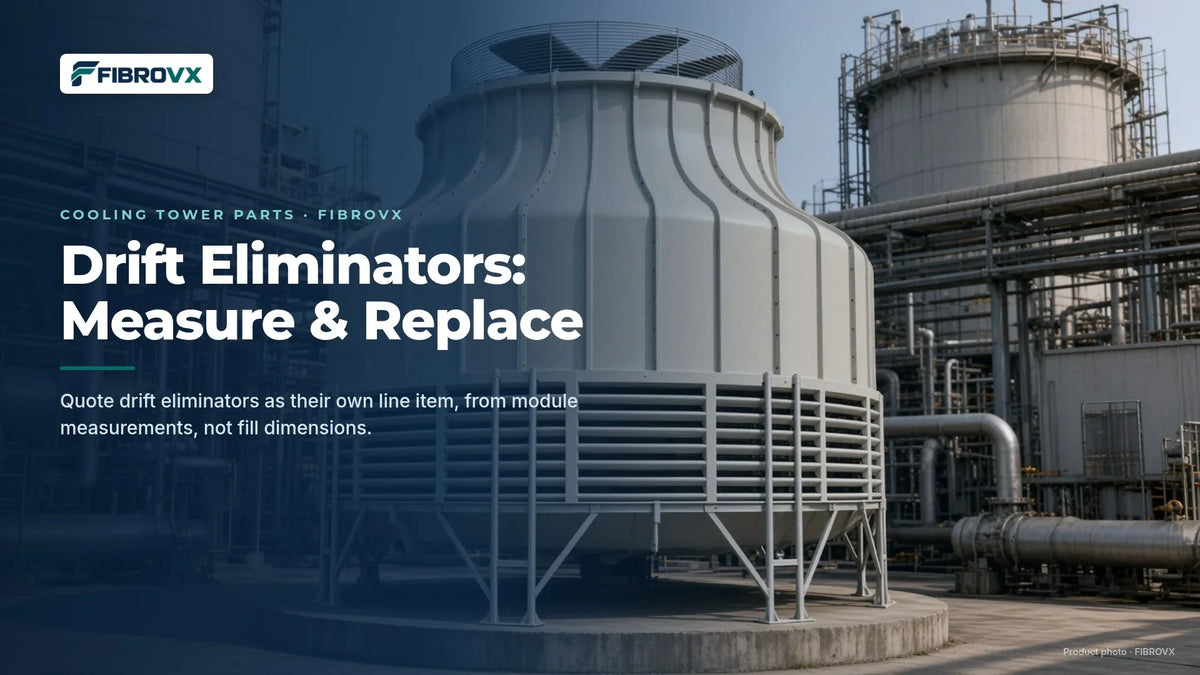
In short: Replace drift eliminators by measuring module length/width/depth, blade or cellular pattern, airflow direction, support ledges and material—not by copying fill dimensions. Drift eliminators sit in a different air path and are quoted as their own line item.


Drift eliminators vs fill — quick comparison
| Fill | Drift eliminators | |
|---|---|---|
| Job | Heat transfer surface | Droplet capture / drift control |
| Location | Packing zone | Air outlet path above/ beside fill (design-dependent) |
| Failure signs | Fouling, collapse, high approach | High drift, visible plume droplets, warped modules |
| Measure for quote | Sheet spacing, pack height, plan area | Module L×W×D, pattern, airflow direction |
Fill fouling and film vs splash topics stay in their own guides; use those when the pack—not the eliminator—is the problem.

Site measurement checklist
- Module length × width × depth (several samples)
- Cellular vs blade pattern; photo of a clean module end
- Airflow direction arrow as installed
- Support ledge width and clear opening of the bank
- Wall seals / blank-off condition
- Tower type (counterflow / crossflow) and cell ID
How good can drift eliminators be?
Drift is water carried out of the tower as droplets, not evaporation. A cooling tower manufacturer states in its drift report TR-024 that modern eliminators can reach drift rates of about 0.001% of the circulating water, and some configurations reach 0.0005%. At 1,000 gpm, 0.001% is roughly 30 ml of water per minute leaving as drift.
Drift performance reference
| Item | Published figure | Source |
|---|---|---|
| Drift rate of modern eliminators | About 0.001% of circulating flow; down to 0.0005% in some configurations | Cooling tower manufacturer TR-024 |
| Example at 1,000 gpm and 0.001% | About 30 ml/min | Cooling tower manufacturer TR-024 |
| Test method | Isokinetic drift testing to CTI ATC-140 | Cooling Technology Institute |
Your permit or the original tower specification may set a drift rate. Ask the replacement supplier for data to that test method, and treat a guarantee without test data with care.
Why new eliminators can perform badly at first
The same manufacturer also notes that new PVC eliminators may need a period of "seasoning", which it puts at 1,000 hours or more, before surface wetting settles and drift falls to its design level. Plan the acceptance test after that period, not on the day of start-up.
Common causes of high drift after replacement
- Gaps. Open joints between modules, or between modules and the casing, let droplets bypass the blades. Seal every gap.
- Wrong orientation. Blade or cell direction must match the air path. Mark the airflow arrow on every module.
- Damaged or sagging modules. Modules that sag or are stepped on lose their shape. Check supports before fitting.
- Water distribution faults. Broken nozzles or overflowing basins throw extra water at the eliminators. Fix distribution at the same time; see cooling tower spare parts.
Drift also carries the dissolved salts and treatment chemicals of the circulating water, and it is linked to Legionella risk. A water management plan should cover the eliminators. See cycles of concentration and blowdown.
Common mistakes
- Ordering eliminators by copying fill dimensions.
- Fitting modules with the airflow arrow reversed.
- Leaving gaps at walls, columns and between modules.
- Testing drift on the first day, before new modules have seasoned.
- Replacing eliminators while ignoring broken nozzles or overflowing distribution basins.
Key terms
- Drift eliminator: a blade or cellular pack that removes droplets from the air leaving the tower.
- Isokinetic testing: sampling the exhaust air at the same velocity as the air stream, so droplet counts are not distorted.
What to send for a quote
- Tower make, model and cell count, plus a nameplate photo.
- Module size, blade or cell pattern and depth, with photos and a tape measure in view.
- Airflow direction (crossflow or counterflow) and how modules are supported.
- Hot-water temperature and water treatment chemicals, for the plastic choice.
- Any drift rate required by your permit or specification.
Quote eliminators as their own line item, separate from fill, so the supplier sizes them to the air path.
Ready to quote? Send drawings, cut lists and duty data to FIBROVX. Trade terms default to CIF destination port; FOB China port is available on request.

Related FIBROVX pages
- Cooling Towers & Components
- Cooling Tower Fill Fouling guide
- Film vs Splash Fill
- FRP Cooling Towers guide
FAQ
Are drift eliminators the same as fill?
No. Fill promotes heat transfer; drift eliminators capture water droplets leaving the air stream. They sit in different elevations and are specified separately.
Can I reuse fill dimensions for eliminators?
Usually not. Module footprints and depths differ. Measure the eliminator bank itself.
What material options exist?
PVC and other plastics are common for eliminators; FRP appears more often in structure, casing and fan stacks. State the existing material and any chemical/temperature limits. As a published manufacturer reference, standard PVC eliminators are typically rated about −20 to 55 °C and PP about −20 to 70 °C; confirm with the supplier for your temperature.
What reduces drift after replacement?
Correct orientation to airflow, intact seals at walls, and modules seated on the designed ledges without crushed edges.
Sources
- A cooling tower manufacturer, Technical Report TR-024 "Cooling Tower Performance — Drift"
- Cooling Technology Institute, ATC-140 Isokinetic Drift Test Code, https://www.cti.org