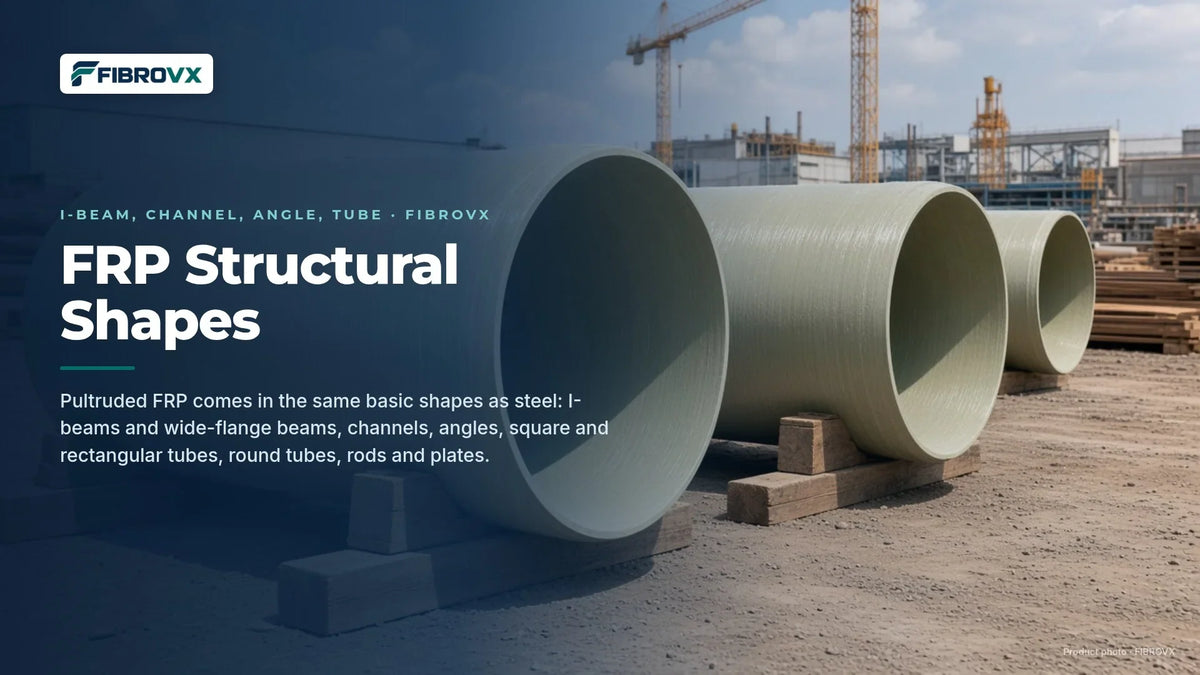
In short: Pultruded FRP comes in the same basic shapes as steel: I-beams and wide-flange beams, channels, angles, square and rectangular tubes, round tubes, rods and plates. FRP weighs roughly a quarter as much as steel, but its stiffness is only about a tenth. That is why FRP design is usually governed by deflection and buckling, not strength. Pick shapes that are deep and closed where stiffness matters.

Which shape for which job?
| Shape | Typical uses | Notes |
|---|---|---|
| Wide-flange (W) beam | Main platform beams, columns | Wide flanges resist lateral-torsional buckling better than narrow I-beams |
| I-beam | Beams, secondary framing | Narrow flanges, so check lateral bracing |
| Channel (C) | Stringers, edge members, bracing | Not symmetrical; loads should pass through the shear center or be braced |
| Angle (L) | Bracing, connection clips, edge trim | Use pairs or back-to-back for larger loads |
| Square/rectangular tube | Handrail posts, columns, frames | Closed section, high torsional stiffness |
| Round tube | Handrail, ladder rails | Good in torsion; needs special fittings |
| Rod and plate | Gusset plates, connection plates, rungs | Flat plate is used for bolted connections |
How does FRP compare with steel?
| Property | Pultruded glass FRP | Carbon steel |
|---|---|---|
| Density | About 1.7–2.0 g/cm³ | About 7.85 g/cm³ |
| Full-section modulus (E) | About 18–19 GPa (2.6–2.8 Msi) | About 200 GPa (29 Msi) |
| Corrosion | Does not rust | Needs coating or galvanizing |
| Electrical | Insulator | Conductor |
Exact values vary by maker and grade. In Europe, EN 13706 grades E17 and E23 set minimum moduli of 17 and 23 GPa. See EN 13706 explained.

Coupon vs full-section modulus. Data sheets from Chinese pultruders often list a coupon tensile modulus (ASTM D638, small samples cut from the wall) of about 15–28 GPa lengthwise. The figure in the table above is a full-section modulus, measured by bending a whole beam, of about 18–19 GPa. EN 13706 grades (E17, E23) are also based on the full profile. Use full-section values for deflection checks, and ask which one a data sheet quotes.
Typical I-beam, wide flange and channel sizes
Figures below are typical industry ranges collected from published Chinese manufacturer listings and data sheets. They are not FIBROVX guarantees or quotes.
| Section (mm) | Approx. kg/m |
|---|---|
| Wide flange 102 × 102 × 6.4 | 3.6 |
| Wide flange 152 × 152 × 9.5 | 8.1 |
| Wide flange 203 × 203 × 9.5 | 10.8 |
| Wide flange 305 × 305 × 12.7 | 21.5 |
| I-beam 152 deep × 76 flange × 6.4 | 3.6 |
| I-beam 203 deep × 102 flange × 9.5 | 7.2 |
| I-beam 254 deep × 127 flange × 12.7 | 11.9 |
Weights are one maker's published values. We cross-checked them against cross-section area × a density of 1.9 g/cm³ (within the typical 1.7–2.0 g/cm³ range); they agree within a few per cent.
Channel sizes
| Section (depth × flange × wall, mm) | Approx. kg/m |
|---|---|
| 76 × 38 × 6.35 | 1.7 |
| 102 × 35 × 6.4 | 2.0 |
| 152 × 42 × 9.5 | 4.0 |
| 203 × 56 × 9.5 | 5.3 |
| 254 × 70 × 12.7 | 8.9 |
| 305 × 76 × 12.7 | 10.4 |
What design checks matter most?
- Deflection: often the limiting check. Include shear deformation, which matters more in FRP than in steel.
- Local and lateral buckling: thin flanges and webs can buckle. Use bracing and compact sections.
- Connections: bolted joints need edge distances and bearing checks. See fasteners for FRP structures.
- Long-term loads: apply creep and time-effect factors. See FRP creep and long-term loading.
Design to a recognized standard, such as ASCE/SEI 74 (US), CEN/TS 19101 (Europe) or the manufacturer's design manual. See FRP structural design basics.
How do you order FRP shapes?
- Shape and size: for example "W 152 × 152 × 9.5 mm", with tolerances.
- Resin: polyester, vinyl ester, or fire-retardant grades.
- Color and UV protection: surface veil and UV-stabilized resin for outdoor use.
- Lengths and fabrication: cut lengths, holes and assemblies.

How FIBROVX can help
Send us your drawings or a member list, and we will quote shapes in stock lengths or cut and drilled to order. Request a quote. CIF by default, FOB on request.
Common mistakes
- Swapping steel sections size for size: FRP needs deeper sections for the same deflection.
- Ignoring shear deformation: it adds to deflection in short, deep beams.
- Unbraced channels: they twist under load.
- Using steel connection details: FRP needs its own bolt spacing and edge distances.

Key terms
- Pultrusion: continuous molding by pulling fibers through a heated die.
- Lateral-torsional buckling: sideways twisting of an unbraced beam.
- Shear center: the point where a load causes no twist.
- Modulus: stiffness, the ratio of stress to strain.
FAQ
Is FRP as strong as steel? Some FRP shapes have similar tensile strength, but they are about ten times less stiff, so they deflect more.
Which FRP shape is best for beams? Wide-flange beams are usually the most efficient and stable for platform framing.
How much lighter is FRP than steel? About a quarter of the weight for the same volume.
Which standards cover FRP shapes? EN 13706 covers pultruded profiles in Europe. ASCE/SEI 74 is the US LRFD design standard.
Related guides
- FRP pultruded profiles guide
- FRP profiles vs steel and aluminum
- What is pultrusion
- FRP structural design basics
- Request a quote
Sources
- A US pultruder, design specifications
- EN 13706, Pultruded profiles specifications (CEN): https://standards.cencenelec.eu
- ASCE/SEI 74-23, LRFD for Pultruded FRP Structures: https://ascelibrary.org/doi/book/10.1061/9780784415771
- A Chinese manufacturer, FRP I-beam sizes and properties
- A Chinese manufacturer, FRP channel sizes
- A Chinese manufacturer, FRP structural profiles technical parameters
- An FRP manufacturer, FRP I-beam