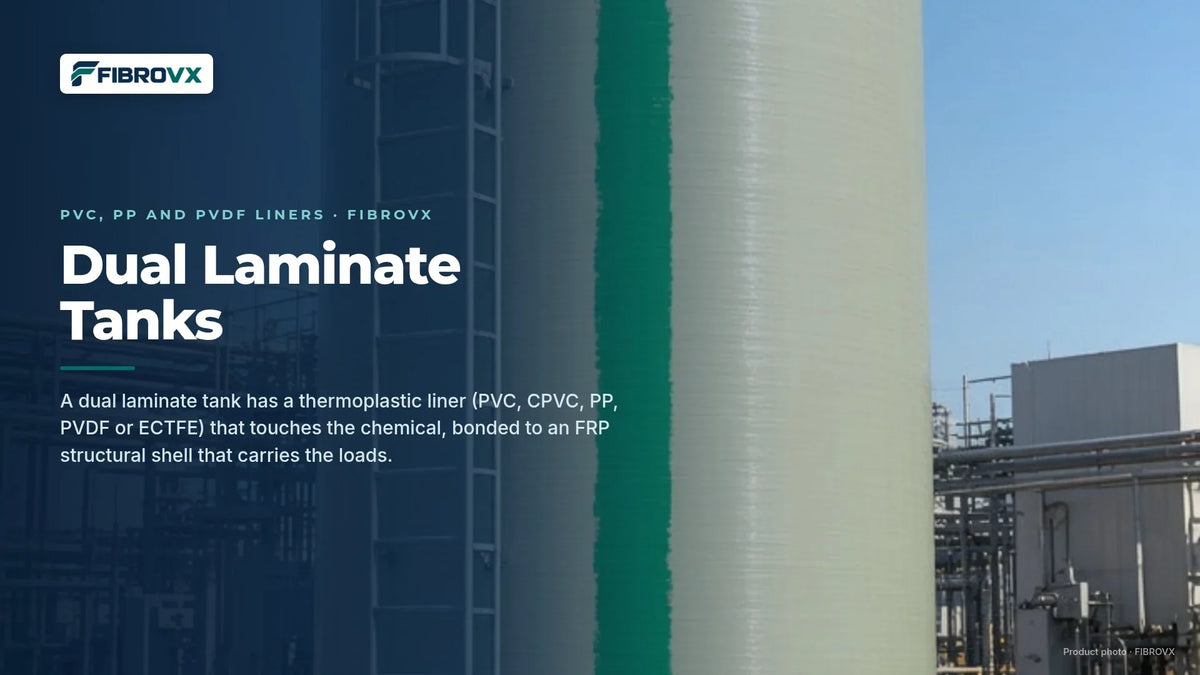
In short: A dual laminate tank has a thermoplastic liner (PVC, CPVC, PP, PVDF or ECTFE) that touches the chemical, bonded to an FRP structural shell that carries the loads. It is chosen when a thermoplastic resists the chemical better than any FRP resin, for example some hot, oxidizing or fluoride services. The welded liner seams are spark (holiday) tested for pinholes.

How is a dual laminate tank built?
- Liner: thermoplastic sheet is formed and welded into the tank shape. The back is fabric-backed or treated so it bonds to FRP.
- Weld testing: seams are spark tested to find pinholes. A conductive layer behind the liner is often used for this.
- FRP overwrap: the structural laminate is built over the liner, by filament winding or contact molding.
- Final inspection: visual, dimensional and hardness checks, and a hydrotest if specified.
Which liner for which service?
| Liner | Typical strengths | Typical limits to check |
|---|---|---|
| PVC | Economical; many acids, alkalis and salts | Lower temperature limit |
| CPVC | Higher temperature than PVC; hypochlorite and many acids | Cost, temperature |
| PP | Broad chemical resistance, many alkalis | Strong oxidizers; temperature |
| PVDF | Strong acids, halogens, oxidizers, higher temperatures | Strong alkalis, cost |
| ECTFE | Very broad chemical and temperature resistance | Cost; specialist fabrication |
Liner temperature limits depend on the grade and service. Always check the liner and resin suppliers' data for your chemical, concentration and temperature.

Dual laminate or all-FRP?
- All-FRP (vinyl ester barrier): proven and lower cost for a wide range of acids, alkalis and salts.
- Dual laminate: for chemicals that attack FRP resins, high-purity duty, or where a seamless, inert liner is required.
- Cost and lead time: dual laminate is usually more expensive and needs welding skills.
See FRP corrosion barrier explained and FRP vs HDPE vs stainless steel tanks.
Which standards apply?
ASME RTP-1 covers reinforced thermoset plastic corrosion-resistant equipment, and dual laminate vessels can be built and stamped to it. Liner welding is often specified to DVS guidelines (German welding society). Ask for weld procedures, welder qualifications and spark test records.

How FIBROVX can help
Send us the chemical, concentration, temperature and tank size, and we will tell you whether an all-FRP barrier or a dual laminate liner is the better fit. Request a quote. CIF by default, FOB on request.
Common mistakes
- Using dual laminate when FRP would do: it adds cost without benefit.
- No spark test records: pinholes allow the chemical to reach the FRP.
- Ignoring temperature limits of the liner: PVC softens at lower temperatures.
- Poor liner-to-FRP bond: it can lead to liner collapse under vacuum.

Key terms
- Liner: the thermoplastic layer that touches the chemical.
- Spark test (holiday test): a high-voltage test that finds pinholes.
- Overwrap: the FRP structural layer around the liner.
- Fabric-backed sheet: thermoplastic sheet with a textile on one side for bonding.
FAQ
Why use a dual laminate tank instead of plastic only? The FRP shell gives strength and stiffness, so large or higher-temperature tanks are possible.
Which liner is best for hydrofluoric acid? PVDF and PP are commonly considered, but check the supplier's data for your concentration and temperature.
How are liner welds tested? By high-voltage spark (holiday) testing, usually with a conductive layer behind the liner.
Can dual laminate tanks be built to ASME RTP-1? Yes. Dual laminate vessels can be built and certified to RTP-1.
Related guides
- FRP storage tanks guide
- FRP vs HDPE vs stainless steel tanks
- FRP chemical resistance guide
- FRP tank standards
- Request a quote
Sources
- Dual Laminate Fabrication Association, What is dual laminate fabrication?: https://duallaminate.org/about/dual-laminate-fabrication/
- ASME RTP-1, Reinforced Thermoset Plastic Corrosion-Resistant Equipment: https://www.asme.org
- DVS 2205, Design calculation of thermoplastic tanks and apparatus: https://www.dvs-home.de